Turin-Lyon
New freight and passenger rail line between Turin and Lyon, with the 57.5 km Mont Cenis base tunnel; opening scheduled for 2033.
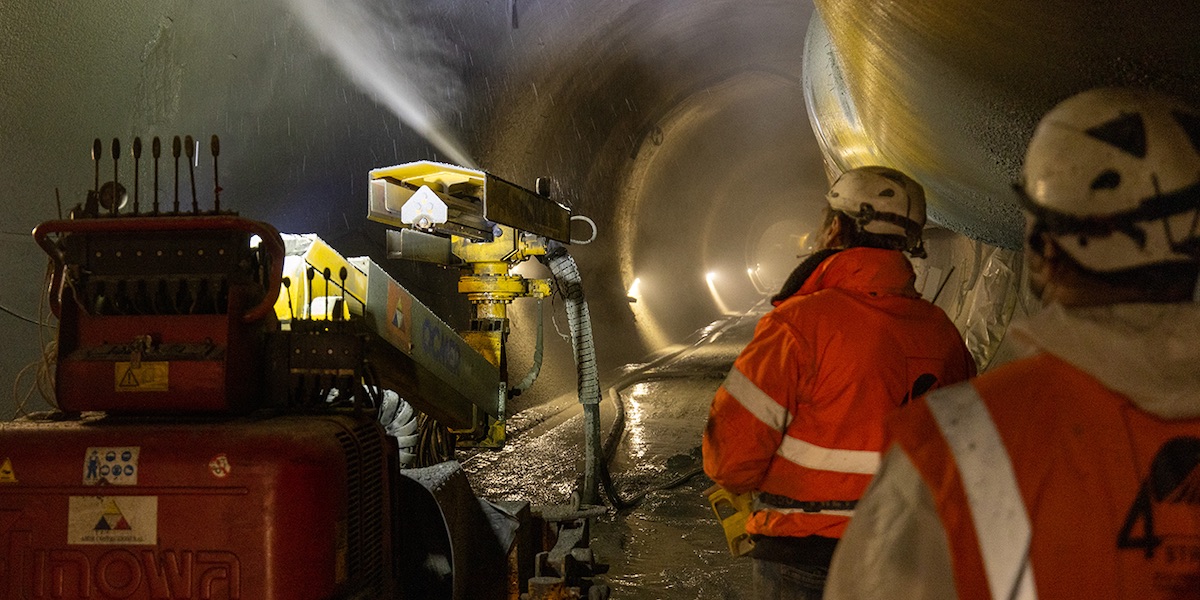
The Turin-Lyon is the new freight and passenger rail line that is to connect Turin and Lyon across the Alps, over roughly 270 kilometres: about fifty in Italy as far as Susa and Bussoleno, 65 in the cross-border section, and about 160 in France up to Lyon.[1] Its heart is the Mont Cenis base tunnel, two bores of 57.5 kilometres each, which TELT, the company responsible for the project, presents as set to become «the longest railway tunnel in the world».[1] Known in Italy above all by the acronym TAV, it has for more than thirty years been one of the most debated political issues in Piedmont: the opposition that arose in Val di Susa gave rise to the No TAV Movement.[2]
Origins of the project
The idea of a high-speed line between Turin and Lyon was launched in 1988 by the Fondazione Agnelli; in 1990 the regions of northern Italy formed a sponsoring committee to support it.[2] The project was later included by the European Union among its priority projects, as a piece of the corridor meant to cross the continent from west to east.[3] The first opposition came early: in 1991 the Habitat committee formed, with Legambiente, the local WWF and about sixty members, and in 1993 the Comitato contro l'alta velocità ("Committee Against High Speed") was founded.[2]
In 2001, on the French side, a first symbolic excavation took place; under agreements reached in 2004 Italy and France committed to funding the project, with Italy covering 58 percent of the costs and France 42.[4] That split was among the most contested points, since only about a third of the work lies on Italian territory.[3] The current cost-sharing for the cross-border section, estimated by TELT at 11.1 billion euros in 2012 money, assigns 40 percent to the European Union, 35 to Italy and about 25 to France.[5]
Venaus, the Observatory and La Maddalena
2005 was the year of greatest tension: after the clashes at Venaus, near Susa, the government temporarily withdrew the project.[6] This was followed, in August, by the ministerial technical commission known as Rivalta and, in December, by the Technical Observatory for the Lyon-Turin rail link, known as the Osservatorio Virano.[2] Another argument raised by opponents, which emerged in 2004 after a proposal to bury part of the route underground, concerned the presence of asbestos beneath Mount Musiné.[2] In 2006 the project was entirely redesigned.[4]
At Chiomonte, in the La Maddalena area, a construction site was opened to collect the debris from exploratory excavations. Parliament classified the area as «of national strategic interest», and from the start of 2012 its surveillance was entrusted to the military; security alone then cost about 90,000 euros a day.[3] In 2011, 1,054 people collectively bought, in shares, a plot of land near Susa affected by the works.[6] On 27 February 2012 the protester Luca Abbà fell from a high-voltage pylon during operations in the valley; in the following days police cleared a protest camp on the A32 motorway, which was later reoccupied.[7] The president of the Region, Roberto Cota, commented:
«it must be clear to everyone that the project has to be built».
The statement is reported by Il Post.[7] The final design was approved in 2017, and preparatory works began in the following years.[4]
The season of the cost-benefit analysis
With the government formed in 2018 by the Movimento 5 Stelle and the Lega, the line came back under discussion. Turin's city council, with an M5S majority, voted to suspend the works pending a new cost-benefit analysis, while Paolo Foietta, chairman of the TAV Observatory, estimated the cost of a possible abandonment, between reimbursements to France and the EU and compensation to firms, at between 2 and 4 billion euros.[8] In January 2019, while the analysis from the Ministry of Transport was awaited — expected, according to leaks, to conclude that the costs outweighed the benefits — the interior minister Matteo Salvini proposed a referendum, and the president of the Region, Sergio Chiamparino, said he was open to a regional consultation.[9]
On 23 July 2019 Prime Minister Giuseppe Conte, who in March had expressed doubts about the project, announced in a Facebook livestream that the government could not oppose it and that stopping the works would cost more than continuing them: «New facts have come up that we have to take into account», he said, citing the European Union's willingness to increase funding.[10] On 7 August the Senate rejected the M5S motion against the line, with 181 votes against and 110 in favour, approving instead four motions in favour.[11]
The construction site
The cross-border section is entrusted to TELT, a binational company set up on 23 February 2015 on the instructions of the Italian and French governments.[12] Of the section's 65 kilometres, 57.5 are in tunnel: 12.5 on Italian territory and 45 in France, always with twin bores; the international station will be at Susa.[4] By 2024, 38.2 kilometres of tunnels had been excavated, of which more than 14 belonged to the base tunnel, all on the French side.[4]
In April 2025 the transport ministers Matteo Salvini and Philippe Tabarot christened in Maurienne the tunnel boring machine "Viviana", 180 metres long and weighing 2,300 tonnes, named in honour of the wife of Mario Virano, TELT's first director general, who died in June 2023.[13] In schistose, fractured rock, however, the machine advanced only about 80 centimetres a day against the 10-15 metres planned, less than 250 metres in ten months.[14]
Timeline and costs
An implementing decision of the European Commission, published in 2025, sets the timetable: end of excavation in 2031, infrastructure and stations in 2032, opening to traffic in 2033.[15] On the Italian side, plans call for the modernization of the line between Bussoleno and Avigliana, a new line of about 30 kilometres from Avigliana to Orbassano, and the reorganization of the Turin rail hub.[15] The base tunnel is estimated at 14.7 billion euros and the whole project at over 20 billion; the European Union can cover up to 55 percent of the tunnel.[15] According to TELT, once operational Turin will be 4 hours from Paris instead of about 6 today, and travel time to Lyon will be halved.[5] The company estimates that about a million heavy vehicles a year will be able to shift from road to rail.[1]
The current situation
At the end of August 2026 TELT announced that it had passed the 30 percent mark of the 164 kilometres of tunnels to be excavated, with 17 active fronts; at the Chiomonte construction site, damaged during the summer, preparations were under way for the excavation of the Maddalena 2 gallery.[16] The opposition has not stopped: on 26 July 2025 a group of protesters broke through the fences of the Chiomonte and San Didero construction sites, throwing stones and firecrackers.[17]
Pages that link here
- Alice Ravinale
- Askatasuna
- Calogero Mauceri
- Chiara Appendino
- State funds for compensatory measures in Valsusa for the Turin-Lyon tunnel (September 2026)
- L'Agenda News
- Rally in support of the Tav in Turin (September 2026)
- "No to violence, yes to the Tav" rally in Turin (27 September 2026)
- No Tav march Sant'Ambrogio-Avigliana of 3 October 2026
- Marco Travaglio
- No TAV Movement
- Orbassano
- Piero Fassino
- Sergio Chiamparino
- Porta Nuova station
- Susa
- Turin ring road
- Val di Susa
Timeline
- — The mayor of Turin, Stefano Lo Russo, announces that he will not attend the «No alla violenza, sì alla Tav» rally on 27 September in piazza Palazzo di Città because of prior commitments, while reaffirming his support for the Turin-Lyon line. → ANSA Piemonte TorinoToday
- — The government allocates 50.2 million euros, through Infrastructure Decree-Law no. 107, for 32 compensatory measures in 11 municipalities of Valsusa linked to the works on the Turin-Lyon base tunnel, while the Conference of Services on the national Avigliana-Orbassano-Pronda junction section, worth about 3 billion euros, continues. → CronacaQui Torino
- — At the No Tav march from Sant'Ambrogio to Avigliana against the new Avigliana-Orbassano section, former Turin mayor Chiara Appendino calls the Turin-Lyon line «a bottomless pit», reaffirming the Movimento 5 Stelle's opposition to the project. → La Stampa CronacaQui Torino
Related articles: No TAV Movement, Sergio Chiamparino, Susa, Val di Susa
Sources
- TELT
- Treccani
- Il Post — 29 February 2012
- Il Post — 3 October 2024
- TELT
- Il Post — 3 October 2024
- Il Post — 28 February 2012
- Il Post — 29 October 2018
- Il Post — 11 January 2019
- Il Post — 23 July 2019
- Il Post — 7 August 2019
- TELT — 23 February 2025
- TELT — 1 April 2025
- Il Post — 23 July 2026
- Il Post — 1 August 2025
- TELT — 27 August 2026
- Il Post — 26 July 2025