No TAV Movement
A grassroots movement that emerged in the Susa Valley in the early 1990s in opposition to the Turin–Lyon high-speed railway line.
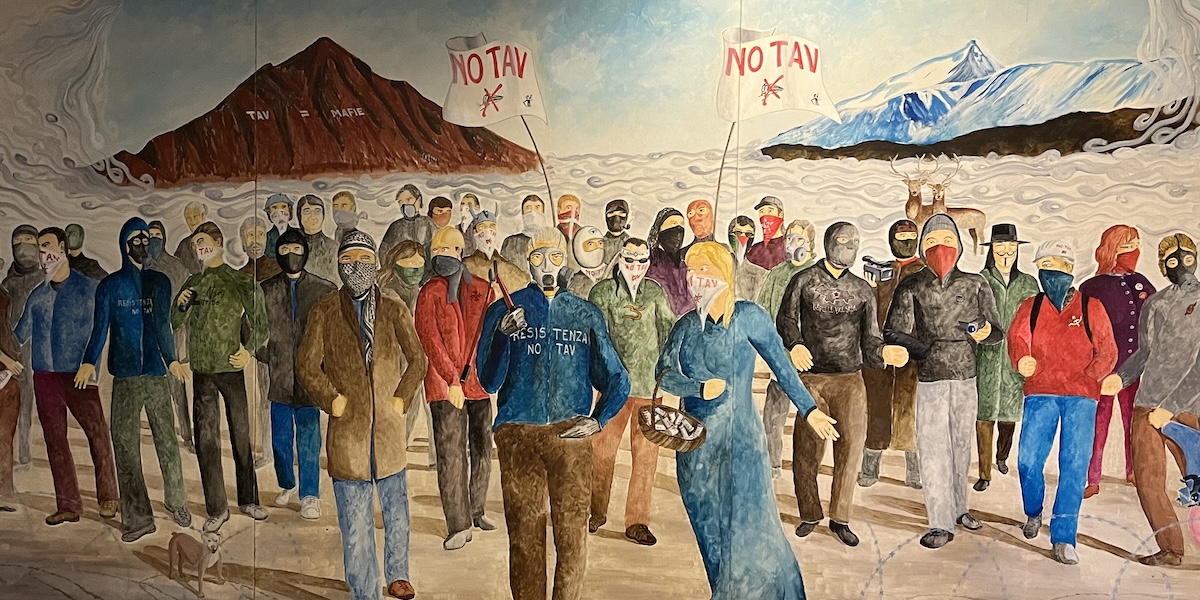
The No TAV movement is the grassroots movement that, since the 1990s, has opposed the construction of the high-speed, high-capacity Turin–Lyon railway line in the Susa Valley. The Treccani Encyclopedia defines it as a «socio-territorial movement opposing the TAV project»[1]. Born among the municipalities of the valley, it has over time involved valley residents, local administrators, technical experts, and activists from the social centers of Turin; today it brings together at least three generations of activists, from retirees to young people from student camps[2].
Origins: from train noise to the committee
The plan for a fast line between Turin and Lyon was revived in the late 1980s; organized opposition appeared in 1991 with the Habitat committee, which brought together Legambiente, the local WWF chapter, and about sixty members, and initially focused on the noise that passing trains would produce in the valley. In 1993 the various groups merged into a broader committee against the high-speed line[1]. The first public demonstration against the TAV was held on 2 March 1995[2][3].
Over the years the issues broadened: the presence of asbestos and uranium in the rock to be excavated (in 2004, after a proposal to bury part of the route underground, there was debate over asbestos beneath Mount Musiné), dust from the construction sites, the overall cost of the project, and its actual usefulness for traffic between Italy and France[1][4]. Working alongside the movement are the Turin–Lyon technical commission of the Unione Montana Valle Susa, made up of professionals, scholars and academics, and a group of lawyers who provide free assistance to activists facing fines, charges and trials[2].
Venaus 2005 and the Observatory
2005 was the year of greatest tension. At Venaus, where a site had been opened for exploratory drilling, valley residents played a decisive role in the so-called Battle of Venaus, when they retook the site that law enforcement had opened overnight[3]; according to Treccani, the strongest tensions followed the clearing of the encampment, on the night of 5–6 December[1]. After the clashes, the government temporarily withdrew the project and set up an Observatory[2]: alongside the technical commission known as "Rivalta", the Technical Observatory for the Lyon–Turin rail link was created, known as the «Osservatorio Virano»; according to Treccani, the dispute nonetheless moved toward an increasingly sharp polarization of positions[1].
Chiomonte and the season of clashes
The project was later revised: the plan described in 2012 called for building 29 of the planned 81 kilometers, partly making use of the existing line[4]. In 2011, to obstruct the expropriations, 1,054 people collectively purchased a plot of land in the Susa area affected by the project[2]. On 27 February 2012, to protest the expropriations in the area of the Chiomonte construction site, activist Luca Abbà climbed a high-voltage pylon, was struck by an electric shock and fell about ten meters; he was airlifted to Turin in serious condition. Before climbing he had spoken by phone with Radio Black Out[5]. The following day, protesters occupying the A32 motorway near Chianocco were cleared by police using smoke grenades and water cannons, and blocked the roadway again; the president of the Piedmont Region, Roberto Cota, reiterated that «the project must go ahead»[6].
In those weeks, Corriere della Sera described a movement made up of three strands: the valley residents, led among others by retired bank employee Alberto Perino; the autonomists from the social centers, from Takùma in Avigliana to Turin's Askatasuna; and the anarchists. About eight thousand residents took part in the peaceful marches, out of sixty thousand residents of the Upper and Lower valley, while 400 to 500 people took part in the clashes[3]. The movement maintains that it is nonviolent by nature, even though it includes groups that engage in confrontation[4].
The yellow-green government and the city of Turin
The issue returned to the center of national politics in 2018. On 29 October, Turin's City Council, with a Five Star Movement majority under mayor Chiara Appendino, approved a resolution calling for work to be «suspended pending a new cost-benefit analysis of the project»; according to calculations reported by Il Post, halting the line would have cost between 2 and 4 billion euros, against roughly 2.4 billion still to be spent[7]. In January 2019, the commission tasked by the Ministry of Transport with the cost-benefit analysis had completed its work, and it was considered almost certain that costs would exceed benefits; Lega leader Matteo Salvini, the Five Star Movement's governing coalition partner, then proposed a referendum on the project[8]. Relations between the movement and the Five Star Movement grew strained: in August 2018, Perino, in an email to a private mailing list of activists, had written:
«The Si Tav [pro-TAV] side and Telt get things done, they move forward and launch the contracts. The Five Star Movement keeps making empty statements instead of taking administrative action»
The text was published by la Repubblica and confirmed by Perino himself[9]. Work continued: today the 65-kilometer cross-border section, with its 57.5-kilometer base tunnel, is entrusted to the Italian-French public company TELT, which on the Italian side has construction sites at Chiomonte-Giaglione and San Didero[10].
Trials, protest camps and festivals
The protests have led to numerous legal proceedings. The largest, linked to Askatasuna and the No TAV movement, concluded at first instance on 31 March 2025: the sixteen defendants charged with criminal conspiracy were acquitted «because the act did not occur», while for individual offenses committed during the protests in the valley and in Turin there were ten convictions and eighteen acquittals. The prosecution had sought a total of 88 years in prison; the initial charge of subversive association had already been dropped during the preliminary phase[11]. The rulings are first-instance decisions.
The movement lives on in the permanent encampments at Vaie, Borgone Susa, San Giuliano, Venaus and the Mulini della Val Clarea in Chiomonte, where the flags have to be replaced every six months because they fade[2]. Every summer the Alta Felicità Festival in Venaus ends with a march toward the construction sites: in July 2025 some of the demonstrators broke through the fences at Chiomonte and San Didero and blocked the A32[12]; on 25 July 2026, according to the organizers, around twenty thousand people took part in the march; in the clashes at the Chiomonte and San Didero construction sites, according to the Coisp police union, at least sixty officers were injured, along with about fifty demonstrators[13]. The movement's website, notav.info, gathers news from the committees and the schedule of the encampments[14].
For long-time activists, the arrival of younger members has been decisive. «Without the young people, they probably would have worn us down», said Loredana Bellone, mayor of San Didero from 2004 to 2019; another activist, Valter Di Cesare, sums up the movement's outlook this way: «We don't stop it, but we make it lose time. And if we don't manage to stop it, the mountain will.»[2]
Pages linking here
Related articles: Askatasuna, Sergio Chiamparino, Susa, Torino-Lione, Val di Susa
Sources
- Treccani
- Il Post — 3 October 2024
- Il Post (da Corriere della Sera, Marco Imarisio) — 3 March 2012
- Il Post — 29 February 2012
- Il Post — 27 February 2012
- Il Post — 28 February 2012
- Il Post — 29 October 2018
- Il Post — 11 January 2019
- Il Post — 13 August 2018
- TELT
- Il Post — 31 March 2025
- Il Post — 26 July 2025
- Il Post — 25 July 2026
- NoTav.info