Askatasuna
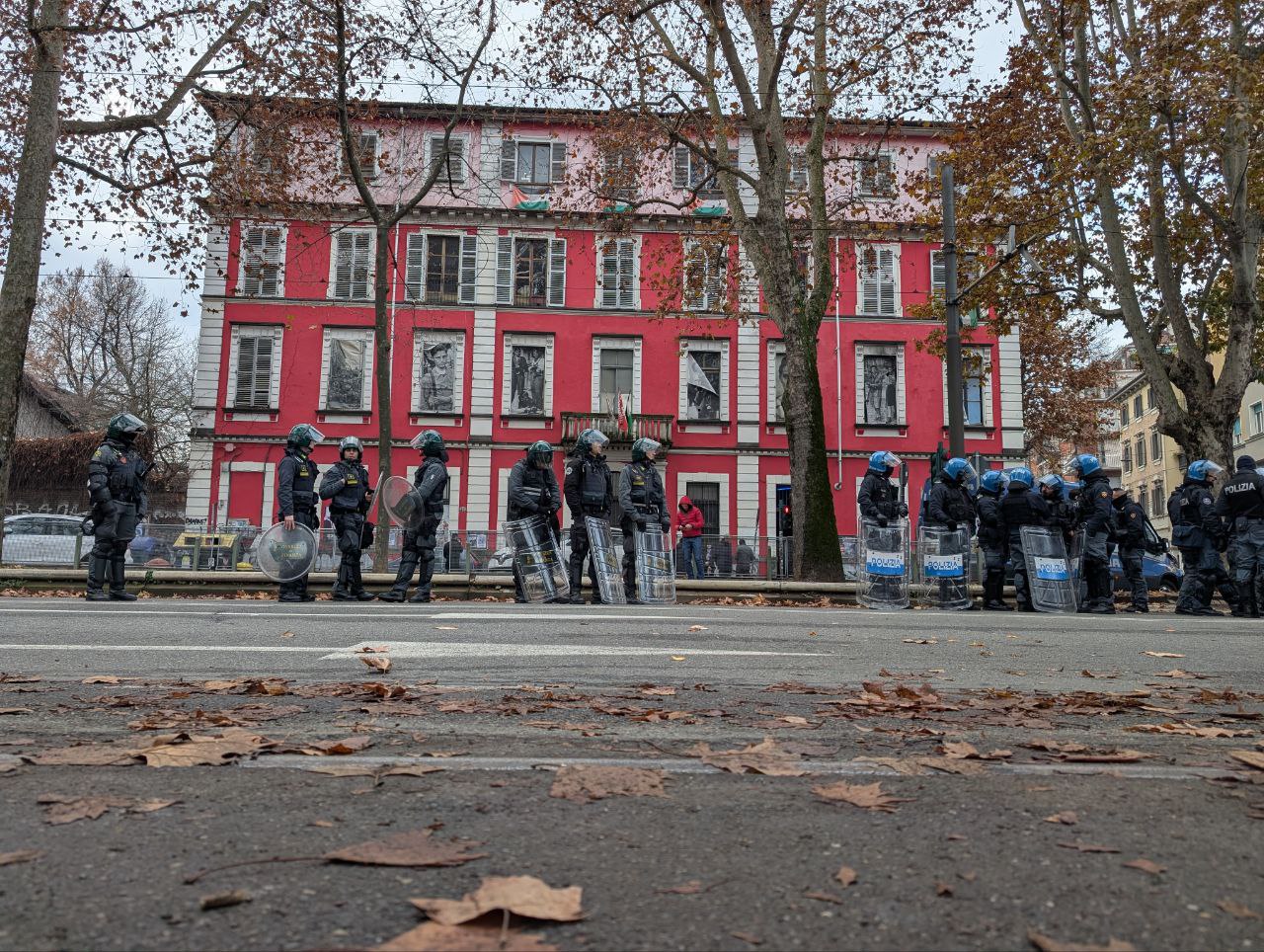
Askatasuna is the autonomous social center born in 1996 with the occupation of a city-owned building at corso Regina Margherita 47, in the working-class neighborhood of Vanchiglia, close to the university and the city center of Turin.[1] The name is the Basque word for «freedom».[2] For nearly thirty years it was one of Italy's best-known social centers and one of the reference points of the Turin radical left in the protest against the Turin-Lyon railway; in December 2025 the building was cleared, after the failure of an attempt at regularization launched by the City.
The 1996 occupation
The occupation came during the expansion cycle of Italian social centers of the 1990s, born after the university protests, the same cycle that saw the rise of Officina 99 in Naples; in Turin, El Paso Occupato had already existed since the 1980s, and Italy's first social center had been the Leoncavallo in Milan, in 1975.[3] The red-painted building on corso Regina Margherita became the headquarters of a collective from the autonomist scene.[1] In 2012, journalist Marco Imarisio, writing in the Corriere della Sera about the different souls of the No TAV movement, described Askatasuna as «a splinter of the Seventies that arrived intact to the present day».[4]
The link with Val di Susa
The trait that most defined Askatasuna is its participation in the No TAV movement. According to Imarisio, it was its militants who convinced the valley residents, who in 1999 had chosen a red flag for the protest, to adopt a more neutral symbol: hence the movement's white flag.[4] In 2011 Imarisio himself wrote that it had been Turin militants who had carried the fight against high-speed rail beyond the local scope of Val di Susa, and he linked the center to the clashes in Rome on 14 December 2010 and 15 October 2011 in Piazza San Giovanni.[1] In those days, mayor Piero Fassino, representing the City that owned the building, observed that any eviction operations had to be managed with an eye to the public order problems they could create.[1]
The trial for criminal association
An investigation by the Turin Public Prosecutor's Office into the protests against the Turin-Lyon line and the clashes with law enforcement – carried out between 2019 and 2021 and extended retroactively back to 2009 – led to the trial of 28 people linked to the social center, the No TAV movement and other groups in the city. The initial charge of subversive association was reformulated as criminal association, brought against 16 defendants; the prosecution had requested a total of 88 years in prison.[5] On 31 March 2025 the court, at first instance, acquitted all 16 defendants of the association charge «because the fact does not exist», among them the longtime militant Giorgio Rossetto, for whom 7 years had been requested; for the individual episodes, involving offenses such as private violence, resistance to a public official and damage to property, sentences ranged from five months to 4 years and 9 months.[5] There were 18 convictions and 10 acquittals.[6] In its reasoning the court observed that ideological leanings and revolutionary ideas are not enough to prove a shared criminal program, and that decisions were made in assembly, not by a hierarchical structure.[7] The Prosecutor's Office appealed the ruling, seeking recognition of criminal association.[7] The appeal trial, involving 25 defendants, 16 of whom were again charged with criminal association, opened on 13 April 2026, and the Court admitted the hearing of two new witnesses from the Digos; none of the rulings is final.[8]
The «common good» and the eviction
In January 2024, mayor Stefano Lo Russo announced a co-design process to turn the building into a «common good», «open to everyone, participatory and shared with the city», backed by a committee of citizens, university professors and entertainment figures; at the festival organized by the center in 2023, speakers had included historian Alessandro Barbero and cartoonist Zerocalcare, among others.[2] The agreement provided for the occupants to leave the building for structural inspections and for activity to remain limited to the ground floor, while the three upper floors, declared unsafe, were to be vacated.[9] The choice was contested by figures from the government and the center-right: Interior Minister Matteo Piantedosi warned that the operation should not appear to legitimize the occupation[9], and Region president Alberto Cirio commented:[2]
«I'll just say that if there is no legality, there should be no freedom»
The agreement broke down on 18 December 2025. During searches linked to the assault on the Stampa newsroom in late November, for which 36 people had been reported, and to the damage at the OGR during Italian Tech Week in October, police found six people sleeping on the third floor. Lo Russo declared the agreement void due to non-compliance with its conditions, and the building was cleared with about 300 officers brought in from other regions; three schools in the area remained closed for 48 hours.[10] That evening about a thousand people gathered in protest, and police used water cannons and tear gas.[10]
After the eviction
On 31 January 2026, a national march starting from Porta Susa, Porta Nuova and Palazzo Nuovo reached corso Regina Margherita: around two hundred groups, including collectives and political and social movements, with 50,000 people according to organizers and 15,000 according to police, including Zerocalcare, Willie Peyote and Subsonica.[11] At the end of the march a group of about a thousand people according to law enforcement (1,500 according to other sources) clashed with police for about an hour and a half; a 29-year-old officer was struck with kicks, punches and hammer blows, and three protesters were arrested on charges of devastation.[12] Prime Minister Giorgia Meloni visited the injured officer along with Cirio, and Defense Minister Guido Crosetto spoke of more than a thousand people organized in a military fashion.[12]
On 1 May 2026, more than a thousand people broke away from the Labor Day march to head toward the former social center, and were stopped by police with water cannons, charges and tear gas.[13] In June 2026, Archbishop Roberto Repole, head of the archdiocese, speaking about the distress of young people in Turin, observed that the controversies over the violence of antagonist movements have at times distracted from the signs of unease they express.[14]
Pages linking here
- No TAV Movement
- Protests over Roberto Vannacci's visit to Turin (18 September 2026)
- Roberto Vannacci
- Subsonica
- Torino
- Val di Susa
- Victor Emmanuel II
Related articles: No TAV Movement, Val di Susa
Sources
- Il Post (da Corriere della Sera, Marco Imarisio) — 18 October 2011
- Il Post — 31 January 2024
- Il Post — 28 August 2025
- Il Post (da Corriere della Sera, Marco Imarisio) — 3 March 2012
- Il Post — 31 March 2025
- Domani — 31 March 2025
- Il Fatto Quotidiano — 6 February 2026
- Quotidiano Piemontese — 13 April 2026
- Il Post — 19 December 2025
- Il Post — 18 December 2025
- Open — 31 January 2026
- Il Post — 2 February 2026
- Il Fatto Quotidiano — 1 May 2026
- Il Fatto Quotidiano — 25 June 2026