Nichelino
A municipality south of Turin on the Sangone: a fief of the Occelli family from 1694, home to the Palazzina di Stupinigi, grown with FIAT to almost 50,000 inhabitants.
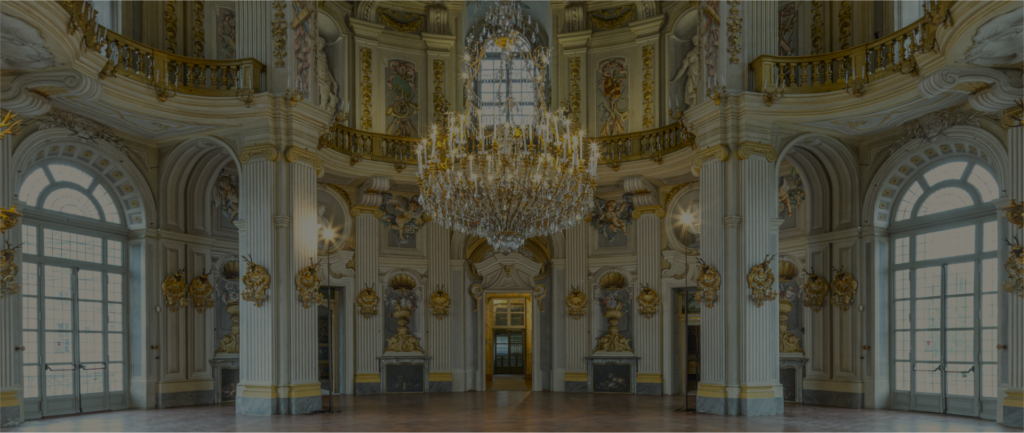
Nichelino is a municipality of the Metropolitan City of Turin, immediately south of the provincial capital, on flat terrain of 20.6 km² crossed by the Sangone and the Chisola before their confluence with the Po[1][2]. It borders Turin, Moncalieri, Vinovo, Candiolo, Orbassano and Beinasco, and the 45th parallel passes right over it: the town lies exactly halfway between the North Pole and the Equator[2]. A farming village for centuries, in the decades after the Second World War it became one of the most populous satellite towns of Greater Turin; within its territory, in the hamlet of Stupinigi, stands the Palazzina di caccia (hunting lodge) by Filippo Juvarra[2][3].
From the fortified house to the Occelli fief
In the Middle Ages Nichelino was a small rural village tied to Moncalieri[2]. Its nucleus is a fortified house documented as early as the 13th century, rebuilt around 1565 as a larger residence; alongside it survives the votive chapel of the Madonna delle Grazie, considered the territory’s first church and attested from at least the 13th century[4]. In 1619 the complex was bought by the Occelli, a family of Cuneo origin who would go on to shape the history of the place[4].
The date local tradition regards as the founding of the community is 22 June 1694: by a Royal Patent Victor Amadeus II recognised Niccolò Manfredo Occelli with the title of feudal lord, and Nichelino became a Savoy fief in every respect[4][5]. The Occelli held civil, judicial and property authority there; until 1726 the count administered justice in the village court, the same building in which the community council met and which also served as a jail for short detentions[4][5]. The economy was that of the plain: farmsteads such as the Granda, the Rena and the Filippa, barns with more than a hundred dairy cows, mulberry trees for silkworm rearing, and farmhouses lined up around a shared courtyard, the "cantonà"[5].
The castle later passed to other families, among them the Segre, and today belongs to the Ceresa family, who use it for ceremonies, conferences and cultural events; the grounds exceed 35,000 square metres[4]. On the facade of the former Segre farmstead, in the Borgo Vecchio, a mural of popular devotion, datable between the 17th and 19th centuries, shows the deposition of Christ in the cloth of the Shroud, held up by the Sorrowful Virgin and by Saint Francis; the 1578 journey that brought the relic down from the Moncenisio pass to Turin, however, did not pass through here[6].
In the shadow of Stupinigi
From 1729 the territory of Nichelino was transformed by the construction of the hunting residence that Juvarra designed for the House of Savoy: more than 31,000 square metres of buildings and 150,000 of gardens and park, expanded throughout the 18th century by Benedetto Alfieri and today owned by the Fondazione Ordine Mauriziano[3]. Around the Palazzina a genuine service settlement grew up[7]:
"The rational management of the territory emerges in the design of a true urban agglomeration serving the Palazzina, complete with stables, warehouses, farmsteads, kennels and dwellings."
From 1754 a tree-lined avenue connected the complex to the capital[7]. Also part of that design is the church of the Visitation of the Virgin Mary, which closes one of the arms of the Palazzina’s exedra and was intended for the inhabitants of the estate’s farmsteads: laid out by Juvarra and built by the royal architect Giovanni Tommaso Prunotto, its first stone was laid in the spring of 1738 in the presence of Charles Emmanuel III, it was consecrated on 7 September 1739 and its bell tower was completed in 1743[8]. It houses the altarpiece of the Visitation by Claudio Francesco Beaumont and a reliquary of Saint Hubert, patron saint of hunters[8]. Savoy weddings were celebrated in the Palazzina, including that of Victor Emmanuel II before he became king of Italy, and since 1997 it has been a UNESCO World Heritage site[3]; it is part of the Savoy Residences grouped in the Consorzio delle Residenze Reali[7].
Miraflores and the Boschetto
Along the Sangone there was another ducal residence. In 1551 Jacopo di Savoia bought the Spinetta estate here, and in 1585 Charles Emmanuel I had the Miraflores castle built there for his wife Catherine of Austria, set amid gardens and overlooking the stream, which was diverted on purpose to create a scenic landscape; after bombardments, floods and changes of ownership it was demolished at the end of the 19th century[9]. In 2006 the Municipality took over the area and turned it into the Parco del Boschetto, about 600,000 square metres included in the Po park system around Turin and linked to the Sangone’s cycle paths[9]. In September 2026 the Region allocated to the park about 1.3 million euros for new plantings of native species, ecological corridors and accessible paths, after the European CICADA4CE project had already created there an urban wood of about 6,000 square metres with more than 220 trees[10]. Right on the border with Turin, in the Mirafiori Sud area, stands the neoclassical mausoleum that the children of Rosa Vercellana, the "Bela Rosin," the king’s morganatic wife, had built for her between 1886 and 1888; on the pediment the motto of the counts of Mirafiori, "DIO PATRIA FAMIGLIA" (God, Fatherland, Family)[11].
The city of FIAT
Modernity arrived with the railway: in 1854 the first train of the Turin–Pinerolo line passed through Nichelino, and the same year the first schoolmistresses arrived[2]. During the Second World War the town was hit by the 1942 bombings[2]. The real turning point was demographic: with the immigration drawn by FIAT, the population rose from 7,200 in 1951 to almost 50,000 in 1974[2]. The farming village became an active industrial centre, with metalworking, electrotechnical, chemical and textile firms[1]. In 2008 the population stood at 48,864, today about 45,600, divided into seven districts: Sangone-Crociera, Castello, Juvarra, Boschetto, Oltrestazione, Bengasi and Kennedy[1][2].
Today
The main cultural venue is the Teatro Superga on via Superga, born from the conversion of an old disused cinema, with a project begun in 1995 and inaugurated in December 1999: 472 seats between stalls and gallery, and the second-largest stage by size in the province; in the early 2000s it hosted more than a hundred events a year[12]. The connection with Stupinigi remains an open issue: since August 2025 line 1N of GTT, on weekends, has run on free of charge as far as the Palazzina in a six-month trial; according to the transport councillor Francesco Di Lorenzo, if results are positive the extension could become permanent, at an estimated cost of about 20,000 euros a year[13].
The Teatro Superga launches the Balletto del Teatro Superga (September 2026)
The Teatro Superga in Nichelino launches the Balletto del Teatro Superga, a new municipal dance company placed under the artistic direction of Laura Rossana Caffaro.
Timeline
- — In Nichelino the Municipal Police find six abandoned kittens near the Palazzina di Caccia di Stupinigi and hand them over to the Moncalieri cat shelter. → TorinoOggi Eco del Chisone
- — In Nichelino the cat colony on via Nino Bixio is set on fire again, after a similar arson attack on New Year’s Day 2026; the Municipality announces the installation of surveillance cameras in the area. → Eco del Chisone CronacaQui Torino
- — The Teatro Superga in Nichelino launches the Balletto del Teatro Superga, a new dance company placed under the artistic direction of Laura Rossana Caffaro. ANSA Piemonte TorinoOggi
- — In Nichelino some residents of via Ponchielli report to mayor Giampiero Tolardo, during the Saturday market, the dilapidated state of the street, with potholes concentrated near numbers 32 and 34. → TorinoOggi CronacaQui Torino
- — In Nichelino firefighters find in via Parri the badly decomposed body of an 80-year-old man, dead for days of natural causes without anyone noticing. → TorinoToday Il Torinese
- — In Nichelino two men use a manhole cover to smash the window of a fruit and vegetable shop on via XXV Aprile and steal the till float, but are caught and arrested by the carabinieri shortly afterwards. → TorinoOggi CronacaQui Torino
- — In Orbassano and Nichelino, construction sites and works on the Gtt network change, from 5 October, the routes of several bus lines, with temporary diversions and termini until January 2027. → CronacaQui Torino
- — A 28-year-old woman living in Moncalieri is critically injured in a head-on collision between her car and the trailer of a lorry at the roundabout between via Debouché and via Stupinigi, on the border between Nichelino, Candiolo and Vinovo; she is airlifted to the Cto hospital in Turin. → TorinoToday Il Torinese
Related articles: Balletto del Teatro Superga, Laura Rossana Caffaro, Superga (footwear), Victor Emmanuel II
Pages that link here
- Abandonment of six kittens at Stupinigi on 21 September 2026
- AES Torino
- Balletto del Teatro Superga
- Banche del Tempo della provincia di Torino
- Metropolitan City of Turin
- Theft with a manhole cover at a shop in Nichelino (September 2026)
- Arson at the via Nino Bixio cat colony in Nichelino (September 2026)
- Car-lorry collision at the roundabout between Nichelino, Candiolo and Vinovo (7 October 2026)
- L'Eco del Chisone
- Laura Rossana Caffaro
- Margherita e i suoi nipoti (Palazzina di Stupinigi, 2026)
- Mirafiori
- Changes to the Gtt network between Orbassano and Nichelino (October 2026)
- Orbassano
- Palazzina di caccia di Stupinigi
- Savoy Residences
- Discovery of a body on via Parri in Nichelino (September 2026)
- Scontro frontale tra un'auto e un tir tra Nichelino e Vinovo (ottobre 2026)
- Residents’ report on the potholes of via Ponchielli in Nichelino
- Six abandoned kittens found in Nichelino near the Palazzina di Stupinigi
- Superga (footwear)
- Turin Ring Road
- Unione Artigiana di Torino e Provincia
- Victor Emmanuel II
Sources
- Treccani
- Mole24 — 9 December 2025
- Fondazione Ordine Mauriziano
- Mole24 — 10 December 2025
- Mole24 — 17 December 2025
- Mole24 — 16 December 2025
- Consorzio delle Residenze Reali Sabaude
- Mole24 — 14 December 2025
- Mole24 — 15 December 2025
- Mole24 — 22 September 2026
- MuseoTorino
- Mole24 — 12 December 2025
- Mole24 — 4 August 2025
- ANSA Piemonte — 26 September 2026
- TorinoOggi — 26 September 2026
- Il Torinese — 26 September 2026