
Stupinigi Hunting Lodge
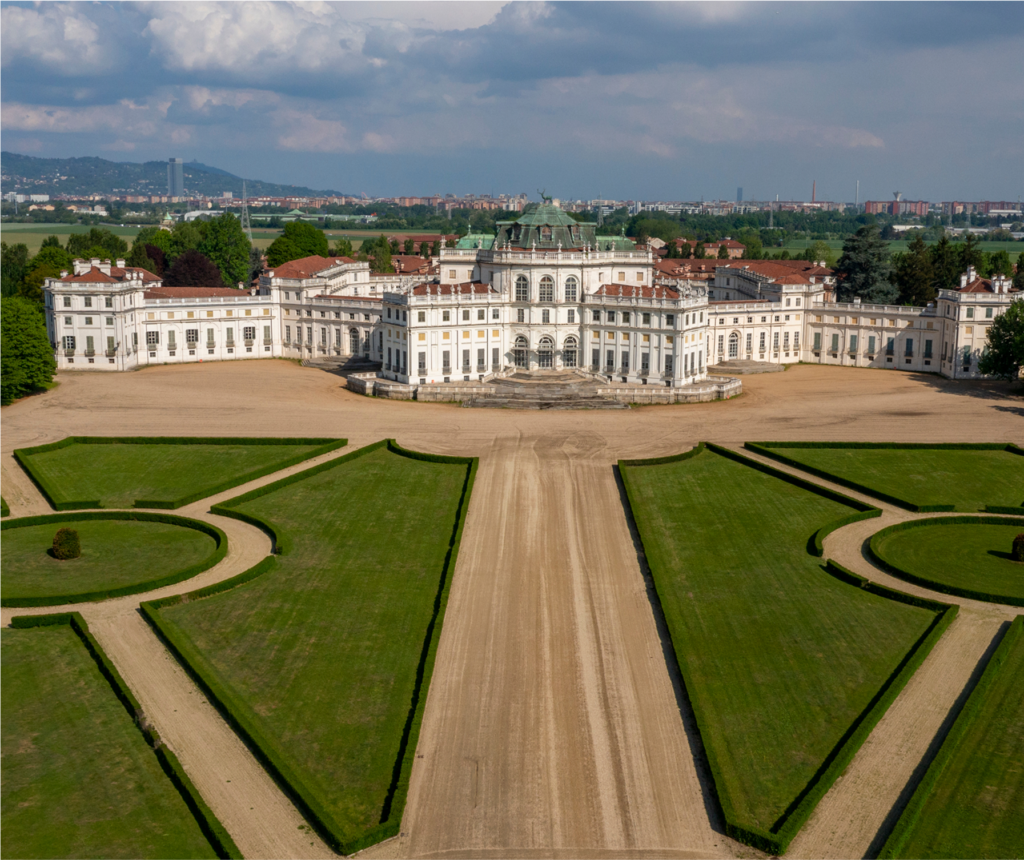
The Stupinigi Hunting Lodge is the Savoy residence built from 1729 to a design by Filippo Juvarra in the hamlet of Stupinigi, in the municipality of Nichelino, about ten kilometres south-west of Turin. Built as a pavilion for hunting and court festivities, it has 137 rooms and 17 galleries across more than 31,000 square metres of building, with 150,000 square metres of park and green areas.[1] It belongs to the system of Residenze sabaude (Residences of the Royal House of Savoy) and is run by the Fondazione Ordine Mauriziano.[2]
The lands of the Ordine Mauriziano
The story of the place begins before the building itself. In 1573 duke Emanuele Filiberto gave the lands of Stupinigi to the Order of Saints Maurice and Lazarus,[2] the religious and chivalric order that he himself had established in 1572 by merging two older orders: that of Saint Maurice, founded at Ripaille in 1434, and that of Saint Lazarus, which arose in Jerusalem to care for lepers.[3] The hamlet of Stupinigi stands on the right bank of the Sangone stream; in 1931 it had 672 inhabitants, at an elevation of 244 metres.[4]
Juvarra's building site (1729-1733)
The hunting lodge, called in the documents the «Reale Fabrica», was begun following a decree of Vittorio Amedeo II of 11 April 1729. The site was initially overseen by Giovanni Tommaso Prunotto di Guarene, and the central block was already finished by 1731.[4] Juvarra, the court architect, conceived the building around a great oval double-height hall from which wings radiate in the shape of a Saint Andrew's cross.[1][2] The Dizionario Biografico degli Italiani defines the lodge as a
«hunting pavilion and a functional template for the celebration of the pleasures of the court»
and sees, in the «wings crossing diagonally and radiating from the oval of the central hall», a way of geometrically binding together architecture, landscape and city, at the end of a long line of research by the architect on this theme.[5]
The hall was frescoed between 1731 and 1733 by the Bolognese brothers Domenico and Giuseppe Valeriani, specialists in quadratura painting, with hunting scenes and the apotheosis of Diana, the huntress goddess.[1][2] Giovan Battista Crosato, Carlo Andrea Van Loo and the Cignaroli family also worked on the decoration of the rooms over the course of the century; the garden was designed by the Frenchman Bernard.[4]
The stag on the dome
At the top of the hall's «upturned boat» dome stands the great bronze stag by Francesco Ladatte, which has become the emblem of the lodge.[1] Its date is disputed: the Fondazione Ordine Mauriziano dates it to 1766,[1] while the Dizionario Biografico degli Italiani, drawing on the studies of Luigi Mallé, places it closer to the sculptor's Turin works of 1732-1734 and considers it possibly inspired by designs by Juvarra himself.[6]
Alfieri's extensions and the eighteenth century
After Juvarra's death, the complex kept growing. From 1740 Benedetto Alfieri, at the request of Carlo Emanuele III, added the apartments intended for the king's sons, the Duke of Savoy and the Duke of Chiablese, decorated in Rococo taste and with Chinese wallpaper.[2] Stables, storehouses and dwellings sprang up around the main building, and from 1754 a long tree-lined avenue linked the lodge to the capital.[2] The cabinetmaker Pietro Piffetti and the court sculptor Giuseppe Maria Bonzanigo worked on the interiors.[1] The extensions came to an end only in 1798, with the French occupation.[2]
Stupinigi was also the setting for dynastic ceremonies of the House of Savoy: the wedding of Maria Teresa of Savoy to Charles Philippe, Count of Artois, the future Charles X of France, was celebrated there, and Tsar Paul I, Ferdinand I King of Naples, Napoleon and his sister Pauline Bonaparte all stayed there.[1]
The nineteenth century and the elephant Fritz
In the nineteenth century Carlo Felice and Maria Cristina of Bourbon chose the lodge as a holiday residence;[2] later Queen Margherita too was a guest there.[1] A menagerie of exotic animals, with ostriches and kangaroos, found a place in the park.[1] The most famous guest arrived in 1827: an Indian elephant named Fritz, a gift from the viceroy of Egypt Mohamed Ali to the king of the Kingdom of Sardinia, accompanied by Egyptian guards. It was said that «he danced to music», and a circular pool with a slide was built for him in the courtyard. After the death of his first keeper, Fritz killed the new custodian; his embalmed remains are today on display at the Museo Regionale di Scienze Naturali in Turin.[7]
Museum, UNESCO and restoration
In 1919 the lodge became the seat of the Museo di Arte e Ammobiliamento (Museum of Art and Furnishing), entrusted to the Ordine Mauriziano.[2] In 1997 it entered the UNESCO World Heritage List together with the other Savoy residences, inscribed as a single site comprising 22 palaces and villas built in and around Turin from 1562 onward, from the Royal Palace to the Palace of Venaria.[8]
Legislative decree 277/2004, converted into law 4/2005, established the Fondazione Ordine Mauriziano, which today administers the lodge together with the Precettoria di Sant'Antonio di Ranverso and the Abbazia di Staffarda.[3] After a long season of restoration, since 2016 the visitor route has included almost all of the state apartments.[2] In 2024 Napoleon's 1805 gala coach returned to Stupinigi, restored.[1] The coach, bearing the Napoleonic coat of arms on its doors and which also once belonged to Gustavo Rol, may have been part of the procession that in that year took Napoleon to Milan for his coronation as King of Italy, with a stop at Stupinigi where the emperor stayed with his wife Josephine.[9]
Today
The lodge is open from Tuesday to Sunday, while the historic garden can be visited from March to October. From Turin it can be reached on line 41 of the Gruppo Torinese Trasporti, about twenty minutes from Lingotto station.[10] Alongside visits, it hosts exhibitions, events and educational activities.[1]
Six kittens abandoned near the lodge (September 2026)
On 21 September 2026 the municipal police of Nichelino, acting on a tip from a resident, recovered six kittens about a month old, abandoned on the roadside in a car park on the SP 143 near the lodge. The animals were handed over to the Moncalieri cat shelter; an investigation was opened, including through CCTV footage, to identify whoever was responsible for the abandonment, an offence punishable under article 727 of the Criminal Code.[12]
FLOReal, the plant festival (October 2026)
From Friday 9 to Sunday 11 October 2026 the lodge hosted FLOReal, the autumn event organised by Orticola del Piemonte and devoted to botany, crafts and nature-related experiences, with rare plants, bonsai and cacti and about a hundred exhibitors among growers, craftspeople and horticulture professionals.[11] The 2026 edition paired the plant fair with three parallel themed trails: Bonsaica, Succulenta! and Agave Spirits.[11]
Timeline
- — In Nichelino the municipal police finds six kittens abandoned near the Stupinigi Hunting Lodge and hands them over to the Moncalieri cat shelter. → TorinoOggi Eco del Chisone
- — The Metropolitan City of Turin announces the 13th Fiera di Stupinigi, devoted to the flour supply chain: at the Stupinigi Hunting Lodge, on 1, 3 and 4 October, with live threshing, traditional crafts and activities for families. → Metropolitan City of Turin
- — On Sunday 4 October, for Grandparents' Day, the Stupinigi Hunting Lodge offered the tour «Margherita e i suoi nipoti» («Margherita and her grandchildren»), the second instalment of the series «La Regina Margherita e i suoi affetti», devoted to the family life of the Queen Mother between Stupinigi and Racconigi. → TorinoToday
- — From Friday 9 to Sunday 11 October the Stupinigi Hunting Lodge hosts the sixth edition of FLOReal, the plant festival organised by Orticola del Piemonte, with a trade fair, bonsai, succulents and the Agave Spirits festival of Mexican spirits. → TorinoToday Torino Free
- — In Nichelino the person suspected of abandoning six kittens left on 21 September 2026 in a car park near the Stupinigi Hunting Lodge is identified and reported, thanks to the investigation by the local police. → TorinoOggi TorinoToday
Related articles: Abandonment of six kittens in Stupinigi on 21 September 2026, Orticola del Piemonte, Six Abandoned Kittens Found in Nichelino Near the Palazzina di Stupinigi, Sixth edition of FLOReal at the Stupinigi Hunting Lodge (October 2026)
Sources
- Palazzina di Caccia di Stupinigi — Fondazione Ordine Mauriziano
- Palazzina di Caccia di Stupinigi — Residenze Reali Sabaude
- La Fondazione — Fondazione Ordine Mauriziano
- Stupinigi — Treccani, Enciclopedia Italiana
- JUVARRA, Filippo - Enciclopedia — Treccani, Dizionario Biografico degli Italiani
- LADATTE, Francesco - Enciclopedia — Treccani, Dizionario Biografico degli Italiani
- FRITZ, L'ELEFANTE DI STUPINIGI — Piemonte Italia (Regione Piemonte)
- UNESCO World Heritage Centre
- La carrozza di Napoleone torna alla Palazzina di Stupinigi - Piemonte — ANSA, 6 September 2024
- Visita Stupinigi: orari e info utili — Fondazione Ordine Mauriziano
- FLOReal 2026 a Stupinigi: tre giorni tra piante rare, bonsai e cactus — Torino Free
- Sei gattini abbandonati nei pressi della Palazzina di Stupinigi — TorinoOggi