Moncalieri
City on the Po at the gates of Turin, founded in 1230 when Testona was relocated there; a Savoy residence and the site of the 1849 proclamation.
Moncalieri is a municipality in the Metropolitan City of Turin, lying at 219 metres above sea level on the right bank of the Po, just south of the regional capital; it covers 47.6 km² and in 2008 had 56,944 inhabitants[1]. A town born in the thirteenth century, it became one of the favourite residences of the House of Savoy, and from its castle in 1849 came the proclamation that marked a turning point in the constitutional history of the Kingdom of Sardinia. Today it is one of the main industrial centres of the Turin area[1].
From Testona to the town on the Po
Before Moncalieri there was Testona, on the hill: a Romanesque church of the first half of the eleventh century still stands there, with bell tower, apse and crypt, and the Castelvecchio remains, a remodelled medieval castle that preserves marble fragments and a ninth-century chancel screen[2]. At the foot of the hill, near the Po, there was a small settlement called Sant'Egidio, held by the Templars[1]. In 1230 the seat of the commune was moved from Testona to the new centre, which from then on took the name Moncalieri[1][2].
The town passed under the Savoys in 1255 or 1256, experienced French rule between 1536 and 1559, and in 1619 gained the title of city[2]. Of medieval Moncalieri what remains are chiefly the churches: Santa Maria della Scala, built between 1330 and 1336, has a bell tower whose lower part dates from the thirteenth century; San Francesco also has a fourteenth-century bell tower, while the church itself was rebuilt in 1789[2]. The church of the Gesù, begun around 1619, dates from the seventeenth century, and Villa Cardinala, designed by Bernardo Vittone, from the eighteenth[2].
The Savoy castle
The first stone of the castle was laid in 1277 at the behest of Thomas III of Savoy, known as Tommasino[3]. The present building arose from the rebuilding carried out in the second half of the fifteenth century, when Duchess Yolande of Valois, wife of Amadeus IX, chose it as her residence; in 1475 she signed a treaty there with Charles the Bold and Galeazzo Maria Sforza[3]. From 1610 Charles Emmanuel I began an expansion that, continued by Victor Amadeus I and by Christine of France, lasted about sixty years, with the architects Amedeo di Castellamonte, Andrea Costaguta and Carlo Morello[3].
With the French occupation of 1798 the castle became a bivouac and then a hospital; in 1817 Victor Emmanuel I ordered its restoration, including the three-flight staircase in Carrara marble[3]. In the second half of the nineteenth century Victor Emmanuel II and Maria Adelaide lived there, and among the last Savoys to live there were Princess Maria Clotilde, wife of Napoléon Jérôme Bonaparte, and her daughter Maria Letizia[3]. The castle is part of the Savoy Residences inscribed since 1997 on the UNESCO World Heritage List[4].
The 1849 proclamation
After the defeat at Novara, peace with Austria was concluded in Milan on 6 August 1849[2], but on 16 November the Chamber of Deputies voted to suspend debate on the treaty[5]. On 20 November 1849, from the castle of Moncalieri, Victor Emmanuel II dissolved the Chamber and signed a proclamation written by Massimo d'Azeglio, in which he accused the outgoing assembly of acts hostile to the Crown and urged voters to choose moderate deputies[5][3]. The appeal worked: the new Chamber, opened on 20 December, counted about two-thirds of deputies favourable to the government[5], and the treaty was approved on 9 January 1850[2].
The 2008 fire and the «castle of ghosts»
On 5 April 2008 a fire devastated the south-east tower: the king's bedroom, the dressing rooms, and the very Hall of the Proclamation itself were lost, with damage estimated at more than ten million euros[6]. The restoration, which took nine years, was entrusted to the architects Visconti and Merlano, who, lacking sufficient documentation of the destroyed rooms, chose to evoke them with installations rather than rebuild them; hence the journalistic nickname «castle of ghosts»[6]. Today the castle is the seat of the 1st Carabinieri Regiment «Piemonte-Liguria», while the royal apartments have been managed since 2014 by the Ministry of Culture's regional museums directorate and can be visited by appointment from Friday to Sunday and on public holidays[4].
The sedition of 1797
On 23 and 24 July 1797 Moncalieri was the scene of a riot against the high cost of living, which also involved local notables: the tax collector Maurizio Crosa, nobles such as the count of Grana, clergy and professionals[7]. The crowd went looking for Carlo Tenivelli, a historian born in Turin in 1754, author of the Biografia piemontese and a teacher in the schools of Moncalieri from 1781[7]. According to the Dizionario Biografico degli Italiani, he «addressed his fellow citizens not so much with an incendiary Jacobin speech as with a humanitarian appeal to lower the price of food»[7]. Tried by a military tribunal, he was shot in the town square on 12 August 1797 together with eight rioters[7].
A few decades earlier Moncalieri had welcomed another popular figure: the shoemaker Giovanni Antonio Panighetti, who settled there in 1765 near the parish of Sant'Egidio and whose reputation for holiness, after 1780, drew nobles seeking advice[8]. Above his workbench he kept a sign: «Whoever does something not done for the pure and simple love of God is an ingrate and does not deserve to live»[8]. He is buried at Sant'Egidio, in the tomb of the Salmatoris family[8].
The Collegio Carlo Alberto and meteorology
In the nineteenth century Moncalieri was also a place of science. At the Royal College Carlo Alberto run by the Barnabite fathers, the Neapolitan Francesco Denza, a graduate of the University of Turin, taught mathematics from 1856; ordained a priest in 1858, the following year he founded a meteorological observatory there[9]. In 1866 the Bullettino meteorologico dell'Osservatorio del R. Collegio Carlo Alberto in Moncalieri was launched, and the observatory became the hub of a network of mountain stations organized with the Italian Alpine Club[9]. Denza ended his career as director of the Vatican Observatory, re-established by Leo XIII in 1891[9]. Moncalieri still houses one of the oldest geodynamic observatories in Italy[1].
The city today
In the twentieth century Moncalieri entered Turin's industrial orbit, with factories producing automotive accessories and bodywork, foundries, chemical, textile and electrotechnical industries, alongside an agricultural trade in vegetables and wine[1]. On the border with the regional capital, at the confluence of the Sangone with the Po, lies the Parco delle Vallere, about 130 hectares: the name comes from the embankments built in 1541 during the French occupation, the Region acquired the area in 1990 to house the management body of the Po River Park, and the flood of November 2016 submerged it entirely[10]. Along the right bank of the Po, the city of Turin is completing a continuous cycle path from San Mauro to Moncalieri, with an investment of six million euros announced in 2024[11].
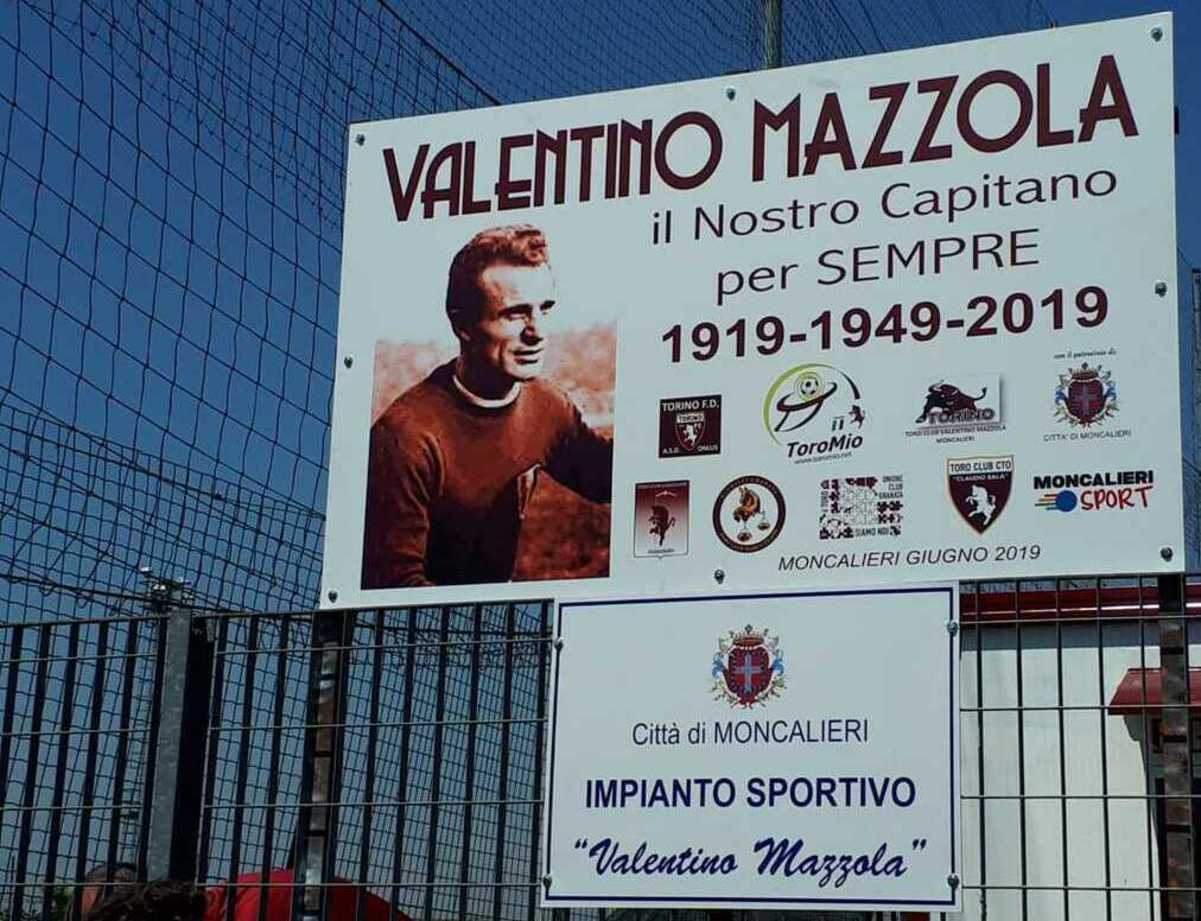
The link with the granata football club is explicit: on 3 June 2019 the Santa Maria sports facility, home of Torino's team for athletes with disabilities, was named after Valentino Mazzola, captain of the Grande Torino, at the proposal of the Toro Club «ToroMio»[12]. Chiara Appendino, mayor of Turin from 2016 to 2021, was born in Moncalieri in 1984[13].
Timeline
- — In the former Ilte plant in Moncalieri, which used to print telephone directories, one of Italy's largest data centres will be built, with a billion-euro investment and 400 jobs expected. → la Repubblica Torino
- — Sarah Rizea, born in Moncalieri and raised in artistic swimming in Turin, is crowned Miss Italia 2026. → Quotidiano Piemontese
- — The Surgery department of Moncalieri's Asl To5 launches a multicentre clinical study on the use of chlorhexidine diacetate in sutures, to reduce post-operative infections in abdominal surgery. → TorinoOggi CronacaQui Torino
- — In Moncalieri the local police seize twenty Maine Coon cats and three Australian Shepherd puppies crammed into a 50-square-metre flat in the historic centre, reporting the couple who kept them. → La Stampa la Repubblica Torino
- — In Moncalieri the National Tripe Fair opens, from Friday 2 to Sunday 4 October, the fourth edition of Gusto Festival at the PalaExpo, the former historic cattle market active until 1993. TorinoOggi
- — The Municipality of Moncalieri allocates 200,000 euros to build 25 new raised pedestrian crossings, prioritizing streets near schools. → TorinoOggi CronacaQui Torino
Related articles: Castle of Moncalieri, Chiara Appendino, Massimo d'Azeglio, Savoy Residences, Susanna Agnelli, Victor Emmanuel II
Pages that link here
- Abandonment of six kittens at Stupinigi on 21 September 2026
- AES Torino
- Announcement of the closure of the Azhar venue on 30 September 2026
- Opening of the National Tripe Fair and of Gusto Festival in Moncalieri (October 2026)
- Protected Areas of the Po and the Turin Hill
- Asl To5
- Autotorino
- Axioma S.r.l.
- Azhar
- Time Banks of the Province of Turin
- Piedmontese bollito misto
- Castle of Moncalieri
- Chiara Appendino
- Final closure of the Azhar nightclub on corso Moncalieri (September 2026)
- Closure of the Azhar nightclub in Turin (September 2026)
- Closure of the Azhar nightclub in Turin (September 2026)
- Circolo dei lettori
- Metropolitan City of Turin
- Two Piedmontese women to the fore at Miss Italia 2026
- Former Ilte plant in Moncalieri
- 2026 National Tripe Fair of Moncalieri
- Giorgetto Giugiaro
- The addresses of the Province of Turin
- Crash between a car and a lorry at the roundabout between Nichelino, Candiolo and Vinovo (7 October 2026)
- Italdesign Giugiaro
- Luciana Littizzetto
- Massimo d'Azeglio
- Mirafiori
- Piedmontese Museum of Computing (MuPIn)
- Nichelino
- New raised pedestrian crossings in Moncalieri (October 2026)
- New giant data centre in the old telephone-directory building (September 2026)
- Santa Croce Hospital, Moncalieri
- Fourth edition of Gusto Festival in Moncalieri (October 2026)
- Savoy Residences
- Sarah Rizea
- Sarah Rizea crowned Miss Italia 2026
- Six abandoned kittens found in Nichelino near the Palazzina di Stupinigi
- Animals seized in a flat in Moncalieri (September 2026)
- Sergio Chiamparino
Sources
- Treccani
- Treccani
- Castello di Moncalieri
- Castello di Moncalieri
- 150anni.it (Comitato per i 150 anni dell'Unità d'Italia)
- L'Agenda News — 11 January 2026
- Treccani - Dizionario Biografico degli Italiani
- Mole24 — 29 April 2026
- Treccani - Dizionario Biografico degli Italiani
- Mole24 — 29 December 2023
- Mole24 — 25 July 2024
- Toro.it
- Treccani