
Residences of the Royal House of Savoy
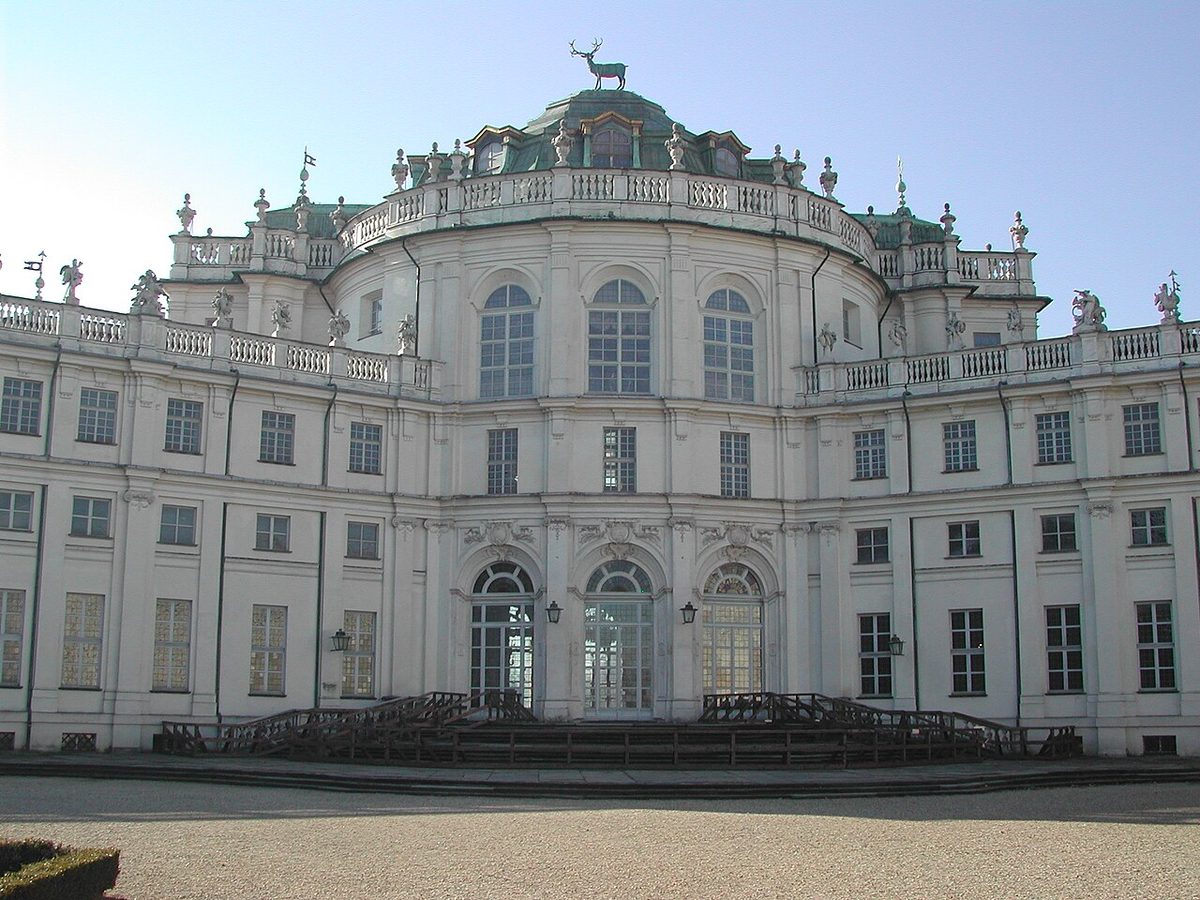

The Residences of the Royal House of Savoy (Residenze Sabaude) are the system of palaces, castles and villas built or transformed by the House of Savoy in Turin and its surroundings between the late sixteenth and the nineteenth century. Since 1997, twenty-two of these buildings have formed a single UNESCO World Heritage Site, inscribed as «Residences of the Royal House of Savoy» under criteria (i), (ii), (iv) and (v)[1][2]. Eleven stand in the city centre, eleven are spread in a radial pattern across Piedmont: together they tell how a dynasty used architecture to set its power in stone[1].
A capital to be built
The system began with the transfer of the court. After the Peace of Cateau-Cambrésis of 1559, which restored most of his father's states to him, Duke Emmanuel Philibert held his court temporarily at Rivoli, waiting for the French troops to leave Turin; on 7 February 1563 he made his official entry into the city with Duchess Margaret and proclaimed it the capital of the state and seat of the court[3]. From then on the dukes, and from the eighteenth century the kings, pursued a reorganisation of the territory designed to celebrate the dynasty's absolute power[1][4].
The World Heritage Centre describes the result as a radial urban design that spreads out from the Royal Palace (Palazzo Reale), in the "zone of command", into the surrounding countryside through the residences of pleasure[2]. The statement of inscription reads:
«The Residences of the Royal House of Savoy is an outstanding example of European monumental architecture and town-planning in the 17th and 18th centuries that uses style, dimensions and space to illustrate in an exceptional way the prevailing doctrine of absolute monarchy in material terms.»
The "zone of command"
The first half of the site is the complex of buildings around piazza Castello where power was exercised in its political, administrative and cultural forms: the Royal Palace, the Royal Armoury, the Prefecture building with the State Archive, the façade of the Teatro Regio (the only part to survive the 1936 fire), the Military Academy, the Cavallerizza Reale (royal riding school), the Royal Mint, Palazzo Chiablese, Palazzo Madama and Palazzo Carignano[1]. The Italian National Commission for UNESCO notes that the Prefecture and the State Archive are among the first buildings in the Western world purpose-built for administrative and archival functions[1].
Constitutional history was also made here: in the Royal Palace Charles Albert signed the Statute on 4 March 1848, and from May 1848 to December 1860 Palazzo Carignano housed the Subalpine Chamber (the Kingdom of Sardinia's lower house); the Royal Palace remained the residence of the first king of Italy, Victor Emmanuel II, until 1865[5].
The "Crown of Delights"
The other half is a ring of out-of-town residences devoted to leisure, festivities and hunting, which, arranged in a radial pattern around the city, reaffirm its centrality[1]. It includes the Castello del Valentino (Valentino Castle), the Villa della Regina, the Castello di Moncalieri (Moncalieri Castle), the Castello di Rivoli (Castle of Rivoli), the Palace of Venaria (Reggia di Venaria Reale), the Stupinigi Hunting Lodge (Palazzina di caccia), the Castello di Agliè (Agliè Castle), the Borgo Castello della Mandria and, further afield, the castles of Racconigi, Pollenzo and Govone[1]. The World Heritage Centre calls them a system of maisons de plaisance around the core of power[2].
Many have medieval roots. Castello di Moncalieri was begun in 1277 at the wish of Thomas III of Savoy and turned into a court residence in the seventeenth century, with work started by Charles Emmanuel I in 1610 and continued by Victor Amadeus I and by Christine of France[6]. Castello di Rivoli, documented as Castrum Riuollum in 1159 and passed into Savoy hands in 1247, was redesigned by the Castellamonte family as a residence of pleasure; the Manica Lunga (Long Wing), built for Charles Emmanuel I's picture gallery, was completed in 1670[7].
Juvarra's century
What gave the system its unity was above all a small circle of court architects and artists who worked simultaneously on the palaces of government and on the residences[1]. The Italian National Commission for UNESCO sums it up like this:
«The unitary character of the complex of buildings, which represent a complete panorama of European monumental architecture of the 17th and 18th centuries, comes from the stylistic homogeneity due to the group of court architects and artists working widely across the residences and the government palaces»
Among the names cited are Benedetto Alfieri and Claudio Francesco Beaumont, but the decisive figure was Filippo Juvarra[1]. Arriving in Turin in the autumn of 1714 as first civil architect to Victor Amadeus II, within a few years he designed the grand staircase of Palazzo Madama (1718–1721), the Galleria di Diana and the church of Sant'Uberto at Venaria, the new 1715 project for Rivoli and, from 1729, Stupinigi, with its crossed wings radiating from the oval of the central hall; in the same period the Basilica of Superga, the dynasty's mausoleum, was being built[4]. Not everything was finished: at Rivoli work stopped in 1734 over costs and the events surrounding Victor Amadeus II's captivity, and the atrium with its unfinished columns can still be seen today[7].
The residences were also settings for diplomatic life. Stupinigi, today in the municipality of Nichelino, which covers over 31,000 square metres within a park of 150,000, hosted Napoleon and Pauline Bonaparte, Tsar Paul I and King Ferdinand I of Naples, and in the nineteenth century even became home to a menagerie of exotic animals[8]. At Moncalieri, on 20 November 1849, Victor Emmanuel II, after the defeat at Novara and the dissolution of the Chamber of Deputies, signed the famous proclamation[6].
Decline and revival
With the arrival of the French in 1798, many of the residences changed use. Moncalieri was occupied by soldiers and became first a bivouac and then a hospital[6]; at Venaria the garden design disappeared, replaced by fields, pastures and a parade ground for drills, and once its military use ended the palace was abandoned and stripped by vandals[9]. Rivoli passed from the Savoys to the municipality in 1883 for 100,000 lire[7].
The 1997 UNESCO inscription coincided with the era of major restoration work. For Venaria, the superintendent Francesco Pernice recalled in 2006 that when the Reggia was entrusted to him in 1994 the town was in a state of neglect; the building site, financed with Lotto proceeds and European funds, had employed more than a thousand people a day at its peak and represented a total investment of 400 million euros[10]. "The 'Venaria project' is the largest in Europe," Pernice said[10]. The Reggia reopened in 2007 after the recovery of 100,000 square metres of floor space[9]. Rivoli had already become, in 1984, the museum of contemporary art, after a restoration led by Andrea Bruno[7].
The site today
The serial site covers about 370 hectares, with a buffer zone of almost 6,932 hectares[2]. The residences belong to different owners and serve different uses: the Stupinigi Hunting Lodge belongs to the Ordine Mauriziano Foundation[8]; at Moncalieri the Piedmont-Liguria Carabinieri regiment, the Ministry of Culture, which owns the royal apartments, and the municipality, which owns the large park, coexist[6]; the Royal Palace and the Royal Armoury are part, together with the Galleria Sabauda and the Archaeological Museum, of the Musei Reali, which in 2018 recorded a 27.82% rise in visitors[11].
Related articles: Camillo Benso di Cavour, Canavese, La Venaria Reale, Royal Armoury of Turin, Royal Palace of Turin, Turin State Archive
Chronology
- — At the Festival delle Regioni in Florence, the Piedmont Region presents its UNESCO heritage in a dedicated panel, from the Savoy Residences to the wine landscapes of Langhe-Roero and Monferrato, with councillors Marina Chiarelli and Marco Gallo. → ANSA Piemonte Il Torinese
Sources
- Residenze Sabaude - Unesco Commissione Nazionale Italiana per l'Unesco — Commissione Nazionale Italiana per l'UNESCO
- UNESCO World Heritage Centre
- EMANUELE FILIBERTO, duca di Savoia - Enciclopedia — Treccani, Dizionario Biografico degli Italiani
- JUVARRA, Filippo - Enciclopedia — Treccani, Dizionario Biografico degli Italiani
- Torino Oggi — 16 March 2022
- Castello di Moncalieri
- La Residenza Sabauda — Castello di Rivoli Museo d'Arte Contemporanea
- Palazzina di Caccia di Stupinigi — Fondazione Ordine Mauriziano
- Storia › La Venaria Reale — La Venaria Reale
- VENARIA REALE (To): il restauro più grande d’Europa. - Mecenate - La rivista dei beni culturali — Mecenate, 15 May 2006
- Musei, un 2018 da boom: 55 milioni di visitatori per 230 milioni di euro. Ecco chi sono i più visitati — Finestre sull'Arte
Similar entries
- Royal Palace of Turin Place
- Emmanuel Philibert Person
- House of Savoy Organisation
- Castello di Moncalieri Place
- La Venaria Reale Place