Siege of Turin of 1706
From May to September 1706 the Franco-Spanish army besieged the Savoy capital; the battle of 7 September saved the city and opened the way for the Savoys to the royal crown.
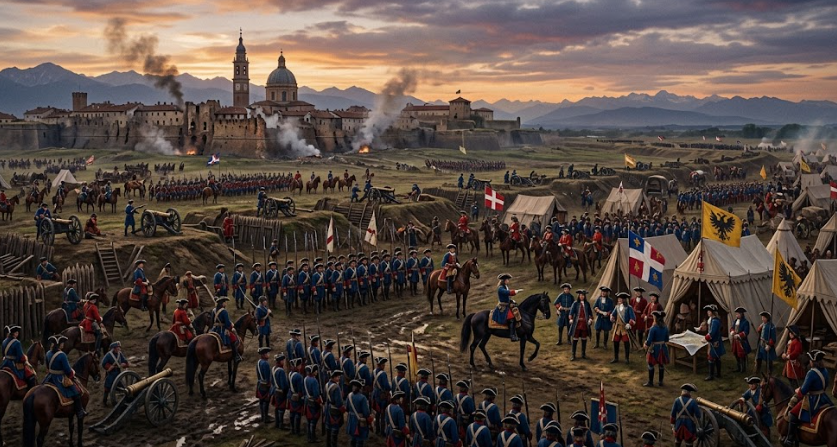
The siege of Turin of 1706 was the decisive episode of the War of the Spanish Succession in Italy: for almost four months the Franco-Spanish army besieged the capital of the Duchy of Savoy, defended by its garrison and by the House of Savoy, allied with the Habsburgs, until the battle of 7 September, fought between the Dora and the Stura, forced the besiegers into a disorderly retreat[1][2]. From that victory descend some of Turin's most deeply rooted symbols: the figure of the miner Pietro Micca, the Basilica of Superga, and, on the political plane, the royal title the Savoys obtained a few years later[3].
The context: a European war
The War of the Spanish Succession (1701-1713) pitted France and Spain, backing Philip of Bourbon, grandson of Louis XIV, against the Habsburg Empire, supported by England, the Dutch Republic, Portugal and Denmark[1]. Duke Victor Amadeus II, initially tied to France, switched to the Habsburg side in 1703[3], alongside his cousin Eugene of Savoy, a general in the emperor's service[1]. Louis XIV had already tried several times to seize the city, and the 1706 siege was the culmination of those attempts[4].
The heart of the defence was the Citadel, the fortress designed by Francesco Paciotto and commissioned by Emanuele Filiberto in the 16th century to protect and control the city[5]. Beneath it ran a network of countermine galleries: 20th-century excavations identified about 14 kilometres of them, of which 9 are passable[6].
May-August: bombardment and the war of the moles
On 13 May 1706 about forty thousand Franco-Spanish soldiers, under the command of the Duke de La Feuillade, arrived beneath the walls; the bombardment proper began on the night of 8-9 June[1]. Thousands of cannonballs, incendiary bombs and mortar shells fell on the city; on 25 July, the feast of Saint James, the Spanish fired twelve exceptionally large bombs from a special piece of ordnance[1]. Command of the stronghold was entrusted to the imperial field marshal Wirich von Daun, while artillery and mining operations were coordinated by Giuseppe Amico di Castellalfero[7].
On 17 June the duke left Turin with about four thousand horsemen, to harass the besiegers from outside and await the imperial reinforcements[1]. During the siege the court's art collections were moved to the basements of Palazzo Madama, considered the safest place, and the building works begun in the palace by the second Madama Reale came to a halt[8]. In the city, packed with soldiers, the chronicle recounts, the brothels of the Quadrilatero thrived while the taverns struggled[1].
Underground, the so-called war of the moles was being fought. On the night of 30 August some French grenadiers managed to approach the gallery leading into the stronghold; the miner Pietro Micca, having sent his companion away, set fire to the mine and died in the explosion, foiling the incursion[9]. The deed had no immediate resonance: the official report by the commander of the artillery, the Enciclopedia Italiana notes, «did not sufficiently bring out this heroism, which was neither recognized nor rewarded by his contemporaries as it deserved»[9]. In 1707 his widow requested a subsidy, recalling that her husband had been
«either ordered by the knight Castel Alfieri, colonel of the artillery battalion, or moved by the generosity of his own spirit to go and set fire to the said mine, notwithstanding the evident danger to his life»
The court granted her «two rations of bread» a day[7]. The myth of Micca as a national hero would grow only between the late 18th and 19th centuries[7].
Eugene's march and the battle of 7 September
Eugene of Savoy led the army from Ala, crossed the Adige by surprise near Piacenza d'Adige on 6 July 1706 and then the Po at Polesella, in a march the Enciclopedia Italiana judges extraordinarily rapid despite the heat and shortage of supplies[2]. At the end of August he joined up with Victor Amadeus at the head of about twenty thousand imperial troops[1]. According to the account by Mole24, the Austro-Savoyard forces fielded 24,000 infantry and 6,000 cavalry against 45,000 Franco-Spanish troops, reinforced by the arrival of Philippe of Orléans[1]; according to the Enciclopedia Italiana, on 6 September the two cousins had 30,000 men between the Stura and the Dora, facing 17,000 French troops in the sector of the attack[2].
On 7 September the attack, initially repulsed, managed to outflank the far right of the French line; a sortie by the garrison completed the rout, and the bulk of the besieging army fell back in headlong retreat[2]. Many fleeing soldiers drowned in the Dora[1]. The encyclopedia calls it a
«Great victory, a battle with the front entirely reversed, of a boldness bordering on recklessness.»
The battle, which ended in a Savoyard victory, brought the siege to a close[4][8].
From the Superga vow to the crown
According to the tradition reported by the national tourism portal, in the summer of 1706 Victor Amadeus, watching the French troops around the city from atop the hill of Superga, vowed to build a church on that height if his soldiers repelled the attack[10]. The design was entrusted to Filippo Juvarra, and the basilica, dedicated to the Virgin, was officially inaugurated on 1 November 1731[10].
The political consequences were long-lasting. The French defeat consolidated the duke's position in Italy, and the Treaty of Utrecht of 1713 recognized him as king of Sicily[3]; Turin thus also became the capital of that kingdom[5]. In 1720 the Savoys were forced to exchange Sicily for Sardinia[11], giving rise to the Kingdom of Sardinia, which would later lead the unification of Italy.
Memory today
The research of Colonel Pietro Magni brought to light the galleries of the mezzaluna del Soccorso, opened to the first visitors as early as 1913; later excavations by Captain Guido Amoretti uncovered the entire countermine system[6]. On 14 May 1961 the Pietro Micca and Siege of Turin of 1706 Civic Museum was inaugurated, at via Guicciardini 7/A, with a thematic route on the period and a visit to the galleries of the mezzaluna del Soccorso[6][12]. After closing for extraordinary maintenance that began on 26 February 2024, the museum reopened on 11 June 2024 with new window fittings, improved climate control, and the gallery floors resurfaced[12]. The miner's name has also survived in the city's street names, starting with via Pietro Micca, the 19th-century diagonal thoroughfare of the centre[13].
Pages that link here
- Alessandria
- Basilica of Superga
- Biella
- Chivasso
- Dora Riparia
- Emanuele Filiberto
- Filippo Juvarra
- Turin grissino
- Orbassano
- Palazzo Madama
- Piazza Castello
- Piedmont
- Pietro Micca
- Kingdom of Sardinia
- Turin
- Torino Football Club
- Venaria Reale
- Villa della Regina
- Victor Amadeus II
- "I Soldi dell'Assedio", numismatic exhibition at Turin's Historical Archive (2026)
The "I Soldi dell'Assedio" exhibition at the City's Historical Archive (September-November 2026)
For the 320th anniversary of the end of the siege, the Circolo Numismatico Torinese, in collaboration with the Historical Archive of the City of Turin, inaugurates on 25 September 2026 the exhibition «I Soldi dell'Assedio. La moneta a Torino nel 1706» ("The Money of the Siege: Currency in Turin in 1706"), hosted at the Archive's premises at via Barbaroux 32. The exhibition, under the patronage of the Piedmont Region, the Regional Council of Piedmont, the Metropolitan City of Turin and the City of Turin, with the support of the Fondazione CRT and the backing of the Pietro Micca and Siege of Turin of 1706 Civic Museum and the Associazione Amici del Museo Pietro Micca, tells the story of the siege through the coins Turin's citizens used to hold out and the medals that celebrated their victory.
On show is a selection of coins and medals from the coin collection of Palazzo Madama, including 5-soldi pieces minted by the Turin Mint during the siege with silver donated by citizens to pay the roughly 10,000 soldiers engaged in the defence. The exhibition, free of charge, is open Monday to Friday from 8.30 a.m. to 4.30 p.m. until 22 November 2026, with free guided tours every Thursday at 3 p.m. and 3.30 p.m.
Timeline
- — The exhibition «I Soldi dell'Assedio. La moneta a Torino nel 1706» opens at the Historical Archive of the City of Turin, marking the 320th anniversary of the end of the French siege, open to visitors until 22 November. TorinoClick TorinoToday
Related articles: Basilica di Superga, Biella, Filippo Juvarra, Pietro Micca, Vittorio Amedeo II, «I Soldi dell'Assedio», a numismatic exhibition at the Historical Archive of Turin (2026)
Sources
- Mole24 — 7 September 2013
- Treccani, Enciclopedia Italiana
- Encyclopaedia Britannica
- Treccani, Dizionario di Storia
- MuseoTorino
- Mole24 — 20 September 2021
- Treccani, Dizionario Biografico degli Italiani —
- Palazzo Madama – Museo Civico d'Arte Antica
- Treccani, Enciclopedia Italiana
- Italia.it (ENIT – Ministero del Turismo)
- Treccani, Dizionario di Storia
- TorinoClick — 4 June 2024
- Mole24 — 29 August 2017
- TorinoClick — 25 September 2026
- TorinoToday — 25 September 2026
- Il Torinese — 29 September 2026