Giorgetto Giugiaro
Car designer born in Garessio in 1938, founder of Italdesign in Moncalieri: his designs include the Golf, the Panda, the Uno and the DeLorean DMC-12.
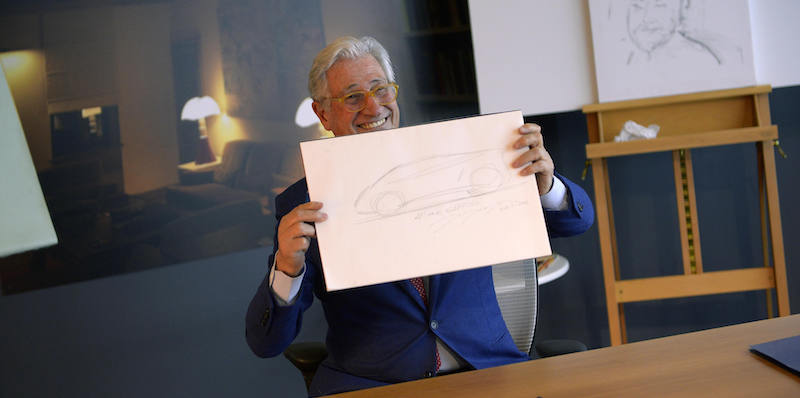
Giorgetto Giugiaro (Garessio, 1938) is a car and industrial-product designer, founder in 1968 in Moncalieri of Italdesign. Trained in Turin and shaped professionally between FIAT, Bertone and Ghia, he put his name to some of the most widespread cars of the late twentieth century, from the Volkswagen Golf to the Fiat Panda, and remains linked to the city as one of the names that made the Turin area a world capital of automotive style.[1][2]
From Garessio to Turin
He was born in Garessio, in the province of Cuneo, on 7 August 1938.[3][4] He came from a family of painters: his grandfather Luigi painted church frescoes, and his father Mario alternated sacred decoration with oil painting. Having moved to Turin, he left art studies for technical drawing, and it was at a school exhibition, in June 1955, that his sketches caught the attention of Dante Giacosa, FIAT's technical director. In September of that same year he joined the company's special-vehicles design office, led by Fabio Luigi Rapi.[2]
Bertone and Ghia
In December 1959 Nuccio Bertone put him in charge of his own styling centre.[2] These were the years of grand tourers designed for small and large marques alike: among them the Aston Martin DB4 GT Jet, unveiled at the 1961 Geneva Motor Show, which Giugiaro would not see again until November 2025, in London,[5] and an open-top version of the Bizzarrini 5300, born from the prototype Giugiaro designed at Bertone in 1962 and left in the archive, built only in 2026 in ten examples and unveiled at the Goodwood Festival of Speed.[6] In November 1965 he moved to head Ghia, where he ran the styling centre and the prototypes department.[2]
Italdesign and everyman's cars
On 13 February 1968, together with engineer Aldo Mantovani, he founded in Moncalieri the company Studi Italiani Realizzazione Prototipi, which would become Italdesign-Giugiaro.[2][7] His first major commission was the Alfasud for Alfa Romeo; the 1970s brought, for Volkswagen, the Passat, the Scirocco and the first Golf, as well as the Audi 80.[7] In 1974 he designed the Pony Coupé with which Hyundai debuted at the Turin Motor Show: the prototype was lost and was rebuilt in 2023.[8] That same year he began work on the DeLorean: the DMC-12, released in 1981, became famous as the car from the film Back to the Future.[7][3]
In Turin his name is tied above all to FIAT's compact cars. The 1980 Panda was designed "in record time" as a two-box, two-door compact with a tailgate and front-wheel drive;[9] the Uno, presented in January 1983 in the United States, was named 1984 Car of the Year and reached around nine and a half million units built worldwide.[10] The Croma, the Duna and the Punto followed, and for Lancia the Delta, the Prisma and the Thema.[4] In the Treccani encyclopaedia's judgement, his distinguishing trait is a
"sober and essentially functional line"
which also led him to work for BMW (the M1), Saab, SEAT and Renault.[1] With Italdesign, according to the Turin press's count, he put his name to more than two hundred models accounting for around fifty million vehicles on the road;[4] the European Union Intellectual Property Office, when honouring him, counted around sixty million.[11]
Beyond the car
From 1971 the studio had an industrial-design division, made independent in 1981 as Giugiaro Design; in 2003 Giugiaro Architettura was born.[1][7] From his drawing board came motorcycles, watches, furniture, cameras and even a pasta shape,[5] and in 2003 the organ of Lausanne Cathedral.[4] His biographical website sums up his idea of the profession like this:
«The role of design is to mediate between man and things»
The phrase appears alongside the figures the family claims: more than three hundred projects and over seventy client brands.[12] He also had a public role for the city: he chaired the promoting committee for the Olympic bid that led to the 2006 Turin Winter Olympics,[1] whose Games he also contributed to.[4]
Leaving Italdesign and GFG Style
In 2010 Volkswagen took over 90.1 per cent of Italdesign; in 2015 Giugiaro also sold the remaining 9.9 per cent and left all his positions.[1] In September of that same year he founded GFG Style with his son Fabrizio, which has two sites in Moncalieri and works as a research and development centre for the car industry.[2][8] Italdesign, meanwhile, passed in 2026 under the control of the company UST, with Audi retaining 40 per cent and Moncalieri confirmed as its headquarters.[13]
Awards and memory in Turin
He received the lifetime Compasso d'Oro in 1984 and for individual projects in 1981, 1991 and 2004; in 1999 he was made a Cavaliere del Lavoro (Knight of Labour)[1] and, that same year, "Car designer of the century" by a jury of 120 international journalists and experts.[2] In 2016 he received the lifetime achievement award at the DesignEuropa Awards, given by the same European office.[11]
The National Automobile Museum dedicated to him, from 25 November 2016 to 26 February 2017, the exhibition «Giugiaro e il suo percorso» ("Giugiaro and his journey"), with cars, paintings and sketches,[14] and presented him with the first Matita d'oro (Golden Pencil), at an evening hosted by Piero Chiambretti before more than four hundred guests.[15] In 2025 his DeLorean returned to the centre of «Ritorno al futuro. Prototipi di tempo» ("Back to the Future. Prototypes of Time"), the exhibition with which the museum opened up to contemporary art.[16] On 29 January 2026, again at MAUTO, Giugiaro met Ferrari's head of design Flavio Manzoni in a public conversation,[17] in which the two defended hand drawing in the face of virtual design and artificial intelligence.[18]
Pages linking here
Related articles: Italdesign Giugiaro, National Automobile Museum
Sources
- Treccani
- Giorgetto & Fabrizio Giugiaro
- Il Post — 7 August 2018
- Mole24 — 7 August 2018
- GFG Style — 15 November 2025
- GFG Style — 8 July 2026
- Italdesign
- GFG Style
- Stellantis Heritage
- Stellantis Heritage
- EUIPO
- Giorgetto & Fabrizio Giugiaro
- Mole24 — 11 September 2026
- GFG Style — 26 November 2016
- GFG Style
- Artribune — 11 October 2025
- AutoAppassionati — 30 January 2026
- GFG Style — 30 January 2026