Carmagnola
A municipality in the Po plain south of Turin: a stronghold of the Marquises of Saluzzo, the hemp capital, homeland of the Count of Carmagnola and of the Pepper Fair.
Carmagnola is a municipality in the Metropolitan City of Turin, set in the plain on the right bank of the Po, some thirty kilometers upstream from Turin.[1] For nearly three and a half centuries it was a stronghold of the Marquisate of Saluzzo, later a border town contested between France and the House of Savoy; in the twentieth century it was Piedmont's hemp capital, and today it is best known for its pepper. Its name traveled farther than the town itself: it is borne by a condottiero beheaded in Venice, by a jacket, and by a song of the French Revolution.
From the Marquisate of Saluzzo to the Savoys
Perhaps already a settlement of the Vagienni and later a Roman pagus, Carmagnola took on the character of a town around the year 1000. It passed from the counts of Auriate to the marquises of Romagnano and then to the Del Carretto family, until around 1200 it came under the orbit of the Marquises of Saluzzo, who held it until 1548.[1] The most important monuments in the town center survive from that long Saluzzo period. Casa Cavassa, at the corner of Via Valobra and Via Benso, is the fifteenth-century palace built for Enrico Cavassa, a member of a family that rose to the highest political offices of the marquisate; it is privately owned and not open to visitors.[2] The collegiate church of Santi Pietro e Paolo, in Piazza Verdi, was built between 1492 and 1514 by the architect Giorgino Costanza di Costigliole; the façade, originally of exposed brick, was rebuilt in 1894, while inside the Chapel of the Immaculate Conception stands out.[3]
The wars of the sixteenth century were extremely harsh for the town, bringing assaults, sackings and severe epidemics. After the Battle of Ceresole in 1544 Carmagnola fell into French hands, and only in 1588 was it stormed by Carlo Emanuele I of Savoy. The sieges conducted by Marshal Catinat in 1690-1691 marked its end as a fortress: in 1694 its defenses were dismantled and the town lost all military importance, while remaining an agricultural, commercial and cultural center.[1]
Churches and abbeys
The church of Sant'Agostino was built between 1406 and 1437 for the Augustinians, who had been invited to the town in 1397; plague delayed the start of construction by several years. It retains Gothic forms in the apse, the eastern flank and the bell tower, a Renaissance marble portal carved in 1496 by the Florentine Amedeo da Settignano, four naves 45 meters long, and a fifteenth-century wooden choir restored in 1999. In the fifteenth and sixteenth centuries it was also the civic hub of the town: the municipal council held its general assemblies in the adjoining convent, and from 1438 the bell tower housed the town clock and the municipality's great bell; the vow to the Immaculate Conception made during the epidemics of 1522 and 1630 is still renewed every 8 December. The building is closed for restoration funded by PNRR funds.[4]
Outside the town center stands the Cistercian abbey of Santa Maria di Casanova, founded around 1150 and considered one of the earliest examples of Gothic architecture in Piedmont. Of the original complex only the church survives, remodeled in the Baroque period with its façade rebuilt in 1680; it is open on Sundays and public holidays.[5]
The Jewish community
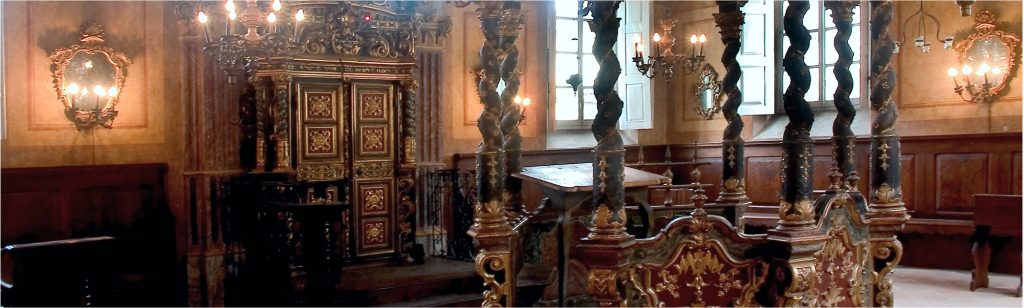
Carmagnola had one of Piedmont's historic Jewish communities. When in 1723 the decrees of Victor Amadeus II extended the ghetto requirement to the whole state, the small group of Jewish families was concentrated in the Cerchie block, between what are now Via Bertini, Via Cherche, Via Benso and Via Baldessano; the group grew in 1737 with the arrival of Jews from Racconigi. The synagogue, at Via Bertini 8, occupies the top floor of a building that, according to the Comunità Ebraica di Torino, stands there "with no outward feature revealing its presence." Inside, with a central plan and in Baroque style, are the tevah under a lacquered wooden canopy dated 1766, the aron decorated with symbols of the Temple of Jerusalem, and painted cartouches bearing the donors' names. The first burial ground is documented from 1599 in the Zucchetta area, behind Sant'Agostino; since 1863 burials have taken place in a separate section of the municipal cemetery.[6]
The Count of Carmagnola, the jacket and the song
Francesco Bussone was born in Carmagnola around 1385, the condottiero who went down in history under the name of his town. Raised in the service of Facino Cane, after the latter's death he served Filippo Maria Visconti, who had married Facino's widow Beatrice di Tenda: he contributed to rebuilding the Visconti state and was governor of Genoa from 1422 to 1424. In 1425 he entered the service of Venice, and on 12 October 1427 he defeated the Visconti forces at Maclodio. His increasingly lackluster conduct of the war, however, fueled rumors of secret dealings with the Duke of Milan: arrested and tried, he was sentenced to death and beheaded in Venice in 1432.[7]
In the eighteenth century the town's name reached Paris with Piedmontese emigrants: the "carmagnole" was a short-skirted jacket, worn in 1792 by the Marseille federates when they entered the capital, which thus became a symbol of equality. The same name was later given to the song danced by the people around the trees of liberty during the Revolution.[8]
Hemp and countryside
The Carmagnola territory is flat and largely irrigable. In 1931 the Enciclopedia Italiana counted 11,987 inhabitants, of whom only 3,842 in the main town, and described an economy built on wheat, maize, mulberry trees and silkworms, paper mills, spinning mills, dairies and mechanical workshops. The leading product was hemp:[1]
"the hemp seed of Carmagnola is highly prized, and is the subject of extensive trade abroad as well"
That era is recounted today by the Ecomuseo della Cultura della Lavorazione della Canapa, part of the network of municipal museums together with the Museo Civico di Storia Naturale, the Museo Civico Navale, the Museo Tipografico Rondani, the synagogue, Palazzo Lomellini and the sacred art museum of the Casanova abbey.[9]
The National Pepper Fair
Today the town's signature product is the Carmagnola pepper, grown according to a strict production code in five different ecotypes, the star of the National Pepper Fair, which in late summer occupies Piazza Mazzini, Piazza Sant'Agostino and the former cattle market of Piazza Italia for ten days and closes with a giant peperonata cooked by volunteers from the Pro Loco.[10] Its appeal is not only local: the 77th edition, held from 28 August to 6 September 2026, with more than three hundred stands, drew around 350,000 visitors, a figure that is still provisional. For Mayor Ivana Gaveglio, at the end of ten years in office, the event "has grown by strengthening its own identity and opening up more and more to the surrounding area."[11]
Pages linking here
- Appeal Against the Light Beam at Sacra di San Michele
- Bagna càuda
- Città metropolitana di Torino
- Elena Patriarca
- Experimenta::::::2001
- Incidente stradale sull'autostrada A6 tra Marene e Carmagnola (7 ottobre 2026)
- Piedmontese Theriological Station
- Three stadium bans over clashes at the Asr Elledi-Asdc Bisalta Under-15 match (18 April 2026)
Three Daspo bans over clashes at the Under-15 match on 18 April 2026
The Chief of Police of Turin issues three Daspo banning orders over clashes between rival supporters that took place on 18 April 2026 at the end of a provincial Under-15 championship match between Asr Elledi and Asdc Bisalta, played at the Giorgio Demichelis sports center in Carmagnola.
Daspo bans over clashes at a youth Under-15 match (October 2026)
Chronology
- — The Chief of Police of Turin issues three Daspo banning orders over clashes between rival supporters that took place on 18 April at the end of a provincial Under-15 championship match between Asr Elledi and Asdc Bisalta at the Giorgio Demichelis sports center in Carmagnola. → ANSA Piemonte TorinoToday
Related articles: Three stadium bans over clashes at the Asr Elledi-Asdc Bisalta Under-15 match (18 April 2026)
Sources
- Treccani – Enciclopedia Italiana —
- Comune di Carmagnola
- Comune di Carmagnola
- Comune di Carmagnola
- Comune di Carmagnola
- Comunità Ebraica di Torino
- Treccani – Enciclopedia on line
- Treccani – Vocabolario
- Città di Carmagnola – Carmagnolamusei
- Il Carmagnolese — 25 August 2026
- Il Carmagnolese — 8 September 2026
- ANSA Piemonte — 1 October 2026
- TorinoToday — 1 October 2026
- Quotidiano Piemontese — 1 October 2026