Torino Film Festival
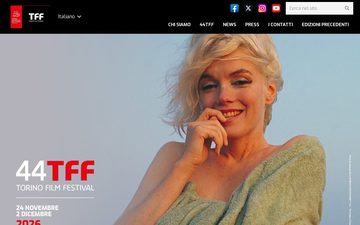
The Torino Film Festival (TFF) is the international film festival held every year in Turin between November and December. Founded in 1982 as the Festival Internazionale Cinema Giovani and renamed with its current title in 1998, it has become known as a showcase for debut and independent films, introducing Italian audiences to directors who later became masters of the craft[1]. It is produced by the National Museum of Cinema, which also organizes CinemAmbiente, the Lovers Film Festival and the TorinoFilmLab[2][3][4].
The origins: the Festival Cinema Giovani
The initiative came from a group of Turin intellectuals including the film historian Gianni Rondolino, the director Ansano Giannarelli and the philosopher Gianni Vattimo[1]. Rondolino and Giannarelli jointly directed the first edition, conceived as[2]
«a metropolitan festival linked on one hand to critical reflection and on the other to developments in cinematic language»
Its roots lay in university film teaching and in the city's cinephile associations, in particular AIACE and the Movie Club[2]. Rondolino taught Film History and Criticism at the University of Turin, was a critic for La Stampa and the author of a nearly 800-page film history textbook, in use since 1977 and nicknamed «il Rondolone» by students; he died in Turin on 9 January 2016[5].
The first edition ran from 25 September to 3 October 1982 and was non-competitive: it offered a panorama of international cinema with debut works, a «Spazio aperto» section for independent productions, a retrospective on 1960s Italian cinema and a tribute to the American director Amos Poe; the program included, among others, À toute allure by Robert Kramer and Finyé by Souleymane Cissé[1].
Competition, awards and discoveries
The competitive section arrived with the fourth edition, in 1987: the first jury, chaired by the ethnologist and filmmaker Jean Rouch, awarded the prize jointly to Esther by Amos Gitai and Noir et blanc by Claire Devers. The audience award, named after Achille Valdata, has existed since 1988, and the Cipputi award, reserved for films about the world of work, since 1996; in 2002 Satin rouge by the Tunisian director Raja Amari was the first African film to win in Turin[1].
Over the years the festival has presented early works by filmmakers such as Jane Campion, Chen Kaige, Tsai Ming-liang, Hou Hsiao-hsien, Jim Jarmusch and Takeshi Kitano, with constant attention to Asian cinema[1]. The festival itself recalls having introduced Italian audiences to the first works of Pablo Larraín, Paolo Sorrentino, Pietro Marcello, Gabriele Muccino, Matteo Garrone, Jafar Panahi and Bryan Singer[2]. Equally characteristic are its retrospectives, devoted among others to the Nouvelle Vague, New German Cinema, John Carpenter, George Romero, Manoel de Oliveira, Aleksandr Sokurov, William Friedkin, Roman Polanski, Wim Wenders and the Turin documentary filmmaker Paolo Gobetti[2].
The directors
Rondolino led the festival until 1988; from 1989, when he became its president, direction passed to Alberto Barbera, who came from AIACE and held the role until 1998[1][2]. He was followed by Steve Della Casa (1999-2002) and then, from 2003, by the pair formed by Roberto Turigliatto and Giulia D'Agnolo Vallan, linked to the Movie Club[1][2].
From the mid-2000s the festival's direction was also entrusted to filmmakers: Nanni Moretti directed the 25th edition, from 23 November to 1 December 2007[6], and after him came Gianni Amelio and Paolo Virzì, alternating with the critics Emanuela Martini and Stefano Francia di Celle[2]. In 2022 Della Casa returned for the 40th and 41st editions[2].
On 12 July 2023 the Museum's management committee chose as his successor the Turin-born director and actor Giulio Base, born in 1964, who holds a degree in literature with a thesis in film history and criticism and a degree in theology, and who has made 29 feature films[7][8]. The appointment came with a clarification from the Museum's president, Enzo Ghigo: the choice, he said, «was made solely on the basis of the candidate's merits and was in no way influenced by external considerations»[7].
The Base era
Base's first edition, the 42nd, opened on 22 November 2024 at the Teatro Regio with the presentation of the Stella della Mole, the festival's award, to Ron Howard, Matthew Broderick, Sharon Stone, Giancarlo Giannini and Rosario Dawson; in the following days guests expected included Angelina Jolie, Alec Baldwin, Emmanuelle Béart and Ornella Muti[9].
The 43rd edition ran from 21 to 29 November 2025[3]. The award for best film, which comes with a prize of 20,000 euros, went to The Garden of Earthly Delights by Morgan Knibbe; the best documentary was Seeds by Brittany Shyne[10].
Today
The festival is based at via Cagliari 34/c, in the offices of the National Museum of Cinema[2]. The 44th edition, scheduled from 24 November to 2 December 2026, is the third in a row directed by Base and is dedicated to Marilyn Monroe on the centenary of her birth[3][10]. In July 2026 the president, Ghigo, and the Museum's director, Carlo Chatrian, confirmed Base for 2027 and 2028 as well, with the aim of ensuring «stability and continuity in the leadership of its main cultural events»[11]. The official website publishes the program, the archive of past editions and a searchable catalogue of the films presented[3].
Pages linking here
- Annuncio della 42ª edizione del Lovers Film Festival e di EuroPride 2027 a Torino
- Francesca Archibugi
- Francesca Archibugi to Chair Jury at 2026 Torino Film Festival
- National Museum of Cinema
- Paolo Conte
Related articles: National Museum of Cinema
Sources
- Treccani — Enciclopedia del Cinema —
- Torino Film Festival
- Torino Film Festival
- Museo Nazionale del Cinema
- Il Post — 9 January 2016
- Torino Film Festival
- ANSA — 12 July 2023
- Artribune —
- Sky TG24 — 22 November 2024
- Sky TG24 — 29 November 2025
- ANSA — 30 July 2026