Fausto Coppi
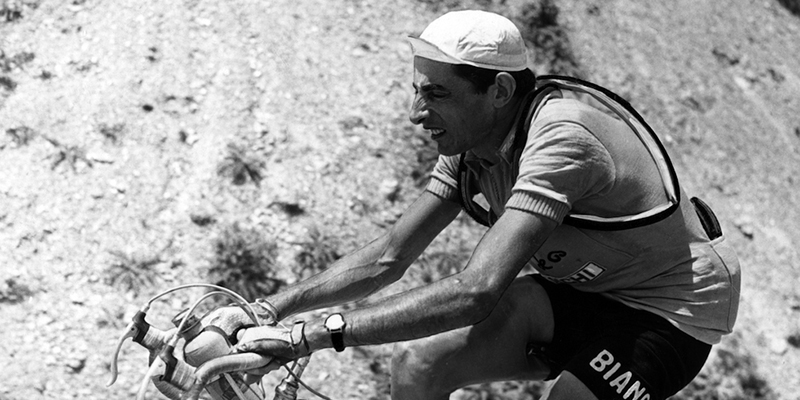
Fausto Coppi (Castellania, 15 September 1919 – Tortona, 2 January 1960) was a road and track cyclist, considered one of the greatest of all time. Born in the hills of the Tortonese, in the province of Alessandria, he won five Giri d'Italia, two Tours de France, one world road race championship, and set the hour record[1]. He is perhaps the most celebrated athlete born in Piedmont, and his most famous feat took place precisely in the Piedmontese Alps, between Cuneo and Pinerolo.
From the hills of the Tortonese to his first Giro
The fourth child of Domenico Coppi and Angiolina Boveri, small landowning farmers, he went to work at thirteen as an errand boy in a delicatessen in Novi Ligure. His daily rides between Novi and his home village, along with tales of the exploits of Costante Girardengo, drew him to cycling. He was noticed by Biagio Cavanna, who ran a cycling school in Pozzolo Formigaro and who for many years acted as his masseur and advisor[2].
His first victory came in 1937 at Boffalora, when he was still racing without a license; in 1939, among the independents, he won the Giro del Penice and the Coppa Città di Pavia, and came third in the Giro del Piemonte behind Gino Bartali[2]. Signed by Legnano in 1940, while still serving in the military, he surprisingly won the Giro d'Italia with a margin of 2'40" over Enrico Mollo[2]: he was the youngest winner in the race's history[3]. Journalist Orio Vergani described him at the time as a boy «as thin as a mountain ham bone»[3].
The hour record and the war
In the following years Coppi dominated track pursuit racing, and on 7 November 1942, at the Vigorelli velodrome in Milan, he covered 45.871 kilometers in one hour, a world record later ratified and corrected to 45.798 kilometers[2]. The record did not spare him from the front: sent to Tunisia, he was taken prisoner on 13 April 1943 in the plain between Mateur and Medjez-el-Bab. He returned to Italy in February 1945, suffering from malaria and a gastric ulcer[2].
Coppi and Bartali
Having moved to Bianchi, he resumed racing in 1946 by winning the Milan–Sanremo[2] with a fourteen-minute lead[3]; radio commentator Niccolò Carosio ended his live broadcast by announcing dance music while waiting for the second-place finisher[3]. On 5 May that same year Bartali beat him in a sprint finish at the Zurich championship: it was the start of a bitter rivalry that would mark the entire postwar period[2]. In 1947 Coppi won his second Giro, finishing ahead of the Tuscan rider, as well as the Grand Prix des Nations in Paris and the world pursuit championship[2][4].
The 1949 Cuneo–Pinerolo stage
On 10 June 1949 the Giro d'Italia tackled its seventeenth stage, from Cuneo to Pinerolo: 254 kilometers to connect two towns barely fifty kilometers apart, crossing into France over the Col de la Maddalena, Col de Vars, Col d'Izoard, Col du Montgenèvre, and finally the Sestriere, often on unpaved roads[5]. Coppi broke away alone already on the first climb and reached Pinerolo in just over nine hours; Bartali, who finished second, arrived nearly twelve minutes later[5]. Mario Ferretti's radio commentary entered everyday language:
«A lone man in the lead, his jersey white and sky blue, his name is Fausto Coppi.»
Following the race was also the writer Dino Buzzati, who described the defeated Bartali thus: «Someone from the roadside greeted him. And he, turning his head slightly that way, smiled—the surly, standoffish, disagreeable, intractable bear with his eternal scowl of discontent, he himself smiled.»[5] That Giro was his, and a few weeks later Coppi also won the Tour de France, making up around half an hour he had lost in the early stages: no one before him had won both races in the same year[6][2]. It was then that the press crowned him «campionissimo»[2], and Gianni Brera described his physique as «an invention of nature to complete the rather modest mechanical ingenuity of the bicycle»[3].
Falls, losses, and final victories
The following years alternated between triumphs and accidents. In 1950 a fall fractured his pelvis; on 11 March 1951, during the Milan–Turin, he broke his collarbone; on 29 June of the same year his brother Serse, his teammate at Bianchi, crashed at the finish of the Giro del Piemonte and died a few hours later from a cerebral hemorrhage[2]. The accident happened in Turin, just a few hundred meters from the finish line at the Motovelodromo on Corso Casale, when one of his bicycle wheels got caught in a tram track[7]. Serse had won the 1949 Paris–Roubaix[8].
In 1952 Coppi repeated the Giro-Tour double[2], also winning five stages in France[6]. In 1953 he claimed his fifth and final Giro, turning the race around on the Stelvio Pass, which he was tackling for the first time: at the summit he held nearly a five-minute lead over the Swiss rider Hugo Koblet, and he took the pink jersey from him at Bormio, on the second-to-last stage[9]. A few months later, in Lugano, he won the world road race championship by 6'16" over Belgium's Derijke[2][3]. All of his Giro victories, except the first, came while riding for Bianchi[10].
The «Dama Bianca» and his death
On the podium of that world championship appeared Giulia Occhini, the woman with whom Coppi was having an affair and whom the newspapers called the «Dama Bianca» (White Lady). In 1954 the champion left his wife Bruna Ciampolini to go live with her in a villa near Novi: a public scandal ensued, with legal complaints and the arrest of Occhini; and on 14 March 1955 the court of Alessandria sentenced Coppi to two months in prison and her to three for failing to meet family support obligations, with the sentences suspended[2].
His last major individual victory was the Grand Prix of Lugano time trial, in October 1956. In November 1959 he signed with San Pellegrino, the team directed by Bartali. On 10 December he left for Ouagadougou, in Upper Volta, for a criterium race and some hunting; upon his return, he fell ill with malaria that was mistaken for the flu, and died at the hospital in Tortona on 2 January 1960. A huge crowd gathered for his funeral in Castellania on 4 January[2].
Legacy
The Dizionario Biografico degli Italiani cites the view of Giancarlo Bocca, for whom Coppi was one of the few «possible demigods» of the difficult postwar years: a hero within everyone's reach, because he rode a bicycle, the vehicle that even the poor could afford[2]. Eddy Merckx summed up the difference between their careers this way: «His victories became fiction, mine became news»[3]. On 25 March 2019, for the centenary of his birth, the Regional Council of Piedmont approved changing the name of his birthplace, which has since been called Castellania Coppi[8].
Pages linking here
Related articles: Cuneo, Pinerolo
Sources
- Treccani
- Treccani - Dizionario Biografico degli Italiani
- Il Post — 15 September 2019
- Treccani - Enciclopedia Italiana, II Appendice
- Il Post — 10 June 2019
- Il Post — 28 July 2014
- Quotidiano Piemontese — 29 June 2021
- Il Post — 25 March 2019
- Il Post — 2 June 2023
- Giro d'Italia (RCS Sport)