Sestriere
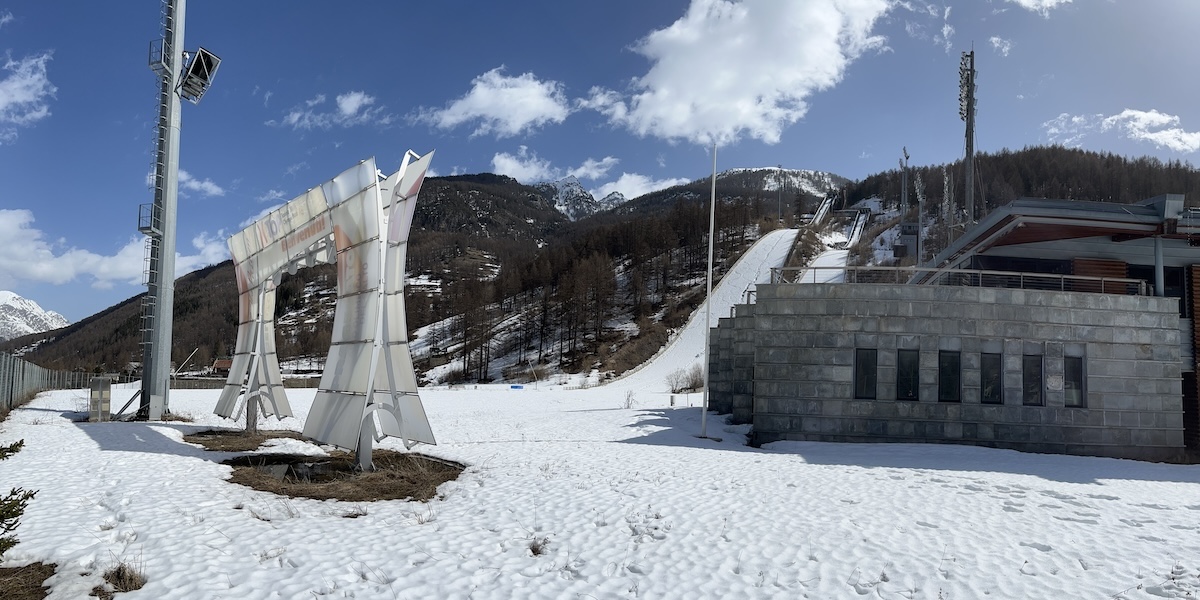
Sestriere is a municipality in the Metropolitan City of Turin in the upper Chisone valley, straddling the pass of the same name at 2,035 metres, between Monte Fraitève and Monte Sises. The municipal area covers 25.8 square kilometres and had 886 inhabitants in 2008; the town is one of the leading winter sports destinations in the entire Alpine arc: its lift system connects it to Sportinia, Sauze d'Oulx, San Sicario, Claviere and the French resort of Montgenèvre within the Via Lattea ski area[1]. For Turin it is the mountain built to order: created in the 1930s at the behest of the Agnelli family, it later hosted Ski World Championships and the 2006 Winter Olympic Games.
The pass before the resort
The pass had been known since antiquity and appeared in the Middle Ages under the name Petra Sistraria: it connected the Chisone valley with the upper Dora Riparia valley, towards Cesana and Montgenèvre. An obelisk still commemorates the opening of the carriage road in 1814[1]. In 1936 the Enciclopedia Italiana still described it as a broad depression of pastureland with a few patches of larch, crossed by the road that ran from Pinerolo, 55 kilometres away, to meet the Montgenèvre road at Cesana Torinese[2].
The Agnelli idea and the towers
The transformation began in the early 1930s. Giovanni Agnelli, founder of FIAT, took an interest in building hotel complexes in the area[3], and the project was entrusted to the engineer Vittorio Bonadè Bottino, who worked on it between 1931 and 1936. His biographer in the Dizionario Biografico degli Italiani links the initiative to «G. Agnelli's attention to the problems of mass tourism, as a solution to the demands of leisure time»[4].
Altitude and frost dictated the design. Excavating the ground was difficult, and the plumbing had to be gathered into just a few load-bearing columns to prevent freezing: the result was a round tower building, a sort of large dormitory for skiers. Inside, a helical staircase, modelled on those at the Lingotto and attributed by Bonadè himself to Agnelli's idea, gave access to the rooms; at the top an eighteen-sided skylight let in daylight and cut running costs[4].
«The high altitude of the settlement, the difficulties of excavating the ground, the need to build the sanitary facilities around just a few load-bearing columns (to avoid freezing problems) led to the design of a round tower-shaped building, a sort of large dormitory for skiers.»
The model proved successful: Bonadè reused it for the seaside colony of Apuania in 1933 and for the mountain colony of Oulx in 1936[4].
The cable cars and the new municipality
Along with the hotels came the lift systems, built by the German firm Adolf Bleichert & Co. of Leipzig (the last one by the company that succeeded it). The first cable car, completed between 1931 and 1932, climbed 1,803 metres to Monte Sises with a 562-metre rise and cabins for 36 people; in 1933 came the one to Monte Banchetta, 2,730 metres long; in 1938 the one to Fraitève, 2,520 metres long with a 639-metre rise[5].
The new resort soon had its own administration too. The municipality of Sestriere was established by royal decree on 18 October 1934, joining the former municipalities of Sauze di Cesana and Champlas du Col together with some hamlets of Pragelato, covering 108.3 square kilometres with 571 inhabitants at the 1931 census[2]. Two years later the Enciclopedia Italiana was already recording its fame: «In recent years the pass has become one of the most famous tourist destinations in Europe, above all for skiing»[2]. Besides the ski slopes there were a golf course and a skating rink; visitors arrived by car from the station at Oulx, in the Susa Valley on the Turin–Modane railway, or from Perosa Argentina, the terminus of the electric tramway from Pinerolo[2].
World Championships and Olympics
The 1997 Alpine Skiing World Championships were held on the slopes of the pass, dominated for Italy by Deborah Compagnoni, who won both the giant slalom and the slalom[6].
Nine years later the town was one of the mountain municipalities of the 2006 Turin Winter Olympics, held from 10 to 26 February together with Pinerolo, Torre Pellice, Prali, Pragelato, Claviere, Cesana-San Sicario, Bardonecchia, Sauze d'Oulx and Chiomonte[7]. The Regional Council's plan called for a 1,200-bed village at Sestriere, the upgrading of the Trebials chairlift to a capacity of 2,400 people per hour, the replacement of the old Garnel ski-tow, and an underpass beneath the Motta ski-tow to avoid crossing the slopes; Sestriere also housed one of the two control rooms of the new weather service, alongside the one in Turin[8]. Unlike the ski jumps at Pragelato and the bobsleigh track at Cesana, abandoned after just a few years, here the legacy has been absorbed: the Olympic village, like the one at Bardonecchia, was converted into a hotel and remains in use today, and the Games left behind new lift systems and gondola cableways[9].
Today
Sestriere has remained a venue for major sport beyond skiing too. On 23 May 2010 the twenty-eight players called up by Marcello Lippi for the national football team, then reigning world champions, met at La Venaria Reale to begin the Sestriere training camp ahead of the World Cup in South Africa; the schedule then called for a further gathering at the Grand Hotel Sestriere on 31 May[10]. The coach said he did not feel «the weight of being reigning champions: we'll try again and we'll do it with the same enthusiasm as 4 years ago»[10].
Altitude also has its price. On the evening of 8 January 2018 an avalanche struck an apartment building on Via III Reggimento Alpini and entered a ground-floor flat; no one was hurt, but firefighters and carabinieri had to shovel snow to evacuate the flats of five families, while the roads towards Cesana and the state road through the Chisone valley between Pragelato and the pass remained closed due to avalanche risk[11].
Pages linking here
- Bardonecchia
- Centesimo anniversario della Squadra di Montagna della Croce Verde di Torino
- Claviere
- Cuneo
- Fausto Coppi
- Fenestrelle Fort
- Inalpi Arena
- Lancia
- Olimpiadi invernali di Torino 2006
- Pinerolo
- Sauze d'Oulx
- Sci Club Sestriere
- Via Lattea (ski area)
Related articles: Bardonecchia, FIAT, Giovanni Agnelli (1866–1945), Inalpi Arena, Olimpiadi invernali di Torino 2006, Sauze d'Oulx
Sources
- Treccani
- Treccani – Enciclopedia Italiana (1936) —
- Treccani – Dizionario Biografico degli Italiani
- Treccani – Dizionario Biografico degli Italiani
- von Bleichert (archivio storico della ditta)
- Treccani
- Treccani – Enciclopedia dello Sport
- Consiglio regionale del Piemonte
- Il Post — 28 March 2024
- FIGC — 23 May 2010
- Il Post — 9 January 2018