Giuseppe Luigi Lagrange
Mathematician born in Turin in 1736, co-founder of the Academy of Sciences, author of the Mécanique analytique; he worked in Berlin and Paris.
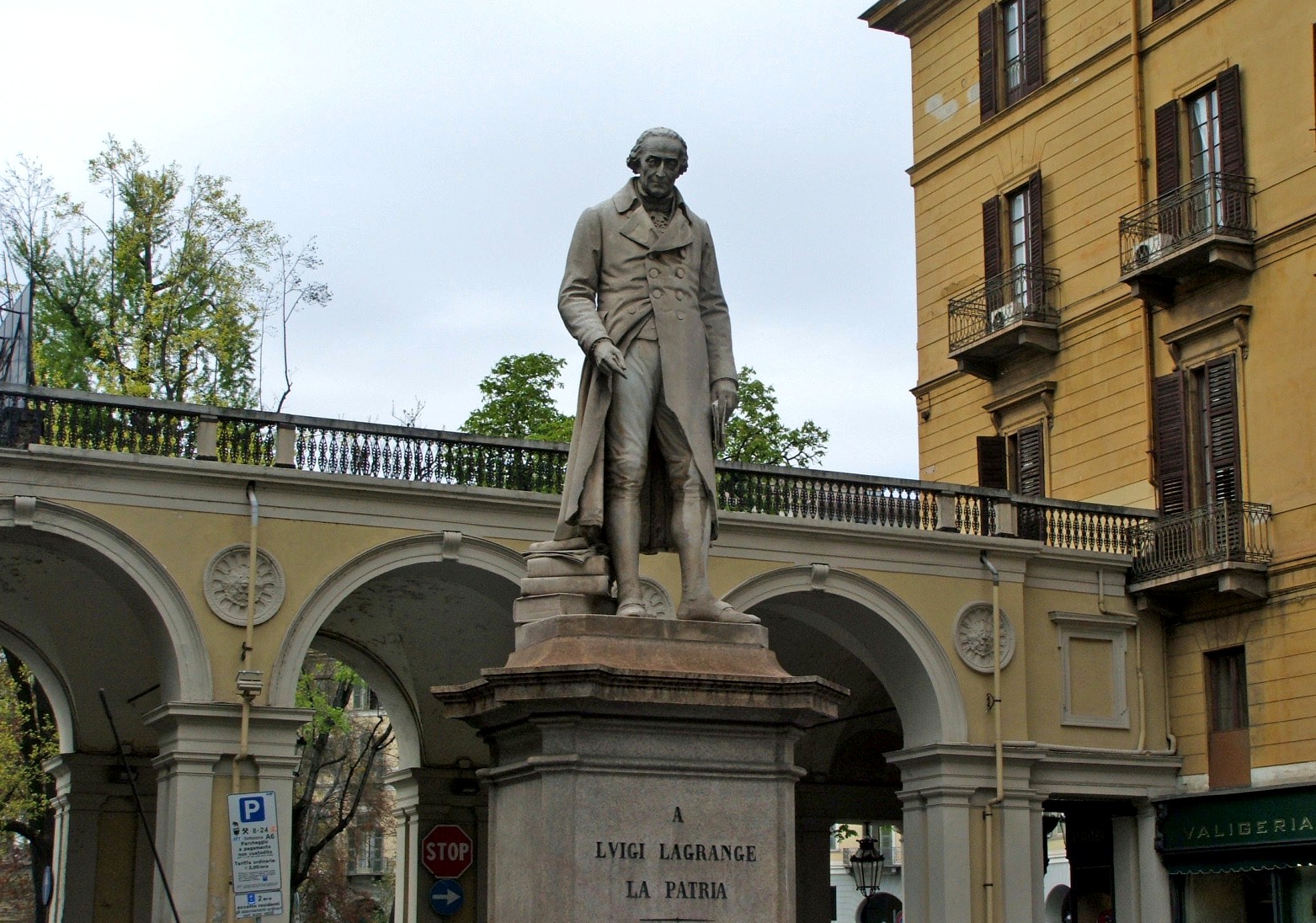
Giuseppe Luigi Lagrange, known in France as Joseph-Louis Lagrange (Turin, 25 January 1736 – Paris, 10 April 1813), was one of the greatest mathematicians of the eighteenth century, author of the Mécanique analytique and one of the founders of the calculus of variations[1]. Born and educated in Turin, he taught there until the age of thirty and, with other scholars, founded the scientific society from which the Academy of Sciences later grew; he then worked for twenty years in Berlin and for more than a quarter of a century in Paris, where he is buried in the Panthéon[1][2]. The family surname was originally Lagrangia[3].
A Turin family of French origin
The eldest of eleven children of Giuseppe Francesco Lodovico and Teresa Gros (Grosso according to MacTutor), he belonged to a family originally from the region of Tours: his great-grandfather had served in the armies of Louis XIV before entering the service of Carlo Emanuele II, Duke of Savoy[1][3]. His father was treasurer of the Office of Public Works and Fortifications of the Savoy state; of the many children, only two reached adulthood[3]. Lagrange himself said that, had he been rich, he probably would not have devoted himself to mathematics[3].
As the eldest son he was destined for the law. At fourteen he enrolled at the University of Turin, but soon began frequenting the university library to pursue his favourite studies, and in 1752 he abandoned law for mathematics[1]. At the Collegio di Torino his teachers included the physicist Giovanni Battista Beccaria[3]. His first printed work, in July 1754, was a letter to the mathematician Giulio Carlo de' Toschi di Fagnano, who had encouraged him; on the title page the author described himself as "Luigi de La Grange Tournier, of Turin"[1][3]. On 12 August 1755 he submitted to Euler his "method of variations" for problems of maxima and minima[1].
The Artillery Schools and the birth of the Academy
From 1755 he taught mathematics at the Royal Artillery Schools of Turin, where officers of the army of the Kingdom of Sardinia were trained: according to MacTutor he was appointed professor on 28 September 1755, at nineteen; according to the Dizionario Biografico degli Italiani he was an assistant in the mathematics course[2][3][1]. For his students he wrote textbooks on analytic geometry and differential calculus[1].
In 1757, together with Count Giuseppe Angelo Saluzzo di Monesiglio, the physician Gianfrancesco Cigna and others, he founded a "private society" that met at the Saluzzo household and pursued mathematical and natural-historical research[1]. In 1760 it became the "Royal Society" and in 1783, under the protection of the House of Savoy, the Academy of Sciences of Turin, the institution that still bears that name today[1][2].
The society published the Miscellanea philosophico-mathematica Societatis privatae Taurinensis, also known as the Mélanges de Turin[1][3]. In the first volume, of 1759, three memoirs by Lagrange appeared, including the Recherches sur la nature et la propagation du son, a genuine monograph on sound; in the second (1760–61) appeared the Essai d'une nouvelle méthode pour déterminer les maxima et les minima des formules intégrales indéfinies, in which Euler's procedure was simplified and generalised with the new formalism of "variation"[1]. These memoirs, together with two prizes from the Académie des sciences in Paris, made his name known to scholars across Europe[2].
Berlin: Euler's post
When in 1766 Euler left Berlin to return to Saint Petersburg, Frederick II of Prussia, on d'Alembert's recommendation, offered the post to the young Turinese[1][3]. Lagrange at first declined, observing that Berlin would not suit him while Euler remained there, and accepted only once Euler's departure became certain[3]. He left Turin in August, never to return: the journey included stops in Paris and London and a sea crossing to Hamburg[1]. He arrived in Berlin on 21 October and on 6 November took up the post of director of the mathematics class of the Academy[1][3].
In twenty years in Berlin he published around eighty memoirs on algebra, analysis, number theory, mechanics and astronomy; the Réflexions sur la résolution algébrique des équations (1770–71) are regarded as a fundamental milestone in the history of algebra[1]. In Berlin he married a relative, Vittoria Conti[1].
Paris: analytical mechanics and the metre
In 1787 he moved to Paris and joined the Académie des sciences as a "pensionnaire vétéran"[1]. The following year, edited by the Abbé Marie, the Mécanique analytique appeared, reducing mechanics to a branch of analysis founded on the principle of virtual velocities[1]. The preface stated the programme bluntly:
«On ne trouvera point de figures dans cet ouvrage. Les méthodes que j'y expose ne demandent ni constructions, ni raisonnements géométriques ou mécaniques, mais seulement des opérations algébriques, assujetties à une marche régulière et uniforme.»
("No figures will be found in this work. The methods I set out here require neither constructions nor geometrical or mechanical reasoning, but only algebraic operations, subject to a regular and uniform procedure.")[2]. The work remained the foundation of all later analytical mechanics[4].
With the Revolution he was called, in 1790, to the commission charged by the Constituent Assembly with unifying weights and measures, and his work on the commissions that developed the decimal metric system was fundamental[1]; during the Terror, when other members were removed, he became its president[3]. When in 1793 a decree ordered the arrest of foreigners, the scientific community rallied to his defence, and a decree of the Committee of Public Safety exempted him from the order[1][2]. After the execution of Lavoisier in 1794, he remarked that it had taken only a moment to make that head fall, and that a hundred years might not suffice to produce another like it[3]. He taught at the École normale, where in 1795 he gave the Leçons élémentaires sur les mathématiques, and later at the École polytechnique, for which he wrote the Théorie des fonctions analytiques (1797)[1].
Senator of the Empire and French Piedmont
In December 1798, in a Turin occupied by the French, the government representative M.A. Eymar paid solemn tribute to the mathematician's father and to his Turin family: Lagrange thus became a symbol of the new alliance between Piedmont and France[1]. At the end of 1799 he was among the first members of the Napoleonic Senate, and in 1802 he signed the senatus consultum annexing Piedmont to the French Republic; he was made a Grand Officer of the Legion of Honour (1804) and a Count of the Empire (1808)[1].
Until March 1813 he remained among the most assiduous attendees at the sessions of the Institut, where he examined the work of young scholars such as Ampère, Poisson and the Modenese Paolo Ruffini[1]. He died on 10 April 1813 in his house on the rue du Faubourg Saint-Honoré, after visits from Monge, Lacépède and Chaptal; his body was laid in the Panthéon[1]. His manuscripts passed to the Institut, whose library still holds them, and his complete works were published in Paris between 1867 and 1892, edited by Serret and Darboux[1].
Lagrange in today's city
The mathematician was born on the central street that today bears his name and was baptised in the church of Santi Eusebio e Filippo Neri; the baptismal record is kept at the parish of San Tommaso[5]. In July 1856, on the initiative of members of the Academy of Sciences, the newspapers launched a public subscription for a monument to the "greatest of geometers". Commissioned first from Vincenzo Vela, the statue later passed to Albertoni, who worked on it between 1865 and 1867: Lagrange stands in civilian dress, with a pencil stub and papers in his hand and a stack of books at his feet[6][7]. The City Council wanted it facing Piazza Carlo Felice; the commission prevailed, and the statue now stands at the centre of Piazza Lagrange, facing Via Lagrange[6].
Sources
- Istituto della Enciclopedia Italiana (Treccani) – Dizionario Biografico degli Italiani, vol. 63 —
- Istituto della Enciclopedia Italiana (Treccani) – Enciclopedia Italiana —
- MacTutor History of Mathematics, University of St Andrews
- Encyclopaedia Britannica
- Torino Oggi — 15 September 2024
- Il Torinese — 10 August 2026
- MuseoTorino