Amedeo Avogadro
Physicist and chemist from Turin (1776–1856), author in 1811 of the hypothesis on equal volumes of gases that bears his name; professor of sublime physics at the University of Turin.
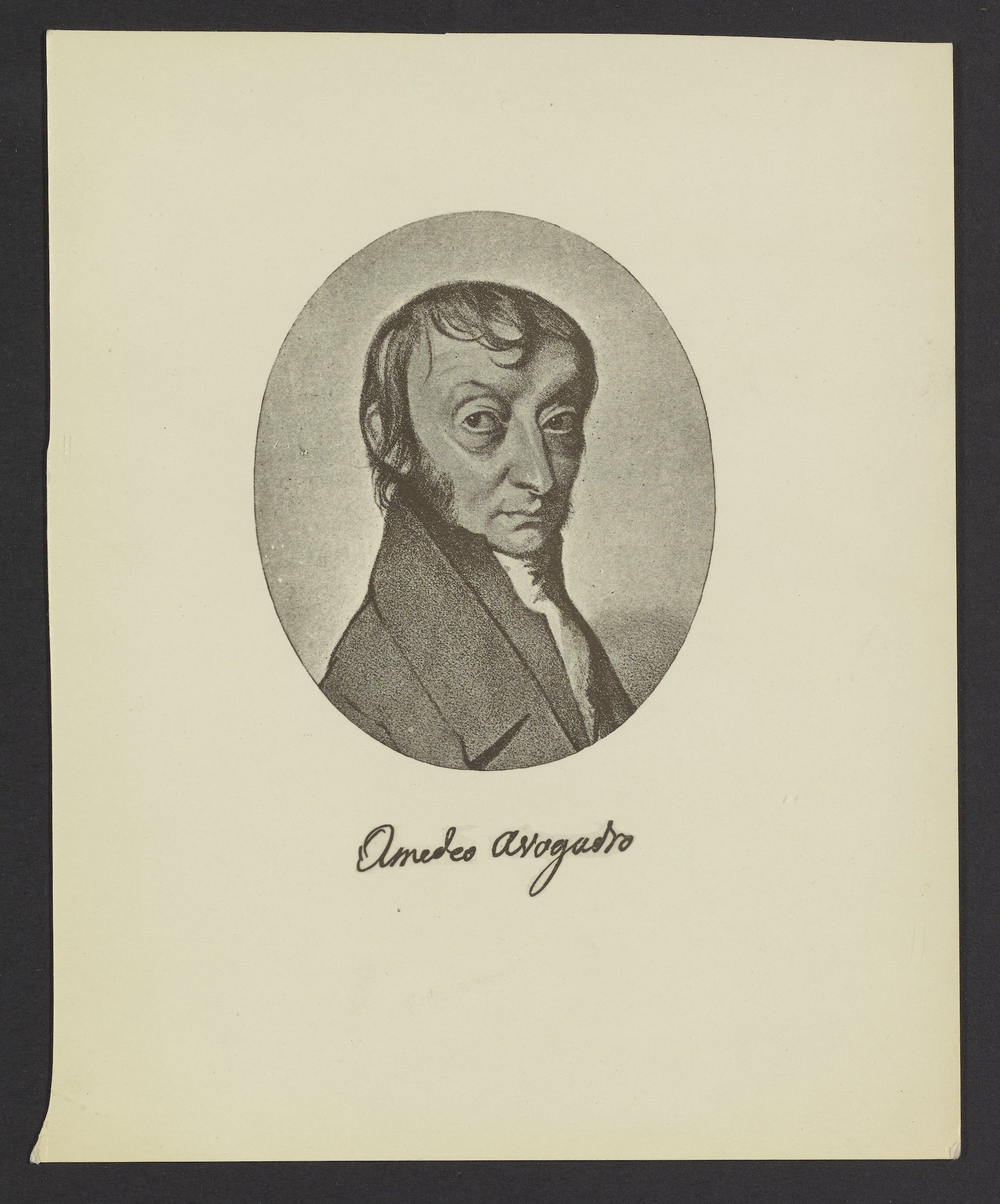
Amedeo Avogadro (Turin, 9 August 1776 – Turin, 9 July 1856), Count of Quaregna, was a physicist and chemist: in 1811 he formulated the hypothesis that equal volumes of different gases, at the same temperature and pressure, contain the same number of molecules[1][2]. Born and died in the capital of the Kingdom of Sardinia, he taught at the University of Turin and sat for half a century in the city's Academy of Sciences; the hypothesis, neglected for half a century, was recognised in its full value only after his death[2][3].
From lawyer to physicist
His father, Filippo Avogadro, Count of Quaregna, had a brilliant legal career and in 1787 became president of the Senate; his mother was Anna Maria Vercellone. The surname, explains historian of science Marco Ciardi, derives from the progressive alteration of the Latin phrase de advocatis[1]. Amedeo attended the Scuole Regie and then the faculty of law: in 1795 he passed his final examinations in canon and civil law[1] and in 1796 graduated in jurisprudence[4]. He practised for some time as a lawyer in ecclesiastical cases[3][2].
The turning point came with Volta's battery, which drove him to study science out of personal passion. From November 1800, a few months after Napoleon's victory at Marengo, he attended Anton Maria Vassalli-Eandi's lectures on experimental physics[1]. In 1803 he presented to the Academy of Sciences of Turin an Essai analytique sur l'électricité: the reviewers appreciated its theoretical reflections but asked for experimental verification, and the manuscript remained unpublished. The following year he nonetheless became a corresponding member of the Academy; in 1806 he was appointed assistant lecturer in physics at the Collegio delle Province and published his first paper in the Paris «Journal de physique»[1].
Vercelli and the 1811 hypothesis
In 1809 Avogadro obtained the chair of physics at the Reale Collegio of Vercelli, where he remained until 1819[1]. It was there that he wrote the paper that was to make him famous, which appeared in July 1811 in the «Journal de physique» (volume 73, pages 58–76)[1][5]. The problem to be solved was how to reconcile Dalton's atomic theory with Gay-Lussac's law, according to which gases combine in simple volume ratios. Avogadro proposed that gases, under equal conditions, contained the same number of particles in equal volumes, and that the particles of simple gases were not isolated atoms but unions of two or more atoms[2][3]. The 1930 Enciclopedia Italiana summed up the core of the proposal thus:
"the molecules dealt with in the first law, which Avogadro calls 'integral molecules', are not the ultimate particles of matter, but can be further divided into 'elementary molecules' (today called atoms)"
The model made it possible to calculate the molecular weights of substances in the gaseous state[1]. Avogadro returned to the subject with a second paper, Mémoire sur les masses relatives des molécules des corps simples, delivered to the journal in January 1814[1]. In 1815 he married Anna Maria Felicita Mazzè[1].
The chair lost and regained
In November 1820 he joined the University of Turin as holder of the chair of "sublime physics", a course in higher mathematics created specifically for him[1]. The uprisings of March 1821 changed everything: King Carlo Felice regarded the university as a hotbed of revolution, had it closed for a year from 15 September, and on 23 July 1822 abolished the chair. Avogadro received a pension of 600 lire and in 1823 was appointed master auditor at the Royal Camera de' Conti[1][2]. In those years he built a "multiplying voltameter", an instrument praised by Hans Christian Ørsted and Louis-Jacques Thénard[1].
In 1832 Carlo Alberto restored the chair of sublime physics and entrusted it at first to the French mathematician Augustin-Louis Cauchy, who left it after about a year. From November 1834 the chair returned to Avogadro, who held it until his last course, in the 1849–1850 academic year[1]. With the king's funding he published, between 1837 and 1841, the four volumes of Fisica de' corpi ponderabili, ossia Trattato della costituzione generale de' corpi, with research on capillarity, crystallography and, above all, thermal phenomena[1][2].
A scientist in the service of the Savoy state
As a member of the Academy of Sciences, Avogadro examined more than a hundred applications for industrial privilege, the equivalent of patents: silk-spinning machines, the mechanical presses of the Pomba printing house, aerostatic devices, submarines, steamboats. He sat on several scientific commissions of Piedmont, including the Higher Statistics Commission, and carried out meteorological research[1]. He was a member of numerous Italian and foreign academies and was held in esteem by Ørsted and Michael Faraday[1]. He died in Turin on 9 July 1856[1].
Posthumous recognition
During his lifetime the 1811 hypothesis remained on the margins of European chemistry; according to the Science History Institute of Philadelphia, Italy's distance from the discipline's great centres, in France, Germany, England and Sweden, also played a part[5]. It was brought back to the centre by the Palermo-born chemist Stanislao Cannizzaro, who had already been teaching it since 1856 and made it the foundation of his Sunto di un corso di filosofia chimica, published in 1858 in «Nuovo Cimento». At the international chemistry congress in Karlsruhe, from 3 to 5 September 1860, Cannizzaro had the chance to make Avogadro's principle known to scientists from across Europe[6]. In the Sunto, as the Dizionario Biografico degli Italiani sums up, Cannizzaro explained
"how Avogadro's hypothesis arose from Gay-Lussac's law of volumes"
His name is also borne by "Avogadro's number", that is, the number of molecules contained in one gram-molecule of any substance, which makes it possible to derive the mass of a single molecule[2]. Turin has celebrated the memory of 1811 more than once: the centenary celebrations opened on 24 September 1911 at the Academy of Sciences in the presence of King Victor Emmanuel III, and the bicentenary was marked on 20 and 21 October 2011 at the Academy and at the University of Eastern Piedmont, which bears the scientist's name, with the presentation of a digital library of his manuscripts and publications[7]. In the history of the Turin university, his 1796 law degree is among the dates the university commemorates[4].
Pages linking here
- Amedeo Avogadro State Industrial Technical Institute
- Emmanuel Philibert
- Norberto Bobbio
- Novara
- Ospedale Maggiore della Carità di Novara
- Politecnico di Torino
- Università degli Studi di Torino
- Vercelli
Related articles: Emmanuel Philibert, Norberto Bobbio, Politecnico di Torino, Università degli Studi di Torino, Vittorio Amedeo II