National Museum of Cinema
Cinema museum in the Mole Antonelliana since 2000, born from the collection of Maria Adriana Prolo begun in 1941; it organises the Torino Film Festival.
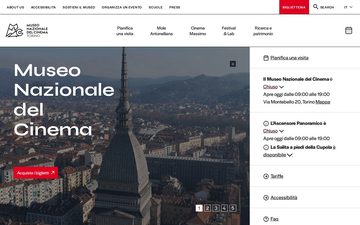
The National Museum of Cinema of Turin has been housed since 2000 in the Mole Antonelliana and is run by the Fondazione Maria Adriana Prolo, which bears the name of the scholar from whom the collection originated[1]. Its route unfolds vertically inside the building by Alessandro Antonelli, up to the panoramic turret at 85 metres[2], and MuseoTorino has for some years placed it among the most visited museum sites in Italy[3].
From private collection to national museum
It all begins in 1941, when Maria Adriana Prolo starts her collection of cinema-related materials[1]. In 1953 the institution joins the Fédération Internationale des Archives du Film (FIAF), the international network of film archives, and in 1958 it opens to the public in the rooms of Palazzo Chiablese, next to the Palazzo Reale; in 1960 the library named after Mario Gromo, founding member and president of the museum, is created[1]. In 1965 it receives official recognition as a national cinema museum, from the ministries of Public Education and the Interior[1]. In 1985 the museum is closed to the public due to safety issues[1].
The bond with the Mole predates the current display: according to Focus, Prolo's collection was kept in the basement of the building during the bombing raids of the Second World War and moved to the second floor in 1946[4]. In the same Mole, moreover, another museum had already resided, the National Museum of the Italian Risorgimento, from 1908 to the 1930s[3].
The foundation and the reopening in the Mole
Maria Adriana Prolo dies on 20 February 1991[1]. The following year the Fondazione Maria Adriana Prolo – Museo Nazionale del Cinema is established, with the support of Regione Piemonte, Città di Torino, the Province of Turin, Cassa di Risparmio di Torino and the museum's association[1]. In 1989, meanwhile, the Cinema Massimo had been inaugurated, the theatre that the foundation still runs today[1].
On 20 July 2000 the museum reopens to the public in the new location in the Mole Antonelliana[1]. The route follows the floors of the building: on level +5 the archaeology of cinema, divided into eight thematic areas; on +10 the Aula del Tempio with its helical ramp, devoted to temporary exhibitions; on +15 the machine of cinema; on +18 the gallery of posters[2]. Higher up one climbs on foot into the dome or takes the panoramic lift, which reaches the terrace of the turret at 85 metres[2]; the glass cabin, Focus recalls, crosses the Aula del Tempio and reaches the top in 59 seconds[4]. In subsequent years the Bibliomediateca Mario Gromo on via Matilde Serao (2008), the CineVR virtual-reality space (2020) and the Video Game Zone (2024) have been added[1].
The collections
The holdings exceed 3,250,000 items: about 2,500,000 photographs, 540,000 posters and promotional materials, 34,100 films on reel and 53,000 on other media, 66,250 books, 19,500 between documents and archival files, 14,000 objects of cinema archaeology and 12,500 pieces of equipment, in addition to magazines, records and memorabilia[5]. The sections include a film archive, photo archive, sound archive, video archive and video games[5].
The historical archive brings together more than a hundred collections and gathers screenplays, letters, contracts and notes from production companies, directors, actors and technicians of the silent and sound eras[6]. Many relate to the period when Turin produced films: the Itala Film collection and the Giovanni Pastrone collection, with materials on Cabiria (1914), the Società Anonima Ambrosio collection and that of the Società Anonima Stefano Pittaluga, active in distribution between the 1920s and 1930s; alongside these, the screenplays of Giuseppe De Santis, including Riso amaro (1949)[6]. Among the most recognisable objects are the scarf, hat and drawings of Federico Fellini, to whom the museum dedicated, in 2020 at the Cinema Massimo, a retrospective for the centenary of his birth[7]. From the museum's website one can access online ticketing for the collections, temporary exhibitions, the panoramic lift and the climb to the dome, the programme of the Cinema Massimo and of the festivals, and the Bibliomediateca, the archive, the film archive and the online collections[8].
Festivals, members and governance
The foundation organises the Torino Film Festival, CinemAmbiente, the Lovers Film Festival and the TorinoFilmLab[1]. Its founding members are Regione Piemonte, Città di Torino, Compagnia di San Paolo, Fondazione CRT, the Associazione Museo Nazionale del Cinema and GTT; the management committee is chaired by Enzo Ghigo and the directorship is entrusted to Carlo Chatrian[1]. The museum also awards its own prize, the Stella della Mole: on 23 September 2026 it was received at the Cinema Massimo by the South Korean director Bong Joon Ho, "for his contribution to contemporary cinema," at an evening that included a masterclass led by Chatrian[9].
Visitors and projects
In 2024 the museum recorded more than 818,000 visits, a record in its history, and in the first seven months of 2026 admissions grew by about 8% compared with the previous year; about 90,000 students enter every year[10]. On peak days more than 3,000 people are exceeded, with peaks around 3,800, while the Mole can accommodate about 600 at a time[10]. For this reason a reorganisation of the entrances is being planned, with separate entry and exit flows, wider use of the gardens and works in the underground spaces, to bring capacity up to 900 visitors; construction is expected to start in 2028[10].
From 19 November 2026 to 31 January 2028 the Aula del Tempio will host the exhibition T. rex vs. T. rex. From Fossils to Icons of Cinema, curated by Gianni Canova and Stefano Boni with Giaime Alonge: two tyrannosaur skeletons with authentic fossil remains from the United States, about ten metres long, mounted facing each other on a platform around the panoramic lift[11].
"T. rex vs. T. rex does not simply tell the story of dinosaurs: it also tells the story of the way we have imagined them"
The curator's remark, reported by ANSA, sums up the approach of the exhibition: cinema as a machine that has given shape to what no one had ever seen[11].
The Stella della Mole to Bong Joon Ho (23 September 2026)
On 23 September 2026 the National Museum of Cinema confers the Stella della Mole on the South Korean director Bong Joon Ho, Academy Award winner for "Parasite" (2019), Palme d'Or winner at Cannes and director of the first non-English-language film to win the Academy Award for Best Picture. The ceremony precedes, at the Cinema Massimo, a masterclass led by the Museum's director Carlo Chatrian, followed by a screening of "Parasite" introduced by the director; the event also opens a complete retrospective of his feature films, running at the Cinema Massimo until 30 September. Bong Joon Ho recalls his bond with the city, where in 2003 the Torino Film Festival had awarded "Memories of Murder" the audience award and the award for best screenplay.
Timeline
- — The National Museum of Cinema at the Mole Antonelliana hosts the exhibition "T. rex vs. T. rex," dedicated to the dinosaur in cinema. → TorinoClick la Repubblica Torino
Related articles: Alessandro Antonelli, Mole Antonelliana, Torino Film Festival
Pages linking here
- Alessandro Antonelli
- Cinema Statuto fire
- Erminio Macario
- Mole Antonelliana
- National Automobile Museum
- Pietro Micca
- Politecnico di Torino
- T. rex vs. T. rex Exhibition at the Mole Antonelliana
- Torino Film Festival
Sources
- Museo Nazionale del Cinema
- Museo Nazionale del Cinema
- MuseoTorino
- Focus
- Museo Nazionale del Cinema
- Museo Nazionale del Cinema
- Mole24 — 5 September 2020
- Museo Nazionale del Cinema
- Mole24 — 16 September 2026
- Mole24 — 11 August 2026
- ANSA Piemonte — 18 September 2026
- ANSA Piemonte — 21 September 2026
- Quotidiano Piemontese — 21 September 2026