Cinema Statuto fire
The fire of 13 February 1983 at the Statuto cinema on via Cibrario: 64 dead, locked exits, and a turning point for safety rules in public venues.
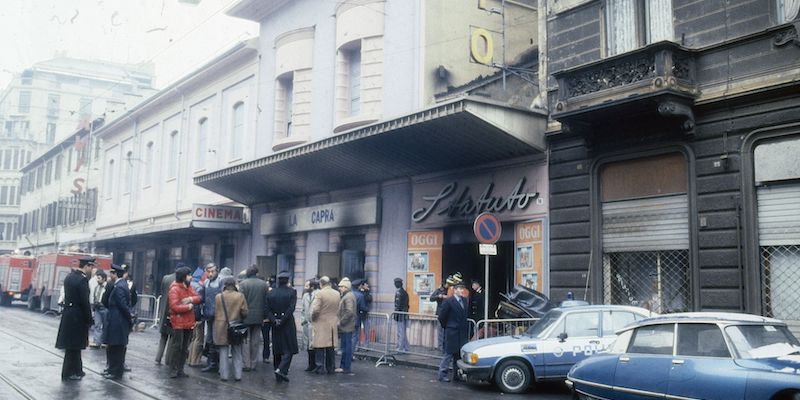
The Statuto cinema fire broke out in the late afternoon of Sunday 13 February 1983 and killed 64 moviegoers in a theatre on via Cibrario, a few steps from piazza Statuto, in Turin. It was the worst accident the city had seen since the end of the Second World War: smoke released by the burning seats and emergency exits locked with chains turned a Sunday screening into a trap. The investigations that followed brought new attention across Italy to safety rules for cinemas, theatres and other venues.[1][2]
The screening of 13 February
Heavy snow was falling on Turin that day.[3] The Statuto, a large theatre, could hold up to 1,200 people; about a hundred had come in for the late-afternoon screening. On the bill was La chèvre, the French comedy by Francis Veber starring Gérard Depardieu.[1]
Around 6:15 pm a short circuit set the curtains at the back of the stalls ablaze. As they fell, the curtains set fire to the seats in the last row and raised a wall of flames in front of the main exit. The owner had locked all the emergency exits but one, chaining them to keep out spectators without tickets; some of those trying to escape went down a corridor that led only to the restrooms and were trapped there. The screening was not stopped, and those sitting in the balcony did not immediately realise what was happening below.[1] According to an account published on the thirtieth anniversary, the owner kept the lights off and the projector running for fear of triggering panic; the smoke, rising toward the balcony, suffocated the audience within two or three minutes — about as long, experts explained, as a person can hold their breath.[2]
The rescue
The first fire brigade vehicle to reach the Statuto was a new tanker truck, redirected by radio from the provincial operations room: at the wheel was Enzo Ariu, who later recounted the rescue. The squad leader ordered him to the via Le Chiuse side, where hoses were laid out, and a second squad was sent in as reinforcement. Beyond the now-destroyed door, the side corridor of the stalls was a single wall of flame.[3] In Ariu's account, when the heat and smoke began to clear, a very young girl was found next to the second emergency door, for whom nothing more could be done.[1]
At 6:45 pm section chief Alberto Pilotto arrived with spare tanks for the breathing apparatus and went up to the balcony.[4] This is how he recalled what he saw:
"I made my way into the balcony and an apocalyptic scene appeared before my eyes: there were bodies everywhere, lying in the strangest positions, under the gallery, scattered among the seats or along the corridors."
Once the fire was out, firefighters worked through the night with volunteers from the Croce Verde: the bodies were carried on canvas stretchers to a nearby garage, requisitioned so relatives could identify them.[4] The dead numbered 64 out of about a hundred present, among them young couples and whole families; they ranged in age from seven to fifty-five.[1][2][3]
The smoke that killed
The autopsies established that almost no one had died from the flames: the victims had been poisoned by smoke from the burning polyurethane foam padding in the seats and the carpeting that covered the walls and floors.[1] The gases contained carbon monoxide and hydrogen cyanide, also produced by the plastic lamps and the fabric of the curtains.[2] The material was certified as fire-retardant, meaning it did not feed the flame, but no one had ever checked how toxic its fumes were.[1]
On 15 February public funerals were held at the Duomo, in the presence of President of the Republic Sandro Pertini.[2]
The trial
Eleven people were charged.[2] The first-instance trial, in 1987, ended with six convictions for manslaughter: eight years for the cinema's owner, Raimondo Cappella (Capella in some accounts), seven for the surveyor Amos Donisotti, who had overseen the theatre's renovation, six for deputy prefect Antonio Di Giovine, five years and six months for Nello Palandri, a technician on the oversight commission, four years each for projectionist Antonio Iozzia and upholsterer Antonio Ricci; electrician Elio Appiano was acquitted.[1] The sentences were reduced on appeal; the owner's conviction became final at two years. Cappella was ordered to pay damages to 250 relatives totalling three billion lire, sold all his property and ended up working as an usher at another Turin cinema, the Romano.[1][2]
In 2008, interviewed by Repubblica, he argued that the fabric on the seats was the same used in almost all Italian cinemas, authorised by the state and labelled with a warning that it produced smoke.[1] He died in 2011 in Cisano sul Neva, Liguria. From the first hours after the fire he had called himself "the sixty-fifth victim of the Statuto," and he repeated the phrase in his final years.[2]
The effect on safety rules
After 13 February, prosecutors ordered inspections of cinemas and theatres and many venues had to close, temporarily or for good. The rules then in force proved inadequate: panic-bar exit handles were not yet mandatory and only became so afterward, smoke detectors were missing, and electrical systems were often old.[1] A fire brigade engineer pointed out in the pages of La Stampa that the regulation required emergency doors to be "operable," and that even a locked door is operable, as long as you have the key. The inspections led to the closure of restaurants, nightclubs and cinemas, and showed that even Italy's great theatres needed structural changes.[2]
Remembrance
In largo Cibrario a plaque and a flowerbed are dedicated to the "Victims of the Cinema Statuto"; every 13 February the City of Turin lays a wreath there. Volunteers from Torino Spazio Pubblico Borgo San Donato, together with some relatives of the victims, look after the flowerbed.[5]
For the fortieth anniversary, in 2023, the city council held a commemorative session in the Sala Rossa, the provincial fire brigade command organised the conference "Safety is not a film," the Museo Nazionale del Cinema association presented the documentary Sale per la capra, built in part on interviews with those involved and on court records, and Rai broadcast Brucia lo Statuto, with period footage from its own archives.[6] On the morning of 13 February, at 11 am, a siren launched the largest evacuation drill ever held in the city: 39 school complexes, 77 school buildings and about 21,000 students.[7] In 2025 mayor Stefano Lo Russo recalled that that Sunday in February "also marked the start of a new awareness: it was a crucial step in the path toward attention to safety rules in public places."[5]
Sources
- Il Post — 13 February 2023
- Il Post — 13 February 2013
- Associazione Nazionale Vigili del Fuoco – Torino
- Associazione Nazionale Vigili del Fuoco – Torino
- Città di Torino – Torinoclick — 13 February 2025
- Città di Torino – Torinoclick — 2 February 2023
- Città di Torino – Torinoclick — 13 February 2023