ThyssenKrupp fire
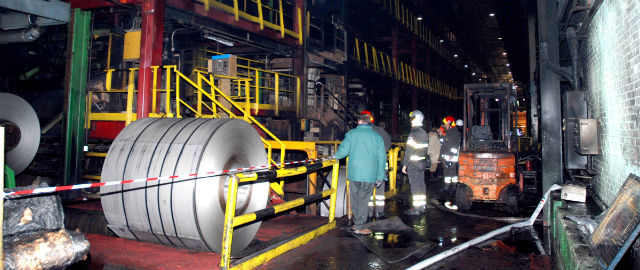
The ThyssenKrupp fire was the blaze that, on the night between 5 and 6 December 2007, engulfed eight workers on line 5 of the ThyssenKrupp steelworks on Corso Regina Margherita, on the outskirts of Turin. Seven of them died within three weeks; only one survived. The tragedy and the trial that followed—the first in Italy to end, at first instance, with a conviction for voluntary manslaughter over a workplace accident—became a touchstone in the national debate on factory safety.[1][2]
A plant being shut down
ThyssenKrupp had taken over the Turin plant in 1994 through Acciai Speciali di Terni. In July 2007 the company and the unions signed an agreement providing for its closure by September 2008, with production transferred to Terni.[1] At the time the plant employed about two hundred people.[2]
Line 5, which was slated to be dismantled, was in those months short of both staff and maintenance. Workers later reported empty fire extinguishers, hydrants that did not work, the absence of specialized emergency teams, and the fact that six of the eight injured men had never received fire-safety training. Some of them, that night, had been working non-stop for twelve hours, four of them overtime.[2] Il Post later wrote that the extinguishers on the line «were almost all discharged or expired».[1]
The night of 6 December
Shortly after midnight, one of the lines, slightly out of alignment, caused a steel sheet to scrape against a wall; the sparks set the oiled paper alight. Small fires of this kind had already occurred over the summer, and the line used as a lubricant a highly flammable combustible oil similar to kerosene. Eight workers went down to put out the flames. An oil pipe burst, and the sudden pressure surge turned the liquid into a cloud of fine droplets, which the fire immediately ignited, engulfing all the men: «the effect was like that of a giant flamethrower», Il Post reconstructed.[1]
Only Antonio Boccuzzi, then thirty-four, survived, shielded by a forklift, with minor burns; he was the only direct witness to the scene.[1][2]
The seven victims
Antonio Schiavone, 36, a resident of Envie in the province of Cuneo, was the first to die, on 6 December, and the only one to die inside the plant. On 7 December, Roberto Scola, 32, and Bruno Santino, 26, died at the CTO hospital, and Angelo Laurino, 43, died at the San Giovanni Bosco hospital; Scola and Laurino had burns over 95% of their bodies. Rocco Marzo, 54, a shift supervisor due to retire at the end of the month, died on 16 December at the Molinette hospital, now part of the Città della Salute e della Scienza. Rosario Rodinò, 26, airlifted to Genoa, died on 19 December at Villa Scassi hospital. The last to die was Giuseppe Demasi, 26, who died at the CTO on 30 December after four surgical operations.[3]
The trial
The investigation by the Turin public prosecutor's office brought to trial chief executive Harald Espenhahn and five executives. On 15 April 2011 the second Court of Assizes of Turin sentenced Espenhahn to 16 years and 6 months for voluntary manslaughter with dolus eventualis: the prosecution argued that, knowing the plant was being decommissioned, he had accepted the risk by postponing fire-safety investments. Cafueri, Salerno, Priegnitz and Pucci received 13 years and 6 months, and Moroni 10 years and 10 months, for manslaughter and arson through conscious negligence. It was the first time in Italy that a workplace death had been judged as voluntary manslaughter.[2]
As early as 1 July 2008 the company had paid out nearly 13 million euros to the victims' families, who in exchange had waived their right to join the proceedings as civil parties.[1][2] In February 2013 the Court of Assizes of Appeal of Turin ruled out voluntary manslaughter and reclassified the offense as manslaughter through negligence, reducing Espenhahn's sentence to ten years and those of the other defendants to between seven and nine years.[1][4]
On 24 April 2014 the joint criminal sections of the Court of Cassation declared the guilt of the six defendants and the company «certain, established, definitively clarified», but overturned the ruling and remanded the case to a new court of appeal to redetermine the sentences for each offense. They rejected the appeal by the Turin public prosecutor's office, which had sought, for Espenhahn alone, a return to voluntary manslaughter with dolus eventualis: the new sentences could therefore not exceed those set at the first appeal. The remanded proceedings would deal with manslaughter through negligence, arson, and the willful removal of workplace safety measures.[4]
The ruling of the new appeal trial, delivered by the Court of Assizes of Appeal of Turin on 29 May 2015, was upheld by the Court of Cassation on 13 May 2016: the court did not grant the request of deputy prosecutor general Paola Filippi, who had sought a further overturning and remand to revise the sentences. The convictions became final: 9 years and 8 months for Espenhahn, 7 years and 6 months for Daniele Moroni, 7 years and 2 months for Raffaele Salerno, 6 years and 8 months for Cosimo Cafueri, 6 years and 10 months each for Gerald Priegnitz and Marco Pucci.[5] When the ruling was read out, the victims' relatives commented: «Justice has been done».[5] And again, according to ANSA:[6]
«It's a victory, a victory for us and for all the victims who have died at work»
For the four convicted Italian defendants, the Turin prosecutor general's office immediately issued arrest warrants; for the two Germans, Espenhahn and Priegnitz, a European arrest warrant was announced.[6]
Serving the sentence in Germany
Enforcement of the two German managers' sentences dragged on for years. In February 2020 the Higher Regional Court of Hamm rejected their appeal and ruled that they would serve their sentences in Germany, where the maximum penalty for manslaughter through negligence is five years.[7] Priegnitz began serving his sentence in 2020 under a day-release regime and was released for good conduct in November 2022; Espenhahn entered prison, also under day-release, only on 10 August 2023, nearly sixteen years after the fire.[8]
Memory
The events have also found their way into civic theater. The play «Perché il cane si mangia le ossa» by Francesco Suriano features Carlo Marrapodi, a former plant worker who survived that night, while «Acciaio liquido» by Marco Di Stefano, directed by Lara Franceschetti, alternates a reconstruction of the events with passages from the court ruling.[9] On every anniversary, the national press has revisited the night of line 5, retracing the sequence of events and the state of the trial: one of the most closely followed labor stories of contemporary Piedmont.[1][2]
Pages linking here
Sources
- Il Post — 6 December 2013
- Il Post — 6 December 2012
- Famiglia Cristiana — 4 December 2017
- ANSA — 24 April 2014
- il Fatto Quotidiano — 13 May 2016
- ANSA — 14 May 2016
- Il Post — 4 February 2020
- Il Post — 18 August 2023
- L'Espresso — 14 February 2022