Districts of Turin
The eight administrative zones into which Turin has been divided since 2016, each with an elected council and chairperson; from 1984 to 2016 there were ten.
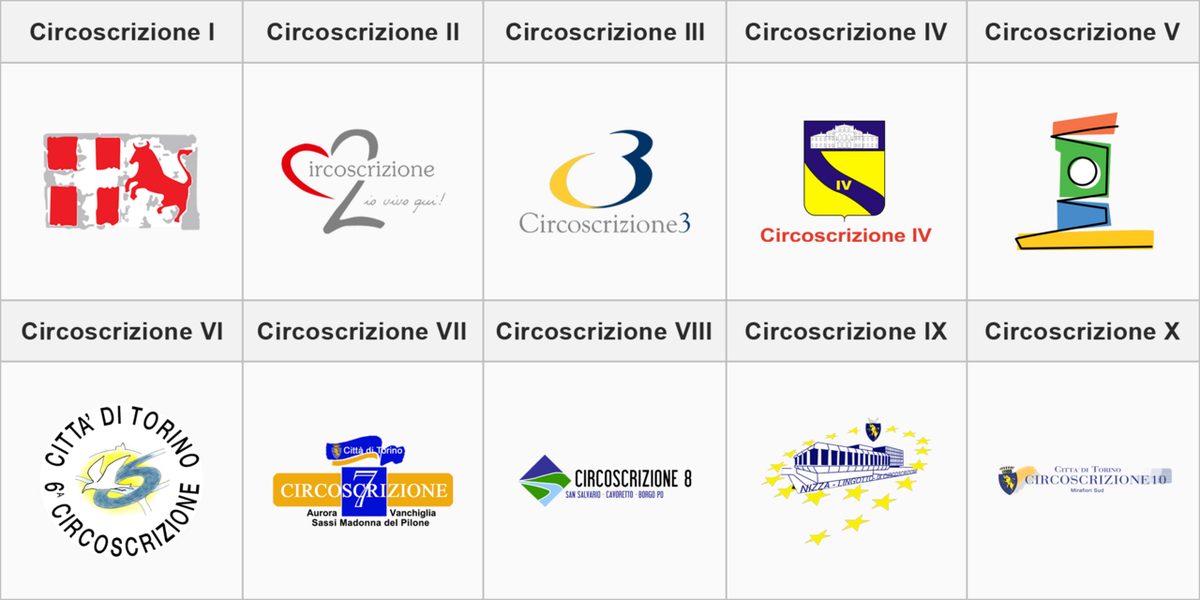

The circoscrizioni (“districts”) are the eight administrative zones into which Turin is divided: each one groups together several historic neighbourhoods and has its own office, through which the City manages part of its local services.[1][2] The current arrangement dates back to 2016; for more than thirty years, from 1984, the city had been divided into ten districts.[3]
From the decentralisation law to the ten districts
The legal basis is law no. 278 of 1976 on decentralisation, which allowed municipalities to divide their territory into districts made up of contiguous neighbourhoods or hamlets.[4] In Turin the boundaries were set by a City Council resolution of 21 December 1984, amended a year later, on 10 December 1985.[3] The result was a city in ten parts:
“From 1984 to 2016 the city of Turin was divided into 10 administrative macro-zones called circoscrizioni.”
The ten were: 1 Centro-Crocetta; 2 Santa Rita-Mirafiori Nord; 3 Borgo San Paolo-Cenisia/Cit Turin-Pozzo Strada; 4 San Donato-Campidoglio-Parella; 5 Borgo Vittoria-Madonna di Campagna-Lucento-Vallette; 6 Regio Parco-Barriera di Milano-Falchera-Rebaudengo-Barca-Bertolla-Villaretto; 7 Aurora-Vanchiglia-Sassi-Madonna del Pilone; 8 San Salvario-Borgo Po-Cavoretto; 9 Nizza Millefonti-Lingotto-Filadelfia; 10 Mirafiori Sud.[3]
The 2016 reform: from ten to eight
With the 2016-2021 council term, the boundaries of today's eight districts were drawn up.[3] Districts 1 and 3 to 7 kept their numbers and reference neighbourhoods; the others were redrawn: Mirafiori Sud, which on its own had formed the old District 10, was merged with Santa Rita and Mirafiori Nord into the new District 2; San Salvario-Borgo Po-Cavoretto and Nizza Millefonti-Lingotto-Filadelfia, until then Districts 8 and 9, merged into a single new District 8.[3][1] Borgata Lesna now also appears in the name of District 3, alongside San Paolo, Cenisia, Pozzo Strada and Cit Turin.[1]
Today's eight districts
The eight territories and their offices are[1][2]:
- District 1 – Centro-Crocetta, including the Quadrilatero Romano and Borgo Nuovo[4]; office at via Assarotti 12.
- District 2 – Santa Rita-Mirafiori Nord-Mirafiori Sud; office at strada comunale di Mirafiori 7.
- District 3 – San Paolo-Cenisia-Pozzo Strada-Cit Turin-Borgata Lesna; office at corso Peschiera 193.
- District 4 – San Donato-Campidoglio-Parella; office at via Servais 5.
- District 5 – Borgo Vittoria-Madonna di Campagna-Lucento-Vallette; office at via Stradella 192.
- District 6 – Barriera di Milano-Regio Parco-Barca-Bertolla-Falchera-Rebaudengo-Villaretto; office at via San Benigno 22.
- District 7 – Aurora-Vanchiglia-Sassi-Superga-Madonna del Pilone, which climbs up to the hill of the Basilica of Superga; office at corso Vercelli 15.
- District 8 – San Salvario-Cavoretto-Borgo Po-Nizza Millefonti-Lingotto-Filadelfia; office at via Federico Campana 32.
Together the eight districts group the 94 statistical zones into which the City divides the town.[4]
Bodies and powers
The City presents them in simple terms:[5]
“The districts of the City of Turin are the territorial bodies that serve as the point of reference for citizens.”
The same institutional page explains that their task is to encourage participation, listen to the community's needs, manage basic services and promote volunteering and active collaboration.[5] They exercise functions delegated by the City with organisational autonomy, under article 54 of the municipal statute and the decentralisation regulation.[6]
Each district has two bodies. The District Council, directly elected by residents, has steering and oversight functions and elects the chair from among its own members at its first sitting, choosing from the list that won the most votes; the Giunta (executive board), made up of the chair and six councillors, is the executive body and coordinates working committees on budget, culture, the environment and health.[4] In daily life the districts deal with social services and after-school activities, sports facilities, gardens and playgrounds, markets and events, granting public space for outdoor seating, proposals on traffic and parking, assistance for the elderly together with local associations, a Youth Plan, and even the choice of Christmas lights.[4]
Elections and neighbourhood politics
The councils are renewed together with the City Council and the mayor (see Mayors of Turin): each voter votes for candidates in their own district, with one preference or with two, provided they are for candidates of different sexes.[4] Neighbourhood majorities may not match the one at Palazzo Civico. In the current term, District 2 is chaired by Luca Rolandi, of the Partito Democratico-Lo Russo Sindaco group, named after mayor Stefano Lo Russo;[5] District 6 by Valerio Lomanto, of the Giorgia Meloni-Fratelli d'Italia group;[6] District 8 by Massimiliano Miano, of the Moderati.[7] The councils reflect the city's full political spectrum: in District 8's council, alongside the Partito Democratico, sit councillors from Moderati, Lega Salvini, Fratelli d'Italia, Movimento 5 Stelle, Casa Riformista, Forza Italia, Sinistra Ecologista and various civic lists.[7]
Pages linking here
- Città di Torino
- Doubling of GTT service desks in the Circoscrizioni (October 2026)
- Fred Buscaglione
- Luca Argentero
- Nizza Millefonti
- Superga (footwear)
- Torino
- Weekly Opening of GTT Service Desks in the Circoscrizioni (1 October 2026)
GTT desks in the districts, from fortnightly to weekly opening (October 2026)
From 1 October 2026 the GTT desks active in Turin's eight districts move from fortnightly to weekly opening.
Related articles: Città di Torino, Doubling of GTT service desks in the Circoscrizioni (October 2026), Nizza Millefonti, Torino, Weekly Opening of GTT Service Desks in the Circoscrizioni (1 October 2026)
Sources
- Città di Torino – Decentramento
- Città di Torino
- MuseoTorino
- Mole24 — 17 December 2023
- Città di Torino
- Città di Torino — 11 December 2025
- Città di Torino
- TorinoClick — 1 October 2026
- CronacaQui Torino — 1 October 2026