Massimo d'Azeglio
Painter, novelist and Turinese statesman (1798-1866), prime minister of the Kingdom of Sardinia from 1849 to 1852, author of the Moncalieri proclamation and of the «Ricordi».
Massimo Taparelli d'Azeglio (Turin, 24 October 1798 – Turin, 15 January 1866) was a painter, novelist and statesman of the Risorgimento, prime minister of the Regno di Sardegna from 1849 to 1852[1][2]. Born and dying in Turin, he led the government through the difficult years that followed the defeat at Novara, wrote the proclamation with which Victor Emmanuel II saved the Statuto, and was Cavour's direct predecessor at the head of the government[1]. Today his name is also tied to a famous saying, which however nearly always circulates in a form different from the one he actually wrote.
Youth between Turin, Florence and Rome
He was the son of the marquis Cesare d'Azeglio, a leading figure of Catholic Turin, and of Cristina Morozzo di Bianzè[1]; he was the youngest of the family's children[3]. After a long stay by the family in Florence he returned to Turin in 1807 and as a young man served as an officer in the Piemonte Reale Cavalleria regiment, before giving up his military career and the dissolute life that went with it, partly through the influence of his friend professor Bidone[1]. Around 1820 he settled in Rome to study painting and stayed there for about a decade, mixing with intellectuals and artists; it was there that he had his first trouble with the papal police, having been implicated in the Maroncelli trial[1][4].
As a painter he devoted himself above all to landscapes and historical scenes: among his paintings are The Death of Montmorency, a canvas on the death of Leonidas from 1823 and, much later, The Meeting of Ulysses and Nausicaa (1862); his small landscapes are the works most prized by critics[1].
Milan, Manzoni and the novels
In March 1831 he moved to Milan, entered the circle of Alessandro Manzoni and married his daughter Giulia[1]. It was there that he wrote the historical novels that made him famous: Ettore Fieramosca, or The Challenge of Barletta (1833), met with resounding success, and Niccolò de' Lapi, or The Palleschi and the Piagnoni (1841), which had a cooler reception[1][2]. Fieramosca, a tale of Italian knights challenging the French, circulated even in seminaries[3]. Published posthumously in 1871 was the unfinished novel La Lega Lombarda[5].
From Romagna to Carlo Alberto
From 1 September 1845 he travelled through the Papal Romagna to persuade liberals to abandon conspiracies in favour of a programme of legal reforms; back in Turin, he reported to King Carlo Alberto, who received him in audience on 12 October 1845[1]. The king's reply, as d'Azeglio recorded it, remains among the most quoted documents of the Piedmontese Risorgimento:
«Let those gentlemen know that they should keep quiet and not stir, there being nothing to be done for now; but let them be certain that, should the occasion arise, my life, the lives of my sons, my weapons, my treasures, my army, everything, will be spent for the Italian cause»
In March 1846 there appeared, printed clandestinely in Tuscany, Degli ultimi casi di Romagna, pages hostile to the secret societies but above all to papal misrule[1][5]; it was followed in 1847 by the Proposta di un programma per l'opinione nazionale italiana[2]. In 1848, the year of the Statuto, he published in Florence the pamphlet Sull'emancipazione degli israeliti, which opens with a question addressed to the reader «be he weak or powerful, great or small, prince or subject, Catholic or Protestant»: whether the precept of universal charity be true or false[6].
War and government (1848-1852)
In the First War of Independence he fought as a colonel and was wounded on 10 June 1848 at Monte Berico, in the defence of Vicenza[1]. After the defeat at Novara and Carlo Alberto's abdication, on 7 May 1849 he accepted the premiership[1][4]. His most urgent task was to secure ratification of the peace of Milan with Austria, signed on 6 August 1849, which imposed a war indemnity of 75 million francs; the Camera, with its democratic majority, was blocking it[7].
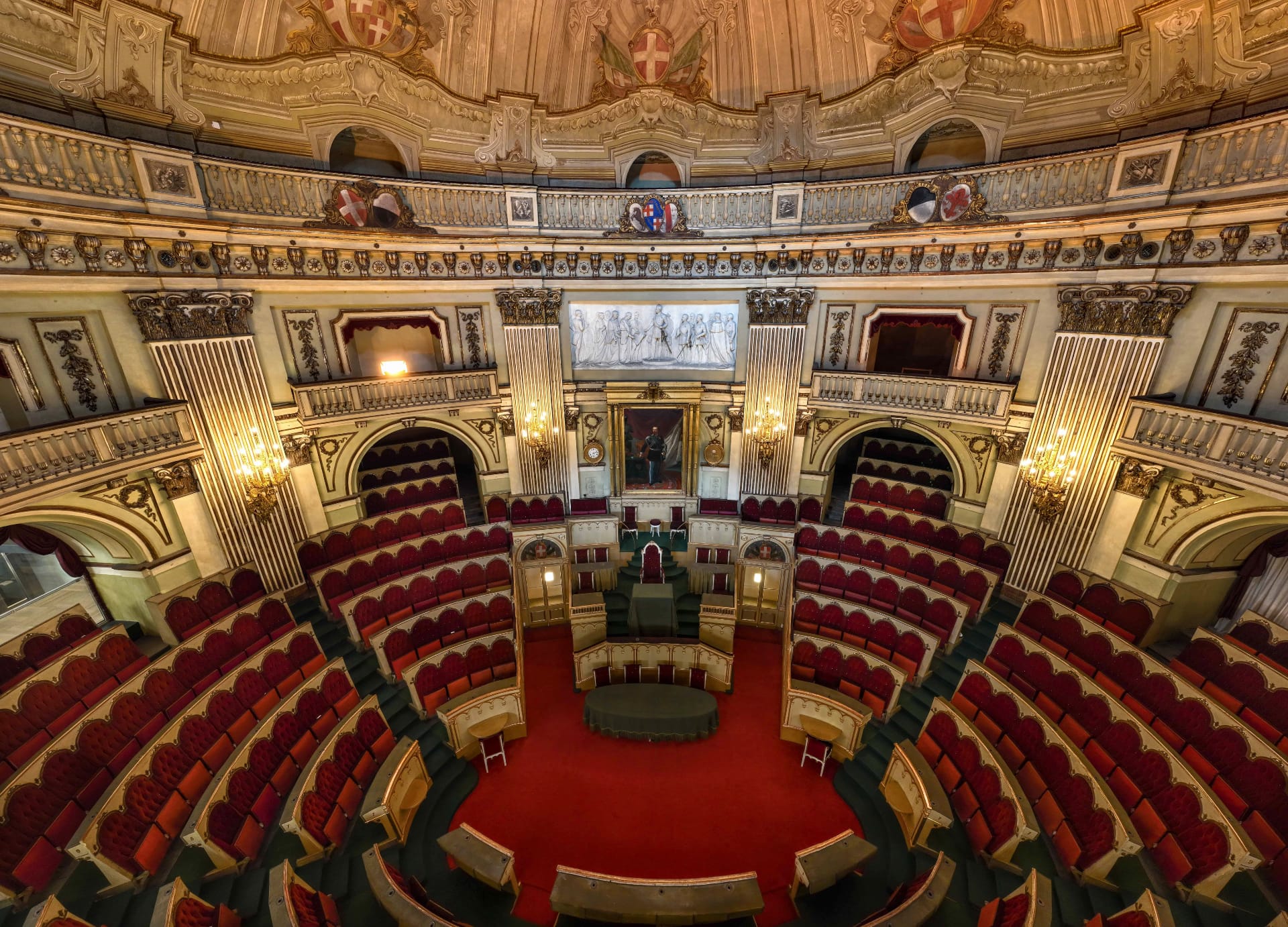
On 16 November debate was suspended, and on 20 November 1849 the king dissolved the Camera, signing, from the castello di Moncalieri, the proclamation written by d'Azeglio, which declared the acts of the outgoing Camera hostile to the Crown and asked voters to elect deputies willing to end the war[7]. According to the castle's own account, it was d'Azeglio himself, as prime minister, who suggested to the sovereign the appeal for a moderate and conscientious vote[8]. In the elections of 9 December about two thirds of the deputies of the new Camera, which opened on 20 December, proved willing to support the government[7]; according to his biographer in the Dizionario Biografico degli Italiani, the proclamation, which seemed unconstitutional «to the vestal virgins of constitutions», was instead «thoroughly constitutional given the honest intentions that had dictated it»[1]. Among the benches of the chamber of the Parlamento subalpino at Palazzo Carignano, today room 16 of the Museo Nazionale del Risorgimento Italiano, Cavour, Gioberti and d'Azeglio himself all spoke[9].
His government passed in 1850 the Siccardi laws, which abolished ecclesiastical jurisdiction and other privileges of the clergy[2][4]. In the same year he brought Camillo Benso di Cavour into the ministry[4], who in time took his place: d'Azeglio resigned on 22 October 1852[1]. Sources disagree on the causes: the Encyclopaedia Britannica cites his disagreement with Cavour, then his minister of Finance[4]; others point to the king's refusal to sign the civil-marriage law already approved by the Camera, and to his defence of parliamentary autonomy[3].
After government
After leaving the government, according to his biographer Walter Maturi, d'Azeglio «no longer went ahead of events, but followed them»[1]. In 1855 he succeeded his brother Roberto as director of the Pinacoteca di Torino, the collection established in 1832 by Carlo Alberto and known today as the Galleria Sabauda[1][10]. In the Senate he supported the Crimean expedition championed by Cavour; in 1859 he was extraordinary commissioner in Romagna and from 16 January 1860 governor of Milan, a post he resigned from in disagreement with policy towards the Mezzogiorno[1][2]. On the Roman Question he railed against what he called Italians' «romanomania»[1].
In his final years he lived for long periods at Cannero, on lago Maggiore, where from early 1863 he worked on his memoirs[1][11]. He died in Turin on 15 January 1866, leaving them unfinished[1][2][11]; they were published the following year under the title I miei ricordi[2].
«Fare gli italiani» ("Making Italians")
From the preface to the Ricordi comes the phrase for which d'Azeglio is best known, usually quoted as «Fatta l'Italia, bisogna fare gli italiani» ("Italy is made, now we must make Italians") or «Abbiamo fatto l'Italia, ora dobbiamo fare gli italiani» ("We have made Italy, now we must make Italians")[12][3]. The printed text reads[13]:
«Italy's first need is that Italians be formed, endowed with lofty and strong characters. And unfortunately each day we move further towards the opposite pole: unfortunately Italy has been made, but Italians are not being made.»
The historian Christopher Duggan observed that the phrase is mostly read as a call to build a national identity, whereas d'Azeglio was thinking above all of character: freeing Italians from vices such as indiscipline, irresponsibility, faintheartedness and dishonesty, a legacy of centuries of despotism[14].
The name in Turin
In 1882 the municipal college founded in 1831 at Porta Nuova, later the Regio Collegio Monviso, took his name, becoming the Liceo Classico Massimo d'Azeglio[15]. In 1897 a group of students at the school founded Juventus; among those who studied there in the 1920s and 1930s were Cesare Pavese and Norberto Bobbio[15].
Pages linking here
- Biblioteca civica centrale
- Borgo Medievale
- Caffè Fiorio
- Carlo Alberto
- Castello di Moncalieri
- Cesare Pavese
- Giulio Einaudi
- Juventus Football Club
- Luigi Einaudi
- Luigi Rolando Museum of Human Anatomy
- March of the Forty Thousand
- Moncalieri
- Monte Rosa
- Monumental Cemetery of Turin
- Norberto Bobbio
- Palazzo Carignano
- Parco del Valentino
- Pier Giorgio Frassati
- Presentation of the Vale Project in Turin
- Primo Levi
- Sacra di San Michele
- San Salvario
- Stefano Lo Russo
- Susanna Agnelli
- Teatro Nuovo
- VALE
- Vermouth di Torino
- Via Po
- Victor Emmanuel II
Related articles: Castello di Moncalieri, Moncalieri, Residenze sabaude, Susanna Agnelli, Victor Emmanuel II
Sources
- Treccani – Dizionario Biografico degli Italiani —
- Treccani – Dizionario di Storia —
- L'Opinione delle Libertà — 29 July 2012
- Encyclopaedia Britannica
- Treccani
- Liber Liber
- 150anni.it – Comitato per i 150 anni dell'Unità d'Italia
- Castello di Moncalieri
- Museo Nazionale del Risorgimento Italiano
- Musei Reali Torino
- Liber Liber
- CNR – Almanacco della Scienza
- Internet Archive
- Il Piccolo — 24 May 2009
- Liceo classico Massimo d'Azeglio