Lavazza
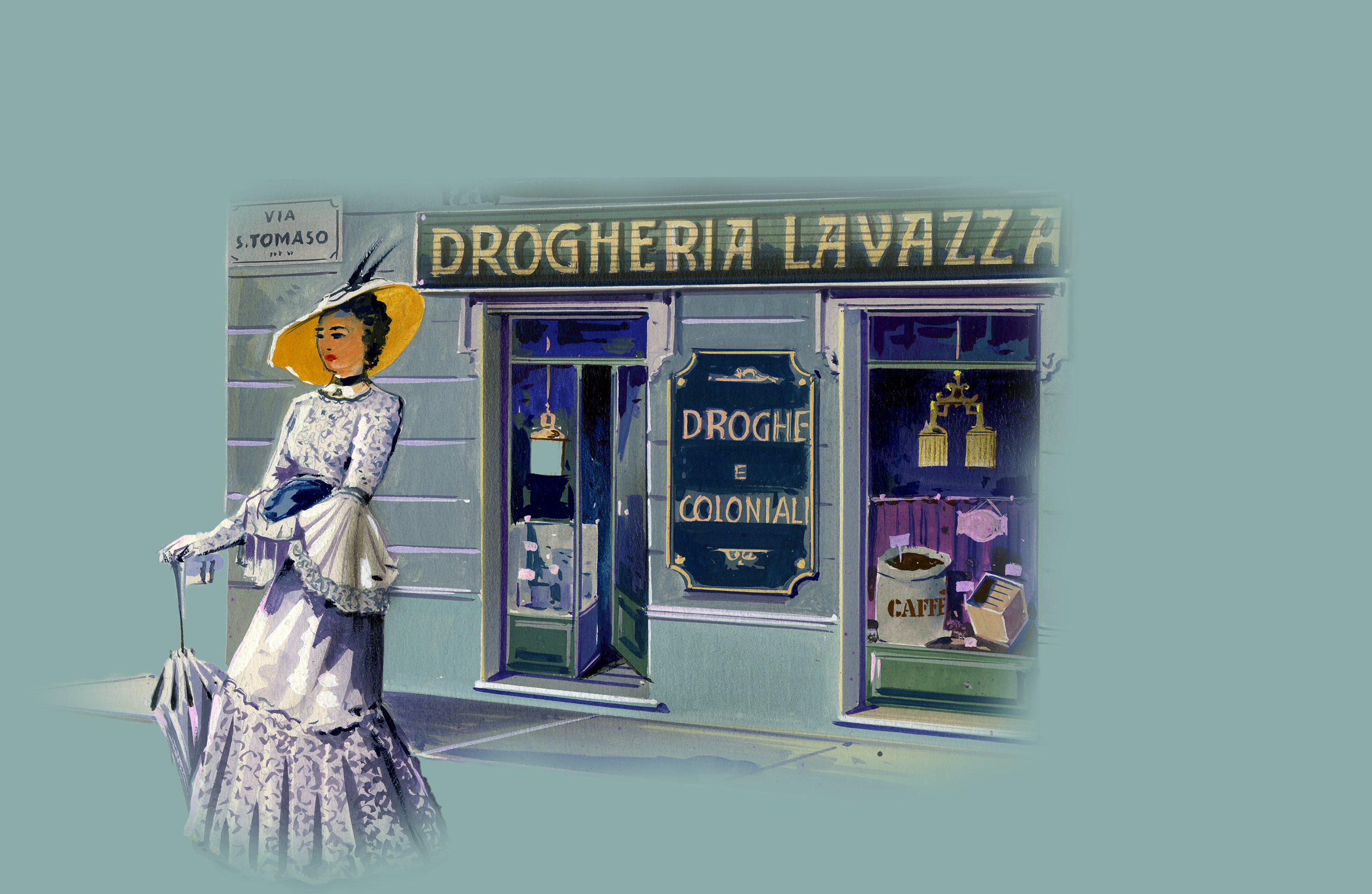
Lavazza is the Turin-based coffee company that grew out of a grocery shop in the historic centre at the end of the nineteenth century to become one of the world's largest coffee roasters. Founded on the initiative of the Lavazza family, it is headquartered at via Bologna 32, in the Nuvola complex built on the site of an old power station, and reports revenues of 3.9 billion euros, over 5,800 employees and a presence in 140 markets[1]. Its history traces a map of Turin addresses: via San Tommaso, corso Giulio Cesare, corso Novara, Settimo Torinese and finally via Bologna.
From Monferrato to the shop on via San Tommaso
Luigi Lavazza was born on 24 April 1859 in Murisengo, in the Monferrato. After a hailstorm destroyed the harvest on 9 August 1885, he moved to Turin with a loan of just 50 lire; there he studied at the Archimede workers' school, at an evening commerce school and, between 1889 and 1891, at the Cavour municipal institute of chemistry[2]. In March 1894 he took over a grocery shop at the corner of via San Tommaso and via Barbaroux, paying for it with his savings and a loan of 10,000 lire from his last employer; the following year the business became a partnership with the entry of his cousin Pericle Franco[2]. By 1900 the shop was taking in 4,200 lire a week and employed six people[2]. The company's historical archive holds an order form from the “first shop” dated 1 January 1899[3].
What set Lavazza apart from other grocers was its blend: from 1910, after the shop moved to larger premises on the same street, the founder began offering coffees made by combining different origins, blended in-house[2]. According to the Dizionario Biografico degli Italiani, “By 1923 Lavazza was the leading Italian coffee-processing company”[2].
Corso Giulio Cesare and the war years
In June 1925 the company moved its headquarters to a facility at corso Ponte Mosca 65, now corso Giulio Cesare, just across the Dora: a two-storey building with a shop and an apartment, where about forty employees handled the wholesale trade in coffee, oil and sugar. New machinery made it possible to seal coffee in parchment-paper wrapping that preserved its roasted aroma for longer[4]. On 7 November 1927 the Società anonima Luigi Lavazza was founded, with capital of one and a half million lire divided among the founder, his wife, and his elder children Mario, Giuseppe and Maria; in 1933 a family agreement transferred the shares to the three sons, including Pericle, who held a degree in medicine[2].
In 1936 Luigi Lavazza retired to Murisengo. Between 1940 and 1945 coffee imports stopped entirely and the company survived by selling oil, soap and candles[2], while bombing raids damaged the building on corso Giulio Cesare[4]. Coffee processing resumed in May 1946, and the recovery coincided with a commercial innovation: coffee reached retailers in packages sealed with the company's name and logo. The founder died on 6 August 1949, by which time production had surpassed 15,000 quintals[2].
Corso Novara, vacuum packing and Carosello
In 1954 the company bought a new building on corso Novara[2]; the new headquarters at number 59 was inaugurated in 1957, and the old factory on corso Giulio Cesare was decommissioned and later demolished[4]. The new facility spanned six floors and used a vertical, “gravity-fed” processing method that handled over forty tonnes of coffee a day; it was here that vacuum packaging was introduced[5], in tin cans[2].
In those same years the brothers Giuseppe and Pericle set the rules for succession. The agreement signed on 26 February 1956 established that[2]:
“only adult male descendants may take part in the running of the company”
In 1957 the company's advertising was entrusted to the small Turin agency of Armando Testa, which the following year launched the Paulista coffee with posters and television commercials (Carosello) featuring Caballero and Carmencita[2]. In 1965 the first section of the Settimo Torinese plant was inaugurated, and production moved there; corso Novara remained the seat of the company's management offices for over fifty years, until 2017[2][5]. By the end of 1967 volumes were approaching 100,000 quintals, and by 1979 they exceeded 260,000; when Pericle died in August 1979, the chairmanship passed, under the terms of the 1956 agreement, to Emilio Lavazza, with his cousin Alberto as managing director, and in December a research centre on coffee named after the founder was inaugurated[2].
Acquisitions abroad
In 2017 Lavazza surpassed two billion euros in revenue for the first time, growing 6.3% over the previous year, with more than 63% of sales made outside Italy; during the year it had acquired the Canadian company Kicking Horse Coffee, the French company ESP and the Italian capsule specialist Nims[6]. In 2018 it announced the purchase of Mars's coffee division, including the Flavia and Klix systems, 900 employees and 350 million dollars in revenue; chief executive Antonio Baravalle explained that the deal “fits perfectly into our strategy of international expansion and strengthening our position in key markets”[7]. Today the group brings together the Lavazza, Carte Noire, Merrild and Kicking Horse brands and manufactures in nine plants across five countries[1].
The Nuvola on via Bologna
The current headquarters occupies the block bounded by via Bologna, largo Brescia, corso Palermo and via Ancona, where at the start of the twentieth century the Società Anonima Elettrica Alta Italia had built a power station that later passed to ENEL. The project by Milanese architect Cino Zucchi, begun in 2010, restores the industrial building across almost 30,000 square metres of floor space, about 60% of which is office space[8]. In 2011, during the excavation of the foundations, a paleo-Christian basilica dedicated to San Secondo and a necropolis with late-antique mausoleums came to light; archaeological excavations by the Soprintendenza, carried out between 2013 and 2015, forced changes to the project in order to preserve the remains and make them accessible to visitors[8]. The inauguration took place in 2018: on 12 April according to MuseoTorino[8], or on 8 June according to the company, which describes the Nuvola as “an ecosystem of places, open to the neighbourhood, the city and the world”[9].
The complex includes the executive headquarters, a tree-lined square open to the public, the archaeological area, the 1,400-square-metre event space La Centrale, and the Lavazza Museum, organised into five areas (the House, the Factory, the Square, the Atelier, the Universe) alongside the historical archive[9][10]. The historic premises at via San Tommaso 10 remain in the city centre: on 20 June 1996 the venue San Tommaso 10 was inaugurated there, which in later years also hosted cultural events, and today the company's archive records it as SANTOMMASO 10[3].
The company and the city
The bond with Turin also extends to public space. Through the TOward2030 project, promoted together with the City of Turin to raise awareness of the United Nations' seventeen Sustainable Development Goals, seventeen street artists, including ZED1, Nevercrew and Gomez, have painted murals on various streets across the city, from lungo Po Antonelli to via Mantova and corso Belgio[11].
Pages linking here
- Castello di Rivoli
- Inauguration of the new multipurpose space at the Museo Lavazza
- Lavazza Museum
- New multifunctional space at the Lavazza Museum in Turin (September 2026)
- Nuvola Lavazza
- Settimo Torinese
- Shaping Tomorrow a Torino (ottobre 2026)
- Tappa torinese del roadshow «Shaping Tomorrow» di Bnl Bnp Paribas (ottobre 2026)
- The first Turin domains
Related articles: Settimo Torinese