Venchi
Venchi is a chocolate and ice cream manufacturer founded in Turin in 1878 from the workshop of a confectioner of Lomellina origin, Silviano (in some sources Silvano) Venchi[1][2]. For nearly a century it was one of the city's great confectionery industries: in 1934, by merging with Riccardo Gualino's Unica, it gave rise to Venchi Unica, which went bankrupt in 1978[2]. The brand was later relaunched in the province of Cuneo, where its plant is now located, and it has become an international chain of chocolate and ice cream shops[3][4].
From the workshop on Via degli Artisti to the Liberty-style plant
The son of farmers with land at Robbio Lomellina, in the Pavia area, Silviano Venchi arrived in Turin in 1863 to learn the confectioner's trade[2]. In 1878 he opened a workshop on Via degli Artisti, in the Vanchiglia district, where he produced sugared almonds and sweets[1][2]. According to some accounts, the business already became a joint-stock company in 1886[2]; according to MuseoTorino, the transformation took place in 1905, after a 1898 move to larger premises in the same district[1]. In 1890 the German Roberto Ochsner designed the brand's "Cacao Due Vecchi" poster, and at the 1904 General Exposition of Turin the firm's "Chocolat de Luxe" won a gold medal[5].
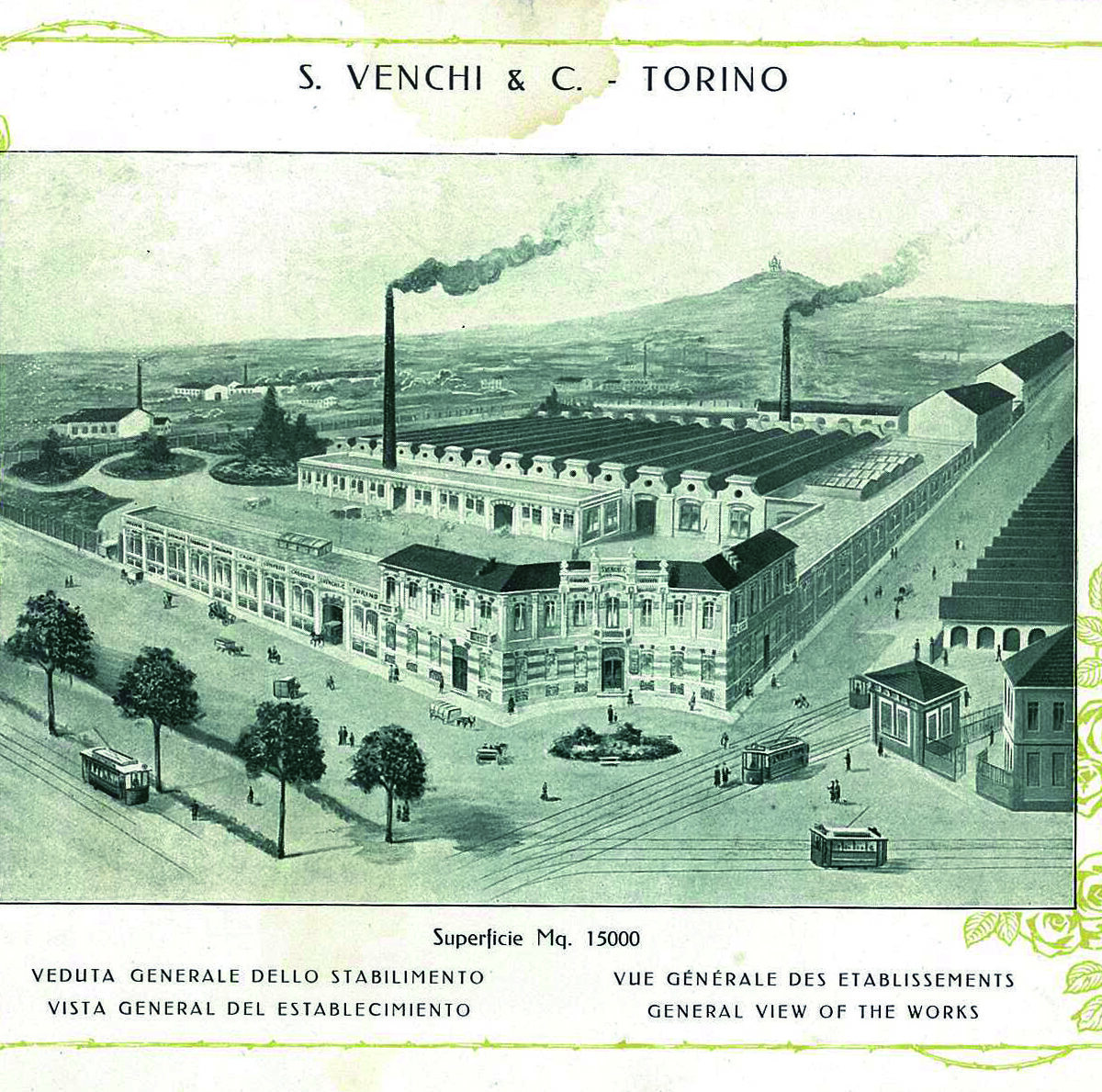
In 1907 the new plant at Corso Regina Margherita 16, at the corner of Corso Farini and Via Fontanesi, was completed, designed by Pietro Fenoglio in a late Liberty style, with reinforced concrete structures by Giovanni Antonio Porcheddu[6]. About 500 people worked there across nine departments, over 12,000 square metres, producing sugared almonds, chocolate, sweets and biscuits; in 1926 departments for biscuits, crackers and wafers were added[1][6]. In 1909 the founder was named a Cavaliere del Lavoro, with this citation[2]:
"From a simple confectionery worker, within 35 years he became the owner of a sugared-almond factory with over 200 workers."
Silviano Venchi died on 24 May 1922 without children; leadership passed to the executive Gerardo Gobbi, who according to the Padovanis also ran Venchi Unica until 1954[2]. On 22 December of that same year, the firm Idea, another Turin confectionery house, registered the "Nougatine" trademark with the prefecture[2].
Venchi Unica
In 1924 the financier Riccardo Gualino founded Unica (Unione Nazionale Industrie Cioccolato e Affini), bringing together confectionery houses active since the nineteenth century, including Venchi itself, Talmone (formerly Moriondo), Gariglio and Idea, in the large plant on Via De Sanctis 4, between Corso Francia and Corso Marche, built in 1921 on 100,000 square metres to a design by the engineer Corrado Gay[2][7]. After the collapse of Gualino's business activities, in 1931 Unica passed to the Istituto Liquidazioni and in 1934 was merged with Venchi: Venchi Unica was born, eventually employing about 3,000 workers, mostly women[8]. After the war, chocolate accounted for 70 per cent of turnover[8]. In 1931 Unica produced the first mini-gianduiotti, and in 1934 Venchi Unica launched the filled bars called "Praletta"[2]: a production tied to the city's tradition of gianduia chocolate and the gianduiotto.
The plant on Corso Regina Margherita, meanwhile, was requisitioned by the army in 1938 and converted into a military factory for leather and footwear; it was bombed by the RAF on the night of 13 July 1943[6]. The Via De Sanctis plant also suffered war damage, to 14 of its 47 rooms[7].
Sindona and the bankruptcy
In the 1970s Venchi Unica, which according to Comunicaffè had more than 350 points of sale in one of the first Italian franchising networks[5], came into the financial orbit of Michele Sindona, who had entered the company in 1970[2][8]. On 13 February 1978 the Court of Turin declared it bankrupt and the Pozzo Strada plant was abandoned[2][8]. The site today houses a public garden, municipal offices and residential buildings[7]; Fenoglio's building on Corso Regina Margherita is now home to military veterans' associations[6].
The revival in the Cuneo area
In 1980 the brand passed to the Cuneo-based pastry chef Pietro Cussino, as a partial recovery of claims against the bankruptcy; in 1998 it was relaunched by a group of young entrepreneurs led by chocolate expert Giovanni Battista Mantelli[2]. In 1999 a plant was opened at Robilante, devastated by a flood in 2002; in 2005 production moved to Castelletto Stura, to a 13,000-square-metre facility[2]. Mantelli, who in 2004 devised "chocolate caviar", summed up the trade this way: "Chocolate is a matter of nose, of blends and of experience"[9]. The company produces its 160 recipes in-house, with 24 blending tanks, and has struck agreements for the shelling of Piedmont hazelnuts sourced locally; ice cream accounts for about a third of revenues[9].
Today
Chairman and CEO is Daniele Ferrero[3], who in 1998 took over the brand together with two other entrepreneurs[10]. In 2024 the De Agostini group acquired 10.28 per cent of the capital; Ferrero holds 30 per cent, Nicolò Cangioli 22 per cent and Mantelli 12 per cent[3]. Revenue rose from about 100 million in 2019[9] to 205 million in 2023[3] and to about 250 million in 2024, with 203 shops and a target of 290 million for 2025[4]. Two thirds of the chocolate produced is exported, and the "Chocogelateria" format, introduced in 2006, is at the heart of the network, which targets airports and major tourist destinations[10]. In 2025 Ferrero outlined the direction: "we expect to increase our presence in various countries, especially at the major hubs of world tourism, particularly in large airports"[4].
Sources
- MuseoTorino
- Clara e Gigi Padovani — 14 September 2018
- Targatocn — 4 August 2024
- Comunicaffè — 10 April 2025
- Comunicaffè
- MuseoTorino
- MuseoTorino
- MuseoTorino
- Il Sole 24 Ore
- retail&food — 8 April 2025