Torre Littoria
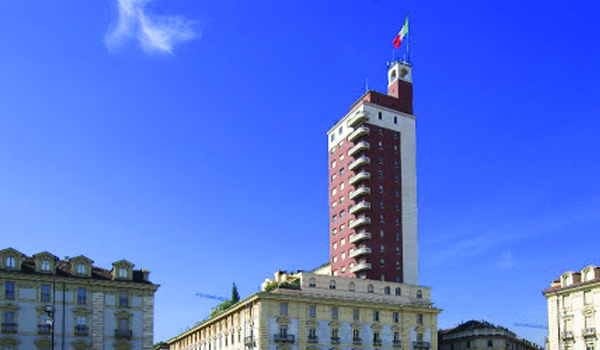
The Torre Littoria is the skyscraper standing at the corner of piazza Castello and via Viotti, in the centre of Turin. Designed by the architect Armando Melis de Villa (1889-1961) with the engineer Giovanni Bernocco and built between 1933 and 1934 by the Società Reale Mutua di Assicurazioni, it has 19 floors and measures 87 metres, 109 with the metal antenna; it was the city's first civil building with a load-bearing metal structure, clad in a brick shell.[1] It remains the tallest residential building in Turin and is still owned by the Reale group, through the company Reale Immobili.[2] Born in the midst of the Fascist regime and planted next to the buildings of the monarchy, it has for ninety years been one of the city's most debated buildings.
The design and construction
The tower was born within the large urban planning operation of the new via Roma, the reshaping of the axis between piazza Castello and piazza Carlo Felice begun with a first stretch in 1931-1932.[1] The building was originally meant to rise in piazza XVIII Dicembre; the choice later fell on the current plot, where the construction site for the new street had already opened.[3] It stands on the old Sant'Emanuele block; according to Torino Storia it was built between 1932 and 1934, while the plaque placed by the City under the arcades of piazza Castello mistakenly gives the years 1931-1933.[4] The design was drawn up in 1933 and construction, entrusted to the firm of engineers Alessandro Ferraris and Armando Bellardo, lasted just over a year, up to the inauguration in 1934.[2] Work proceeded at a fast pace, even at night.[5]
Conceived as the headquarters of the National Fascist Party, the tower was from the very start owned by Reale Mutua, which used it for offices and upmarket housing; the party's headquarters were never actually installed there.[3][6] Accounts differ on Mussolini's role: according to some stories the head of government pushed for the tower to rise precisely in piazza Castello, as a counterweight to the monarchical power represented by Palazzo Reale and Palazzo Madama;[5] according to the reconstruction by Torino Storia, based on research by Gian Luca Giani, grandson of the designer, Mussolini never took a specific interest in the tower, and the name "Littoria" was given to it by party officials simply because it was the most prominent, towering building on the city skyline.[4]
The architecture
The building consists of a low nine-storey block topped by the tower's shaft; on the north side it joins the old arcaded building of Vitozzi-style layout that closes off piazza Castello.[3] Its language oscillates between Rationalism and the Novecento style, with the contrast between travertine and brick on the side facades, the corner terraces in glass block, and an attic at the point where the base meets the tower.[1] Each floor of the tower, square in plan and about 15 metres to a side, houses a single apartment.[2] The construction site was a showcase for materials that were new at the time, from glass block to klinker tile to linoleum, mounted on an electro-welded metal frame.[7] According to the trade press it was the first Italian building with a load-bearing structure of this kind.[6]
The small tower at the top originally housed a bell dedicated to the fallen.[3]
The war and the nicknames
During the Second World War, one of the city's air-raid sirens was mounted on top of the tower, a "triple" system made up of three sirens.[8] In the bombing of 13 July 1943 the building suffered minor damage to its window frames and the breakage of some of the glass.[1]
Turin residents never fully warmed to it: they called it "the Duce's finger", in Piedmontese ël dil dël Dus, then "eyesore", and in more recent times "mobile phone".[7] Giani dedicated to his grandfather and his work the book L'incanto della Torre, which tells "the story of a man and the tower he built", a building that only a few years after its construction many would have liked to demolish, halve in height, or repaint.[4]
The belvedere that never was
From 2012 Reale Mutua studied an external panoramic lift, to be attached to one corner of the tower, with a café-bar on the eighteenth and nineteenth floors and a restaurant on the seventh and eighth.[5][9] The Soprintendenza, led by the architect Luca Rinaldi, rejected the project and then also a "dark" version, without external lighting. According to La Stampa, Rinaldi commented: "We have already allowed escalators to be installed in the baroque building of the Egizio, now let's not destroy the Torre Littoria. We are Turin, not Dubai," referring to the Museo Egizio.[9] In August 2014 the company's board of directors shelved the project, and the general manager Luigi Lana announced that in September it would request the return of the 250,000 euros in development charges already paid to the City; the councillor for urban planning Stefano Lo Russo said he was sorry the go-ahead had not been given.[9]
Today
In 2003 the architect Benedetto Camerana had turned the thirteenth floor into his own home; in December 2017, after winning a competition, his firm Camerana&Partners began the redesign of the tower.[6] Among the inspirations for the project, the architect recalled "the first flight by plane, to New York, landing in Turin right over piazza Castello" and the views in the 1682 Theatrum Sabaudiae.[6] In 2020 the upper floors became luxury rental apartments, single-storey and duplex units with terraces, included by Reale Immobili in its "Collezione Prestige" line and equipped with a concierge service.[10][11] By December 2020 ten units had been completed.[6]
At 87 metres without the antenna, the tower is today the fourth tallest building in Turin, after the Intesa Sanpaolo skyscraper, the Mole Antonelliana and the Piedmont Region skyscraper.[2]
Pages linking here
Sources
- MuseoTorino (Città di Torino)
- Urbanfile — 2 May 2024
- AtlasFor – Fondazione Landscapefor
- Torino Storia — 3 March 2017
- Un anno in Piemonte
- Imprese Edili News — 12 December 2020
- Mole24 — 15 October 2012
- MuseoTorino (Città di Torino)
- Intermedia Channel (da La Stampa, Emanuela Minucci) — 13 August 2014
- idealista/news — 22 June 2020
- Torino Magazine — 27 March 2020