Piazza San Carlo
Seventeenth-century arcaded square in Turin, laid out by Carlo di Castellamonte in 1637, with its twin churches and the monument to Emanuele Filiberto.
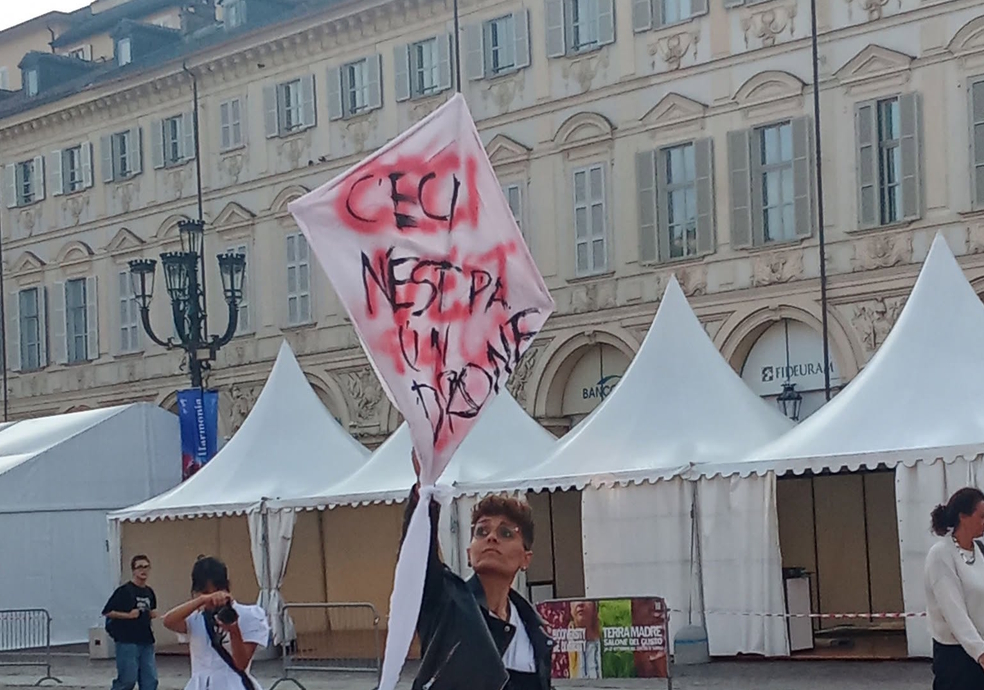
Piazza San Carlo is the large rectangular arcaded square that opens along the axis of the old Via Nuova, today via Roma, halfway between Piazza Castello and Porta Nuova, in the centre of Turin. Created in the seventeenth century as the «piazza Reale» (Royal Square) of the first Baroque expansion of the Savoy capital, with its two twin churches on the south side and the equestrian monument to Emanuele Filiberto at its centre, it is one of the city's main public spaces. The Enciclopedia Italiana, in its entry devoted to the city, recalled it as the work commissioned by the Madama Reale Cristina di Francia, «considered one of the most beautiful in Europe»[1].
The Piazza Reale of the Città Nuova
The square is the heart of Turin's first expansion beyond the Roman walls. The plan for the «Città Nuova» (New City) took shape in 1620 under Carlo di Castellamonte: a regular grid in the area still free to the south of the city, crossed by the Via Nuova, which ran from the gate of the same name all the way to the front of the royal palace. Castellamonte increased the width of the street from seven to eleven metres and that of the arcades to seven and a half metres, a geometric order set against the medieval street network[2]. Castellamonte thus continued the work begun by Ascanio Vittozzi, extending the Via Nuova beyond the square, which «he himself designed in composed and severe forms», as far as Porta Nuova[1].
The laying-out of the piazza Reale, later named after San Carlo, dates to 1637. Castellamonte's design relied on broad rhythms: paired, widely spaced columns under the arcades, only enclosed in pilasters in 1773, with the facades behind them looking out onto countryside still untouched[2]. The Enciclopedia Italiana attributes the construction of the square to the regent Cristina di Francia[1].
The twin churches
The south side of the square is closed off by two churches standing side by side. Santa Cristina was built two years after the square was laid out and completed by Castellamonte's son, Amedeo. Records show that on 4 October 1638 Cristina di Francia bought the architect's house in order to donate it, on 3 March 1639, to the Discalced Carmelite nuns[2]. As for its twin, San Carlo, the Dizionario Biografico degli Italiani is unequivocal: the attribution to Castellamonte is arbitrary, and the architect was probably Maurizio Valperga[2].
Almost eighty years later the second Madama Reale, Maria Giovanna Battista di Savoia Nemours, entrusted Filippo Juvarra with the design of two twin facades for the head of the square. Only one was actually built, that of Santa Cristina, between 1715 and 1718[3]. In the judgement of the Enciclopedia Italiana, in the churches of Santa Cristina, Santa Croce and San Filippo, Juvarra «overcomes the laborious complexity of the Baroque's spatial problems in a supreme decorative freedom»[1].
The monument to Emanuele Filiberto
At the centre of the square stands the equestrian statue of Emanuele Filiberto, the sixteenth-century Duke of Savoy. The commission came from King Carlo Alberto to the sculptor Carlo Marochetti, who worked on the piece from 1831 to 1838. The first sketch, presented in October 1831, already showed the commander on his rearing horse; in December there followed a study with a more elaborate base. Marochetti proposed to the king that he carry out the monument asking only for his expenses to be reimbursed, and was given the go-ahead[4].
The statue was made entirely in France and cast in only two pieces. Before leaving for Turin it was exhibited in 1838 in the courtyard of the Louvre, and for this reason it entered that year's Salon catalogue. The sculptor attended the unveiling in Piazza San Carlo on 4 November 1838, and four days later received the title of baron from Carlo Alberto; the enthusiastic reception of the work brought him numerous commissions for equestrian monuments across Europe between 1840 and 1850[4]. The figure being honoured was the victor of Saint-Quentin: in 1557, during the siege of the city, the imperial army led by Emanuele Filiberto surprised and resoundingly defeated the French troops of the Constable Anne de Montmorency[5].
«In the second half of the nineteenth century, almost all the squares and gardens of the city were adorned with monuments, not all of them equal to the statue of Emanuele Filiberto, by Marochetti (1838).»
The Enciclopedia Italiana's judgement makes the monument the yardstick for the whole of nineteenth-century Turin statuary[1].
The night of 3 June 2017
The square is also linked to the tragedy of 3 June 2017. That evening a large crowd of Juventus fans were watching the Champions League final against Real Madrid on a giant screen when a false alarm triggered panic: hundreds of people were injured in the crush, and the then mayor Chiara Appendino apologised, promising to establish responsibility[6]. Investigations traced the wave of panic to irritant spray used by a group of robbers[7]. In the crush two women were seriously injured: one died a few days later, the other, left tetraplegic, in January 2019[7].
On 27 January 2021, in the fast-track trial over the organisation of the evening, Appendino was sentenced at first instance to one year and six months along with four other defendants, including the former police chief; a second trial, under ordinary procedure, concerned other officials[7]. The conviction was upheld on appeal in June 2023; on 17 June 2024 the Court of Cassation made the former mayor's criminal liability final and ordered a new appeal trial to recalculate the sentence; according to Il Post's reconstruction, more than 1,500 people were injured that night[8].
Pages linking here
- Adam Sandler
- Arturo Brachetti
- Augusta Taurinorum
- Basilica di Superga
- Bicerin
- Caffè San Carlo
- Chiara Appendino
- Christine of France
- Digi.TO - the online magazine of Turin's Informagiovani
- Dora Riparia
- Emmanuel Philibert
- Festival Digitale Popolare
- Fifth Edition of the Festival Digitale Popolare at Gallerie d'Italia in Turin
- Filippo Juvarra
- Filming of «Grown Ups 3» in Turin (September 2026)
- Gianduiotto
- Gianduja chocolate
- House of Savoy
- Intesa Sanpaolo
- Kingdom of Sardinia
- Massimo Gramellini
- Mayors of Turin
- Palazzo Reale
- Piazza Castello
- Piazza San Carlo tragedy
- Portici di Carta 2026
- Toret
- Torino
- Victor Emmanuel II
- Vittorio Alfieri
- «Luca Campigotto. Wandering Europe» Exhibition at the Gallerie d'Italia (September 2026–February 2027)
Chronology
- — The exhibition "Luca Campigotto. Wandering Europe" opens at the Gallerie d'Italia in Piazza San Carlo, on view until 7 February 2027. → TorinoOggi Il Torinese
Related articles: Carlo Alberto, Castello del Valentino, Chiara Appendino, Emmanuel Philibert, Monte dei Cappuccini, Piazza San Carlo tragedy