Sauze d'Oulx
Municipality in the upper Susa Valley, a tourist resort since 1906 and now part of the Via Lattea, host to Olympic freestyle skiing in 2006 and birthplace of Piero Gros.
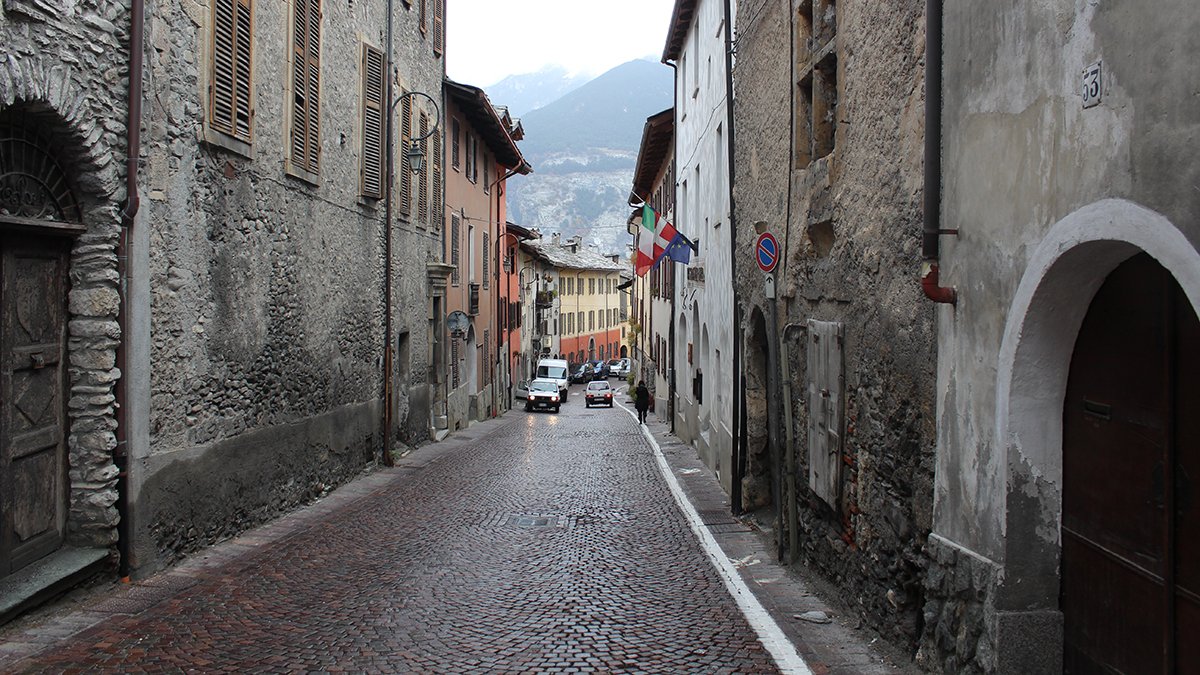
Sauze d'Oulx is a municipality in the upper Susa Valley, in the Metropolitan City of Turin: 17.1 square kilometres of territory and, according to the 2008 survey, 1,157 inhabitants[1]. For more than a century it has been one of the leading ski resorts for people from Turin, it is part of the Via Lattea ski area together with Sestriere and Claviere, it hosted the freestyle events of the 2006 Turin Winter Olympics and is the birthplace of Piero Gros, Olympic gold medallist in the slalom in 1976. The nickname by which the resort is known in the skiing world is "Balcony of the Alps"[2].
From the Escartons to the Savoy
For most of its history the upper valley looked toward the Dauphiné more than toward Turin. In 1343 the Grande Charte granted by the Dauphin Humbert II recognised for the mountain communities, in exchange for a ransom of 12,000 gold florins, broad fiscal and administrative autonomy: the federation of the Escartons was born, five cantons straddling the Alps. The Escarton of Oulx ran from Cesana to the Gelassa stream and also included Bardonecchia. The arrangement lasted until the Treaty of Utrecht, at the start of the eighteenth century, when the upper valley passed to the Savoy; what remains is the memory of an alpine culture with a Provençal-based language[3].
The French origin of the name weighed on it in the twentieth century. In 1940 a law of the Fascist regime declared the everyday use of almost all foreign words anti-Italian, with the stated aim of "combating the unconscious servility that delights in foreign words," and the municipalities of the Susa Valley received Italianised names: Oulx became Ulzio, Sauze d'Oulx became Salice di Ulzio[4]. Treccani dates the name Salice d'Ulzio from 1939 to 1945[1].
The birth of the resort
The town traces its birth as a tourist resort to 1906: in 2026 it celebrated its 120th anniversary with a night show on the slopes[5][6] and with a documentary by Giorgia Mecca broadcast on Sky Sport, featuring Piero Gros, the historian Amedeo Macagno and the director of the Museo Nazionale della Montagna, Daniela Berta[2]. In the same year an exhibition of posters and historic skis from Macagno's collection retraced the story of the sport, starting with Adolfo Kind, the pioneer who brought skiing to Italy in 1896. Macagno has curated for more than thirty years the vintage ski race, born between Sauze and Sestriere, which in 2026 reached its thirty-fourth edition and is raced with equipment produced between the early twentieth century and the 1970s; the poster for the first edition was dedicated to the architect and skier Carlo Mollino[7].
A 1952 newsreel by the Istituto Luce shows what the day trip of Turin skiers was like at the time: train to Oulx, then the coach to the town, where ski lifts and ski instructors awaited. In the years of the economic boom, the farming village was transformed into a resort of hotels and second homes[8]. Already in the 1960s Delfo Baccon, restaurateur and painter, opened on the main square, named after the Third Alpini Regiment, the Hotel Derby, one of the town's first hotels, frequented by Italians and English[9].
The town of the English
More than fifty years ago charter flights from England began bringing British skiers to Sauze, and some of them stayed. In 2021, when the English community organised a mass in memory of Prince Philip, the mayor Mauro Meneguzzi gave a sense of the scale:
"Sauze d'Oulx has always been closely tied to Great Britain. More than fifty years ago the first charter flight arrived from England. Since then the English in Sauze have always felt at home and been made to feel at home."
According to the same mayor, the English community makes up 10% of residents[10]. An emblematic case is that of Vincent Hawkins, originally from Liverpool, owner of the Il Falco restaurant in the historic village: the first Englishman elected to the municipal council and later tourism councillor in the Roberto Faure administration, in June 2018 he unanimously received honorary citizenship, because, said Meneguzzi, "he has been in Sauze for almost 40 years"[11].
Piero Gros, the champion from Jouvenceaux
The hamlet of Jouvenceaux is the birthplace of Piero Gros (1954), winner of the Alpine Skiing World Cup in 1974 and the Olympic title in the slalom at the 1976 Innsbruck Games[12]. In 2021 his portrait was painted on the Jouvenceaux bus stop, with the image of the start of the Innsbruck race[13]; the fiftieth anniversary of that gold medal was celebrated together with the resort's 120th anniversary[6].
The 2006 Olympic moguls
Sauze d'Oulx was one of the municipalities hosting events of the 2006 Turin Olympics[14]. For freestyle skiing a slope rich in moguls was built, with a gradient of 27 degrees, served by a ski tow and a system of programmed snowmaking[14]. The medals for moguls and aerials were awarded here: in the moguls the winners were the Canadian Jennifer Heil and the Australian Dale Begg-Smith, in the aerials the Swiss Evelyne Leu and the Chinese Han Xiaopeng[15].
The Games left the town new ski lifts; the freestyle stadium, however, was dismantled, and in its place a sports centre arose with tennis and padel courts, a golf practice range and a swimming pool[16]. As early as 2020 the municipality had planned, in the former freestyle area, on the meadow of via Seguret above the Genevris underground car park, a free-access multi-purpose sports field, with a total projected cost of 50,000 euros[17].
Today
The slopes of Sauze are linked to the Via Lattea, which has more than 400 kilometres of slopes and 70 lifts between Italy and France and presents itself as the largest ski area in Piedmont[18]. The lifts are managed under a May 2020 agreement between the lift operating company and seven municipalities, including Sauze d'Oulx, valid until 2040; in 2022 the partners Giovanni Brasso and Alessandro Perron Cabus, who had taken over the company from the Agnelli family at the time of the Games, signed a preliminary agreement worth 100 million euros to sell it to the British fund Icon Infrastructure[19].
The parish is dedicated to San Giovanni Battista. Don Fiorentino Vair was its parish priest for 36 years, from 1980 to 2016; at his death, in 2021, the funeral was celebrated in the cathedral of San Giusto in Susa by the bishop of Turin and Susa, Cesare Nosiglia[20]. Out of season the town lives on events such as the mountain potato festival, which in its September 2026 edition drew thousands of visitors[21].
Pages linking here
- Bardonecchia
- Centesimo anniversario della Squadra di Montagna della Croce Verde di Torino
- Claviere
- Inalpi Arena
- Olimpiadi invernali di Torino 2006
- Sestriere
- Val di Susa
- Via Lattea (ski area)
Related articles: Bardonecchia, Inalpi Arena, Lingotto, Olimpiadi invernali di Torino 2006, Sestriere, Stadio Olimpico Grande Torino
Sources
- Treccani
- L'Agenda News — 6 January 2026
- L'Agenda News
- L'Agenda News — 5 July 2020
- L'Agenda News — 5 February 2026
- L'Agenda News — 9 February 2026
- L'Agenda News — 21 February 2026
- L'Agenda News — 31 January 2021
- L'Agenda News — 31 March 2022
- L'Agenda News — 19 April 2021
- L'Agenda News — 12 June 2018
- Treccani
- L'Agenda News — 20 May 2021
- Consiglio regionale del Piemonte
- Treccani
- Il Post — 28 March 2024
- L'Agenda News — 13 February 2020
- Vialattea
- L'Agenda News — 18 January 2022
- L'Agenda News — 5 November 2021
- L'Agenda News — 23 September 2026