Rocciamelone
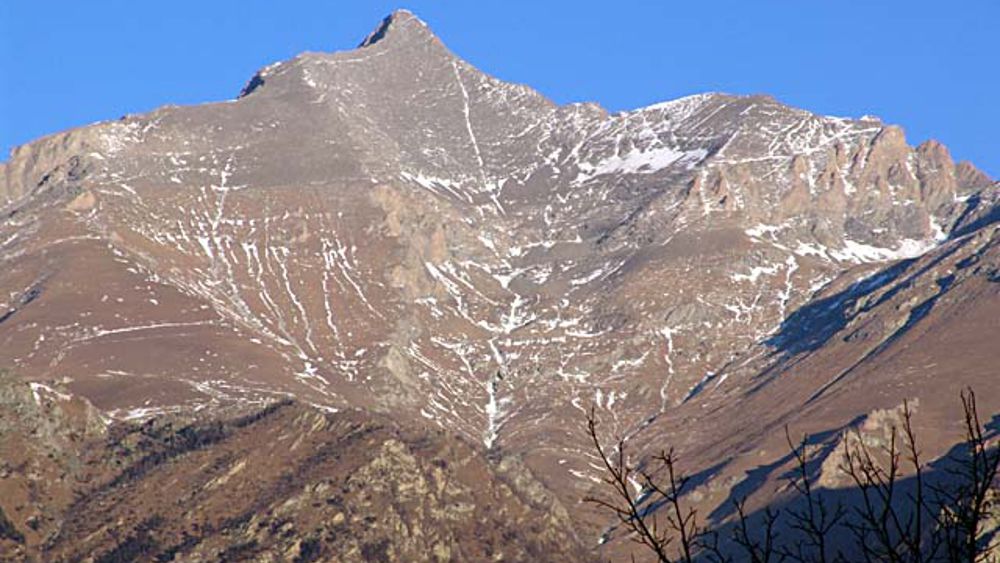
The Rocciamelone is a mountain in the Graian Alps, 3,538 metres high, on the border between Italy and France, east of the Moncenisio[1]. The summit lies within the territory of Mompantero, above Susa, in the Val di Susa (Metropolitan City of Turin), and is also one of the highest peaks of the Valli di Lanzo[2]. It is the sacred mountain of the valley: on the summit stand a bronze statue of the Madonna and a sanctuary-refuge, said to be one of the highest Marian sanctuaries in Europe[3], and its first ascent, in 1358, is the oldest documented climb of an Alpine peak[4].
Geography and name
The Italian side, facing the Val di Susa, includes the summit and descends in grassy slopes and scree; on the French side lies the upper part of a broad glacier that flows down toward the Arc valley[1]. The origin of the name is disputed: one theory links it to a Celtic root meaning a summit, another to a Ligurian root; the Romans latinised it as Mons Romuleus, and a legend tells of a King Romulus who is said to have spent his summers there and hidden his treasures. In the Middle Ages it was believed to be the highest peak in the Alps, partly because it was clearly visible from the busy Via Francigena, which crossed the Alps at the Moncenisio[2].
Bonifacio Rotario's ascent (1358)
On 1 September 1358, Bonifacio Rotario, a nobleman of the Astigiano family of the Rotari, later called Roero, reached the summit[4]. In the last days of August he had already attempted the climb, stopping at around 2,800 metres: at that spot, where the group had camped, the shelter later known as "Ca' d'Asti" was built in honour of his home city, considered the first mountain refuge in the Alps[4]. The feat fulfilled a vow: according to one hypothesis it was linked to the liberation of Asti from Visconti rule, according to another to his safe return from an expedition to the Holy Land, where Rotario had been held prisoner[4].
At the summit Rotario left a gilded bronze triptych of Franco-Flemish workmanship, perhaps made in Bruges: at the centre the Madonna with the Child, flanked by Saint George on horseback slaying the dragon and a bearded saint presenting the donor to the Virgin[4]. A Latin inscription in Gothic lettering runs across the panels, giving the date of the feat:
"Hic me aportavit Bonifacius Rotarius civis astensis"
The triptych in the valley
In 1673 a farmer from Novaretto, Giacomo Gagnor, climbed to the summit, took the triptych and brought it to Rivoli, to the court of Duke Carlo Emanuele II of Savoy. Since then the work has never returned to the summit: it was kept in Susa, first in the church of San Paolo and then in the abbey of San Giusto, which became a cathedral in 1772; since 2000 it has been on display in the Diocesan Museum housed in the church of the Madonna del Ponte[4]. Every year, for the patronal feast, the triptych is carried in procession: in the 2026 programme, on the evening of 4 August it arrives from the hamlet of Seghino at the sanctuary of Mompantero, and on the evening of the 5th it sets off again for the cathedral of Susa[5].
The statue of the children of Italy (1899)
The idea of a large statue on the summit came from Canon Antonio Tonda, parish priest of the cathedral of Susa, in 1895[6]. Giovanni Battista Ghirardi, editor of the children's newspaper "Innocenza," launched a fundraising campaign aimed solely at children, not at the wealthy: about 130,000 children from all over Italy took part, each contributing ten centesimi, and their names were collected in a volume placed inside the base[6][7]. The statue, modelled by the sculptor Giovanni Antonio Stuardi, was divided into eight pieces[3][7]; the City of Susa describes it as 4 metres tall, with 650 kilograms of bronze and 800 of internal framework[7], while "L'Alpino," the magazine of the National Association of Alpini, and other sources give 3 metres[8][2]. The pieces were carried on the shoulders of the Alpini of the "Susa" battalion of the 4th regiment[8]. According to the City of Susa, sixty Alpini, together with some men from Mompantero, carried the pieces up in several stages: the hardest part began on 26 July, and the statue reached the summit at 10 a.m. on 28 July 1899[7]; "L'Alpino" places the inauguration on 28 August of the same year[8]. Leo XIII blessed the work and wrote its dedication, engraved on a bronze plate[7]:
"Alma Dei Mater / nive candidior / MARIA / lumine benigno Segusiam respice tuam / Ausoniae tuere fines / coelestis Patrona"
According to "In Terris," it was Leo XIII himself who made the Madonna del Rocciamelone the principal patron of the diocese of Susa[6]; the diocese recalls the apostolic letter "In Alpium Cottiarum" with which, on 21 November 1961, John XXIII proclaimed the Madonna del Rocciamelone and Saint Giusto of Novalesa as patrons of the diocese[5].
The chapel-refuge
The first chapel, according to the City of Susa, had been carved into the rock by Rotario; in the eighteenth century it was replaced by a wooden structure, which was soon damaged by the weather[7]. Another wooden chapel, commissioned by Canon Tonda, was blessed in August 1895 and destroyed by fire in 1913[7] (1912, according to the Città e Cattedrali record[3]). Bishop Giuseppe Castelli and Tonda then decided to rebuild it with an attached refuge, so that a priest could remain at the summit to assist pilgrims during the period of greatest attendance, from 1 to 15 August; Popes Pius X, Benedict XV and Pius XI supported the project with donations[7]. The first stone was blessed on 15 August 1920, and the chapel-refuge, designed by the architect Natale Reviglio, was inaugurated by Bishop Umberto Rossi on 12 August 1923; during the construction work the path from Ca' d'Asti to the summit was laid out[7][3]. In the 1970s the Val Susa section of the National Association of Alpini restored it together with Giovane Montagna and Bishop Giuseppe Garneri[7].
The glacier and the lake
The glacier on the north-western slope, at around 3,200 metres, has shrunk and fragmented rapidly over the last twenty years. In 1985 a lake formed within it, and its growth worried both the French and Italian authorities: drainage works began in 2004 and were completed in the summer of 2005[2]. On 5 October 2004, French technicians from RTM-ONF, LGGE and Cemagref, together with civil protection and the French army, installed a first 100-millimetre pipe to siphon the water toward the French side, in order to reduce the pressure on the fragile ice dam and the risk of a sudden outflow toward the Ribon valley, above Bessans[9].
Today
The summit can only be reached on foot; for the climb up to 3,538 metres, the City of Susa recommends suitable clothing and good hiking fitness[7]. The feast of the Madonna del Rocciamelone, patroness of the diocese and of the city of Susa, is celebrated at the sanctuary of Mompantero with a triduum that culminates on 5 August with a Mass presided over by the bishop[5], and the procession draws worshippers from the valley and from neighbouring dioceses of Piedmont[6].
Pages linking here
Sources
- Treccani, Enciclopedia Italiana
- TorinoMeteo — 19 August 2018
- Città e Cattedrali
- Il Lambello
- Diocesi di Susa
- In Terris — 5 November 2019
- Città di Susa
- L'Alpino (Associazione Nazionale Alpini) — 22 April 2011
- Nimbus – Società Meteorologica Italiana — 6 October 2004