Rita Levi-Montalcini
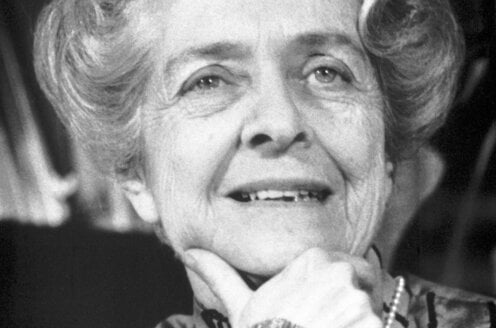
Rita Levi-Montalcini (Torino, 22 April 1909 – Rome, 30 December 2012) was a neurobiologist, winner of the Nobel Prize in Physiology or Medicine in 1986 for the discovery of nerve growth factor (NGF), and a senator for life from 2001. Born into a Jewish family in Turin, she trained at the University of Turin and began the research that would lead her to the Nobel Prize in a bedroom in the city, during the racial persecutions.[1]
A Turinese family
She was the daughter of Adamo Levi, an electromechanical engineer and mathematician, and the painter Adele Montalcini; she was born together with her twin sister Paola, who would become a painter, and had two older siblings, Gino, later an architect, and Anna.[1] Their father believed that a professional career would interfere with the duties of wife and mother, and decided that his three daughters would not pursue studies leading to a profession nor enroll at university.[2] The scientist's recollection of this, given in the autobiography she wrote for the Nobel Foundation, is unambiguous:
«I realized that I could not possibly adjust to a feminine role as conceived by my father, and asked him permission to engage in a professional career.»
Having obtained his consent, she made up for gaps in Latin, Greek and mathematics in eight months, passed her school-leaving exams and enrolled in medicine in Turin.[2]
At Giuseppe Levi's Institute of Anatomy
Enrolled in the Faculty of Medicine and Surgery in 1930, she attended the Institute of Anatomy directed by the histologist Giuseppe Levi, where her fellow students included Renato Dulbecco and Salvatore Luria, both future Nobel laureates, as well as Cornelio Fazio and Rodolfo Amprino.[1] Levi, who remained her mentor for the rest of her life, introduced her to the study of the nervous system.[3] She graduated with honors in 1936 and in 1939 obtained a specialization in neuropathology and psychiatry.[1]
The racial laws and the bedroom laboratory
With the anti-Jewish laws of 1938 she was suspended from her position as a voluntary assistant and excluded from Italian public institutions.[1][4] After a period in a neurological laboratory in Brussels, she returned to Turin in 1940 and set up a small clandestine laboratory at home, where she welcomed Giuseppe Levi himself, who had also been removed from the university.[4] Instruments, glassware and reagents were improvised; chicken embryos were dissected on household tables.[3] It was Levi who suggested she study the effects of limb removal in chicken embryos, following the model described by the embryologist Viktor Hamburger in a 1934 paper.[1] Many years later she summed up that period with a paradox:
«Devo ringraziare Mussolini per avermi dichiarato di razza inferiore. Questo mi ha portato alla gioia di lavorare, non più purtroppo negli istituti universitari, ma in una camera da letto».
The statement is recorded in the World Jewish Congress's collection of Holocaust testimonies.[5] When the 1942 bombings struck the city, the family moved to the countryside, in the Asti area, and the laboratory went with them.[1][3] After 8 September 1943, to escape German round-ups, she took refuge with her family in Florence under a false name; once the city was liberated in 1944, she worked there as a doctor in a military hospital.[1] In 1945 she returned to Turin and resumed her post as assistant to the chair of anatomy.[4]
From Saint Louis to the Nobel Prize
In the autumn of 1947 Hamburger invited her to Washington University in Saint Louis: the stay, originally planned for ten to twelve months, lasted for decades, with her appointment as associate professor in 1956 and full professor in 1958, until her retirement in 1977.[2] She herself recalled it as the happiest and most productive period of her life.[1] There, through experiments on chicken embryos, she hypothesized the existence of a chemical factor capable of stimulating the growth of nerve fibers; in 1952 she confirmed the hypothesis with in vitro cultures at the Institute of Biophysics in Rio de Janeiro, together with Hertha Meyer.[1][4] From 1953 the biochemist Stanley Cohen worked with her to isolate its protein component, nerve growth factor.[4]
In the 1960s she returned to Italy and in Rome directed the CNR's Center for Neurobiology Research at the Istituto Superiore di Sanità.[1] On 10 December 1986, in Stockholm, she received the Nobel Prize in Physiology or Medicine, shared equally with Cohen, «for their discoveries of growth factors».[1][6] The citation reported by the Dizionario Biografico describes the discovery of NGF as «a fascinating example of how a keen observer can draw valid hypotheses from apparent chaos».[1]
The final years
On 1 August 2001 President Carlo Azeglio Ciampi appointed her senator for life «for having brought honor to the Homeland through outstanding achievements in the scientific and social fields».[7] In 1992, together with her twin sister and in memory of their father, she founded the Rita Levi-Montalcini Foundation to help young African women; she chaired the Istituto dell'Enciclopedia Italiana from 1993 to 1998 and founded the European Brain Research Institute, which from 2004 was based in Rome at the Fondazione Santa Lucia.[1] On 7 October 2009, having just turned one hundred, she returned to the University of Turin to meet with students.[8]
She died in Rome on 30 December 2012, in the home she had shared with Paola.[1] On 2 January 2013 her coffin arrived at the Cimitero Monumentale in Turin for a public civil ceremony: thousands of people attended, including ministers Elsa Fornero and Francesco Profumo and the President of the Region, Roberto Cota; representatives of the Jewish community recalled the racial laws and her exile.[9] After cremation, her ashes were placed beside the remains of her twin sister, in the family tomb designed by her brother Gino.[10][1]
Her name in the city
In Turin, her name is given to the comprehensive school at via Pietro Palmieri 58, housed in the former elementary school building built in 1910 by engineer Ghiotti for the City.[11] In December 2023 the City's street-naming commission unanimously decided to name the central pedestrian strip of corso Galileo Ferraris, between corso Matteotti and via Cernaia, «Passeggiata Rita Levi Montalcini».[12]
Pages linking here
Sources
- Treccani – Dizionario Biografico degli Italiani
- The Nobel Prize (nobelprize.org)
- Focus
- Treccani – Enciclopedia
- About Holocaust (Congresso ebraico mondiale – UNESCO)
- The Nobel Prize (nobelprize.org)
- Consiglio Nazionale delle Ricerche — 7 August 2001
- Torino Scienza
- Il Fatto Quotidiano — 2 January 2013
- Quotidiano Nazionale — 2 January 2013
- MuseoTorino
- CittAgorà – Consiglio comunale di Torino — 12 December 2023