Fenestrelle Fort
Europe's most extensive Alpine fortification: three Savoyard forts linked by a covered stairway of 4,000 steps, built in the Chisone valley between 1728 and 1850.
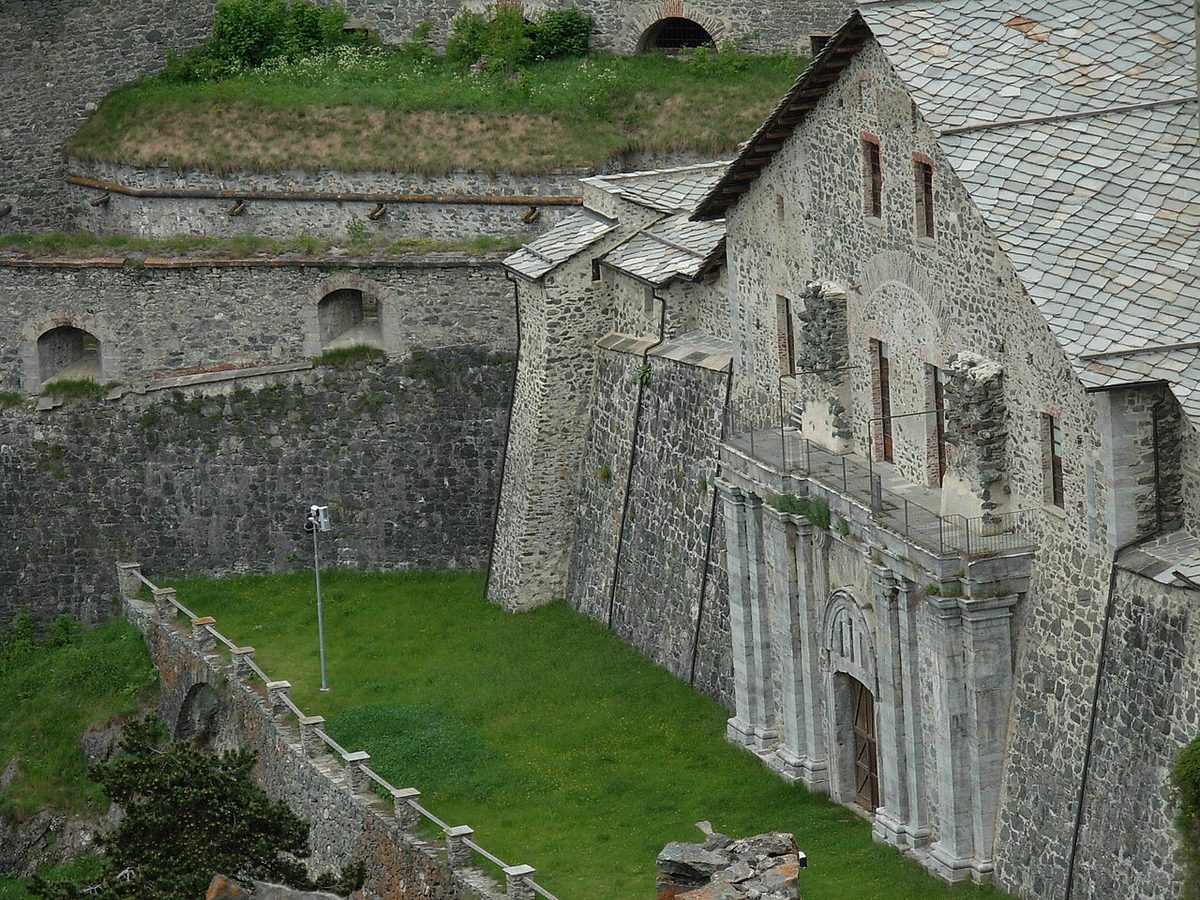

The Fenestrelle Fort is the large eighteenth-century system of fortifications that bars the Chisone valley above the village of Fenestrelle, in the Metropolitan City of Turin. Commissioned by Vittorio Amedeo II and built between 1728 and 1850, it stretches for more than three kilometres along the mountain ridge, over an area of about 1,350,000 square metres and with a difference in elevation of about 600 metres between its works[1]. The Region presents it as the longest fortification in Europe and one of the very few from the eighteenth century to have survived intact to this day[2].
A new frontier after Utrecht
The upper Chisone valley had not belonged to Savoy: it passed to Vittorio Amedeo II under the 1713 Treaty of Utrecht, and the duke, having become king, decided to seal it off with works that, together with those of Exilles, Susa and the Brunetta, would form the so-called «Alpine military line» against French incursions[3]. The village stands at 1,154 metres above sea level; in 1921 it had 1,195 inhabitants[3].
The project was presented in the autumn of 1727 by the engineer Ignazio Bertola, on the king's commission. Work began in the spring of 1728, under Bertola's own direction alongside the engineer Varino de la Marche, and continued for more than a century, until 1850[1]. With the works already well advanced, Carlo Alberto added, according to the Enciclopedia Italiana, «a grand fort in addition to the others»[3].
Three forts and a stairway of four thousand steps
The complex comprises eight defensive works spread along the ridge: the main one is Fort San Carlo, at the bottom, the smallest the Santa Barbara Redoubt[1]. The three fortified nuclei — San Carlo, Tre Denti and Delle Valli — are linked by a tunnel enclosing the covered stairway, described by the association that manages the site as the longest in Europe[4]. Its 4,000 steps, protected by walls two metres thick, climb for more than two kilometres: they allowed troops to move from one fort to another sheltered from enemy fire and from snow[1]. Alongside it runs the open-air Royal Stairway, of about 3,000 steps; the full visit climbs to the 1,800 metres of Fort Delle Valli, while the Garitta del Diavolo viewpoint stands at about 1,400 metres[5].
State prison
Besides its military garrison, the fort long served as a prison: state prisoners were held in the main buildings, common prisoners in the barracks[1]. Among its illustrious prisoners, the 1932 Enciclopedia Italiana recalls Cardinal Pacca and Xavier de Maistre[3].
Bartolomeo Pacca, pro-secretary of state to Pius VII and among those who urged the pope to resist Napoleon, was taken from the Quirinal together with the pontiff in July 1809, when General Étienne Radet occupied the palace, and interned at Fenestrelle; he was released in early 1813, after the Concordat of Fontainebleau[6]. During his detention he dictated his memoirs to his nephew Tiberio; published in Civitavecchia in 1829 as an account of his two journeys to France «and of his imprisonment in the fort of San Carlo at Fenestrelle», they were collected the following year in the Memorie storiche[6]. In the book the cardinal describes the isolation regime that greeted him[7]:
«From the very moment I set foot in the fortress, the commander had informed me of the government's order, by which I was strictly forbidden to write to anyone whatsoever»
To evade the surveillance of the fort's commander and major, who would enter unannounced, Pacca took to «rising in the morning some time before sunrise» to write in the silence[7].
The Bourbon prisoners of 1860
After the fall of the Kingdom of the Two Sicilies, 1,189 Bourbon soldiers arrived at Fenestrelle as prisoners of war in November 1860. According to the account given by the association that manages the fort, based on documents from the Turin State Archive, they received a double ration of minestrone and clothing suited to the cold; the sick were treated or transferred, four men died of natural causes and on 9 December the rest were enrolled in the Italian army[1]. The village's name also remained tied to later military history: an Alpini battalion was named «Fenestrelle», and in 1931 twenty-one of its men died under an avalanche above Bardonecchia[8].
Abandonment and revival
The military left the fort in 1947, and for more than forty years its works fell into ruin. In 1990 a group of volunteers set up the Associazione Progetto San Carlo, which began the restoration and has brought the fortress back among Piedmont's historic destinations[1]. The property belongs to the State: since 2022 the association has managed it under a concession from the State Property Agency[2]. Guided visits range from the hour devoted to the buildings, cellars and kitchens of San Carlo up to the seven-hour «Royal Walk», which the association compares to a mountain hike[5]; in summer a nocturnal travelling re-enactment tells the fort's story from 1728 onward[9].
The fort today
In 2022 it had about 50,000 visitors. In November 2023 the Piedmont Region launched an 800,000-euro project — 700,000 from the Region, 50,000 from the municipality and 50,000 from Fondazione CRT — to redo the roof of the eighteenth-century church with original materials, replace the wooden beams, manage water drainage at the Tre Denti and Delle Valli forts and set up a virtual-visit room for those who cannot manage the walking routes[2]. Presenting the works, Region president Alberto Cirio and councillor Vittoria Poggio drew a comparison with the Great Wall[2]:
«Many know the Great Wall of China as the longest in the world; here in Piedmont we have the longest in Europe.»
In May 2025 the Region announced a further 400,000 euros in European funds for lighting, video surveillance and the safety of the most critical sections; councillor Gian Luca Vignale called the fort a «flagship asset» of Piedmont[10]. In summer the Governor's Palace hosts the «Le Fenestrelle» book fair, which reached its thirtieth edition in 2024, with more than ten thousand volumes and talks in the church overlooking the parade ground[11]. From Fenestrelle the valley road runs down towards Pinerolo and up towards Sestriere.
Pages linking here
Sources
- Associazione Progetto San Carlo – Forte di Fenestrelle
- L'Agenda News — 11 November 2023
- Treccani – Enciclopedia Italiana (1932) —
- Associazione Progetto San Carlo – Forte di Fenestrelle
- Associazione Progetto San Carlo – Forte di Fenestrelle
- Treccani – Dizionario Biografico degli Italiani
- Internet Archive (Pesaro, Annesio Nobili, 1830) —
- L'Agenda News — 26 July 2025
- Associazione Progetto San Carlo – Forte di Fenestrelle
- L'Agenda News — 23 May 2025
- L'Agenda News — 7 July 2024