Emilio Salgari
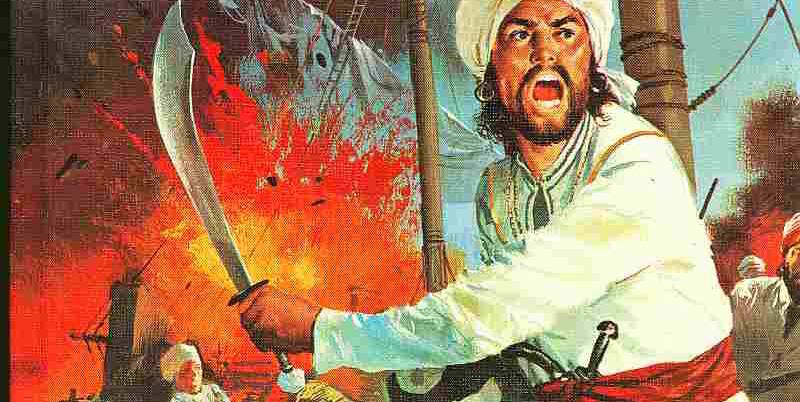
Emilio Salgari (Verona, 21 August 1862 – Turin, 25 April 1911) was the most widely read adventure writer of Italy's Umbertine era, the creator of Sandokan and the Black Corsair. Born in Verona, he spent almost his entire adult life in Turin: here he wrote most of his novels, and here, on the hill beyond the Po, he took his own life.[1] He published over eighty novels, the fruit of a fervid imagination rather than of adventures actually lived.[2]
From Verona to journalism
The second son of a landowner and cloth merchant, he attended the technical institute in Verona and in 1878 enrolled as an auditing student at the Paolo Sarpi Nautical Institute in Venice, staying with an aunt; he never earned the certificate of long-haul sea captain.[1] His only sea voyage was confined to the Adriatic.[3]
From the summer of 1883 he worked at Verona's Nuova Arena as a reporter, editor and writer of serialized novels;[1] it was in that newspaper that La Tigre della Malesia appeared in installments, the first core of the Sandokan saga, and in 1884 came his first book, La favorita del Mahdi.[3] Moving to the Arena, he signed his foreign-policy commentaries with the pen name "Ammiragliador" and was founding president of the Verona Cycling Club. In 1889 his father took his own life by jumping from a window; in 1892 Salgari married Ida Peruzzi, an amateur actress known by the stage name Aida.[1]
In Turin, a writer paid by the piece
At the end of 1893 he left journalism and settled in Piedmont to write for the Turin publishers Speirani and Paravia.[1] The stages of the move are recounted differently: the Treccani encyclopedia points to an initial stay in Cuorgnè, in Canavese,[2] while Antonio Dini, writing in Il Post, mentions a stop in Ivrea in 1894.[4] In Turin, on 18 January 1894, his second child, Nadir, was born; Romero and Omar followed, after his firstborn, Fathima.[1]
Under a fixed contract with Speirani he published some thirty titles between 1892 and 1898,[3] and in the meantime began writing for Bemporad, Cogliati, Treves and Voghera.[1] In 1897 King Umberto I made him a Knight of the Crown of Italy.[3] In the second half of 1898 he moved to Sampierdarena to work with the Genoese publisher Antonio Donath, for whom, among others, Il Corsaro Nero (1899) and I figli dell'aria were published; a little over two years later, in 1900, he was back in Turin.[1]
The Sandokan and Black Corsair cycles
Sandokan, "Tiger of Malaysia" and king of Mompracem, a wild island near Borneo, fights the British, the Dutch and the Portuguese across six novels published between 1895 (I misteri della jungla nera) and 1910; the cycle of the Caribbean corsairs begins with Il Corsaro Nero and continues with Jolanda, la figlia del Corsaro Nero (1905) and Il figlio del corsaro rosso (1908).[5] The exotic settings sprang from imagination, not from real travels;[2] according to Dini, who counts roughly two hundred works, eighty of them novels, Salgari was an "extraordinary chronicler of the imaginary, a talented and unstoppable traveler of the mind".[4]
Critics were hostile to him for a long time. Guido Mazzoni, in the 1936 Enciclopedia Italiana, rejected the title of "Italian Verne" and dismissed him thus:
"S. was little more than a lively depicter of scenes almost devoid of structure, where curiosity is superficial and stylistic merit is lacking"
The same entry noted, however, that those books had been translated into German, English, French, Spanish and Czech.[6] Eighty years later the writer Michele Mari reversed that judgment, arguing that one need only open a Salgari novel at random to find a style that "could only be described as hyper-literary".[7]
The final years and death
Back in Turin, Salgari edited the Genoese periodical Per terra e per mare between 1904 and 1906. In 1906 the Florentine publisher Enrico Bemporad lured him away from Donath by paying the contract penalty and guaranteed him ten thousand lire a year for no more than four novels.[1] In his lifetime he was the country's most popular author, and better paid than many colleagues, but his standard of living, his wife's medical care and poor financial management kept him in constant difficulty.[8] With four children and his wife's illness, while publishers were slow to pay him royalties, his debts grew serious,[5] and in 1910 Salgari made a first suicide attempt, but was saved.[3]
On 25 April 1911 he killed himself in the woods of the Rei estate, in Val San Martino, on the hill overlooking Turin.[1] He left a letter to his children and a scornful one to his publishers, in which he asked them at least to pay for his funeral;[3] the closing line of the latter, published by La Stampa on 27 April 1911, has remained famous: "I salute you by breaking my pen".[1] His family continued to be marked by tragedy: his wife died in an asylum, and two of his sons, Romero and Omar, also took their own lives.[4]
Salgari and Turin today
The site of his death is Villa Rey (then the Rey estate), now city-owned, on the hill overlooking the northern part of the city: a metal plaque in front of the villa commemorates the event, and the City Council newsletter has described the estate as a "green balcony" over the city still awaiting restoration.[9] Along the streams and the "Salgari trails" of the hill, along the Reaglie stream, the Salgari Wild Trail is run, an eco-sports race sponsored by the City (its second edition held in 2019) that starts from the banks of the Po and climbs to Colle della Maddalena, with a stop at the Salgari Campus on Via Chieri.[10]
MUFANT, the Museum of the Fantastic and Science Fiction on Piazza Riccardo Valla, dedicated to the Indo-Malay cycle the exhibition Sandokan. Il ritorno della tigre, opened in September 2025 together with a new terrace overlooking the Basilica di Superga, timed to coincide with Rai 1's new television series about the pirate of Mompracem.[11] Rosalba Graglia's Guida letteraria a Torino, presented at the Turin International Book Fair in 2026, lists him among the writers who lived in the city and invented their characters there.[12]
Pages linking here
Sources
- Treccani – Dizionario Biografico degli Italiani, vol. 89 —
- Treccani
- Liber Liber
- Il Post — 21 August 2012
- Treccani – Enciclopedia dei ragazzi
- Treccani – Enciclopedia Italiana —
- Il Post — 13 June 2016
- Il Post — 28 July 2017
- Cittagorà – Città di Torino — 11 October 2017
- Torinoclick — 12 June 2019
- Torinoclick — 21 September 2025
- Torinoclick — 18 May 2026