Borromean Islands
Archipelago on Lake Maggiore between Stresa and Pallanza, transformed since the seventeenth century by the Borromeo family with the palaces and gardens of Isola Bella and Isola Madre.
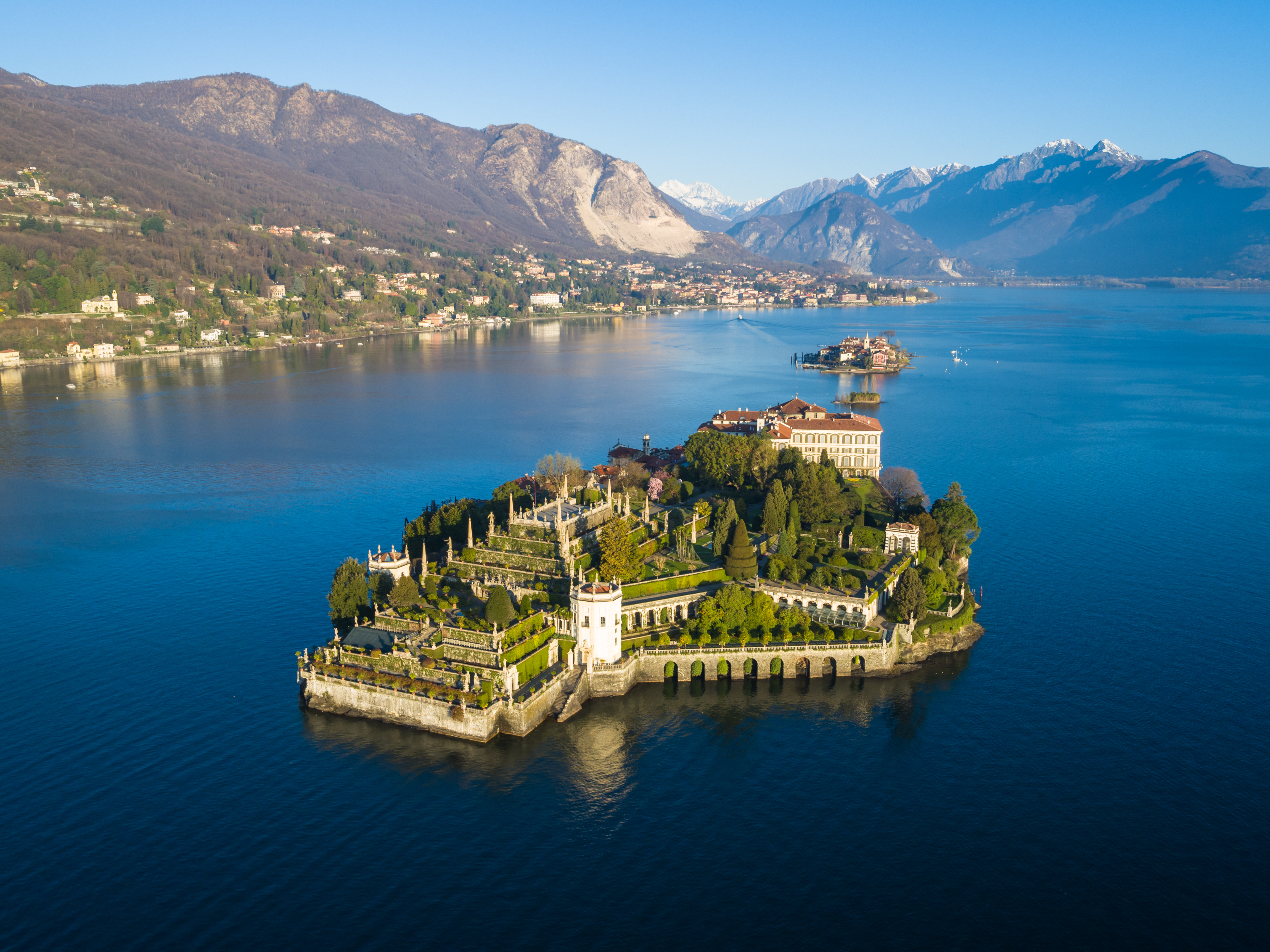
The Borromean Islands are the archipelago of Lake Maggiore that occupies the gulf between Stresa and Pallanza, where the Toce river flows in[1]. The main islands are four — Isola Bella, Isola dei Pescatori, Isola Madre and Isola di San Giovanni — and take their name from the Borromeo counts, who still own them[1]; some accounts add the Scoglio della Malghera, bringing the count to five[2]. They belong to the Piedmontese shore of the lake, and the palaces and gardens built by the Borromeo family over four centuries have made them one of Piedmont's historic destinations.
A glacial rock archipelago
According to the entry in the 1930 Enciclopedia Italiana, written by the geographer Manfredo Vanni, the islands are what remains of a rocky threshold emerging from the bottom of the submerged valley, at the point where the glacial valleys of the Toce and the Ticino converged, both occupied by large glaciers during the ice ages[3]. The same entry described Isola Madre as the largest, anciently called Isola di San Vittore; the Isola Superiore, that is, dei Pescatori, as a strip of land with a village of about three hundred fishermen and a modest church with a bell tower; and the Isolino di San Giovanni, the smallest, as a rocky ridge covered in vegetation facing Pallanza[3].
The Borromeo family
The family descends from Vitaliano, from a Paduan family, who took his mother's surname Borromeo and died in 1449 holding the title of Count of Arona[4][5]. Through military campaigns, political offices and marriages — including with the Visconti and with the House of Savoy — the family rose to princely rank within the Milanese patriciate[4]. The main line died out with Saint Charles Borromeo and with Federico, Prince of Oria; the cadet branch, enriched by the marriage of Renato (1613-1685) to Giulia Arese, whose property and surname he acquired, is the one that survives to this day[4]. The remains of the founder Vitaliano, buried in Milan at San Francesco Grande, were transferred to Isola Bella at the end of the eighteenth century[5].
Isola Bella: from rock to ship
Isola Bella, about 400 metres long and 180 wide, is the most famous of the Borromean Islands and until the mid-seventeenth century was a "bare rock"[6]. The Enciclopedia Italiana set out its origin as follows:
"In 1632 Count Carlo Borromeo had a small town built on this island, naming it after his wife Isabella."
The project was begun by Carlo III and Giulio Cesare III, but the family regards Vitaliano VI as its true founder; the design of the baroque garden dates to 1630[7]. According to the Enciclopedia Italiana the palace was completed in 1670[3], the year in which Stresa's tourist office places the start of the transformation commissioned by Vitaliano[8]. The building work did not end there: the island took its present form only in 1948, with the completion of the palace's Salone Nuovo[7].
Seen from the lake, the island has the shape of a ship: to the north the palace and the landing stage, to the south the Italian garden with its ten descending terraces, closed off by the Teatro Massimo[7]. Its summit reaches 28 metres above the level of the lake, and as early as the 1930s orange, citron and magnolia trees were recorded there[3]. Inside the palace visitors can see the Throne Room, the Hall of the Queens, the room dedicated to Napoleon, General Berthier's gallery with about 130 paintings, and six grottoes lined with pebbles, tufa, stucco and marble[8]. Napoleon stayed there in 1797[2].
The Stresa Conference
From 11 to 14 April 1935 the Borromeo palace on Isola Bella hosted the conference between Italy, France and Great Britain, with Mussolini as host[9][2]. The meeting, as the Treccani encyclopedia writes, "represented the last attempt to create solidarity among the three Western powers to guarantee European peace"; the war in Ethiopia marked its failure a few months later[9].
Isola Madre, the botanical garden
Isola Madre, the largest of the islands[3], has had several names: San Vittore, Isola Maggiore, Isola Renata[10]. The palace, built in the sixteenth century on its highest point, looks out over the lake; when Isabella Borromeo married Renato Trivulzio the island passed to the Trivulzio family, returning to the Borromeo in 1563[10]. It was Count Lancillotto Borromeo who transformed a smallholding of vines, figs, olives, chestnuts and cherries into a large garden[10]. In the nineteenth century camellias, azaleas, rhododendrons and magnolias arrived; the first greenhouses date from 1826, the family's private chapel from 1858, and the orchids from the end of the century[10]. Gustave Flaubert called it the most voluptuous place he had ever seen[8]. Today the park holds more than two thousand species[2]; the Kashmir cypress, felled by a whirlwind, has been brought back to life, and the palace houses a collection of marionettes and period toy theatres[8].
Isola dei Pescatori and Isolino di San Giovanni
Isola Superiore, or dei Pescatori, measuring about 100 by 350 metres, has been inhabited for at least seven centuries and today has around thirty residents who live from fishing and tourism[8]. Records from the local ecomuseum trace its history: "In the early medieval period there was a fishing village gathered around a chapel and a small cemetery"[11]. In 1069 the first holdings of the monastery of Santi Felino e Gratiniano of Arona appear; the church of San Vittore, originally dedicated to Saint Gangolf, became an independent parish in 1627[11]. In 1722 the island was attached to the municipality of Chignolo Verbano, passing to that of Stresa in 1927[11]. Every year, for the feast of the Assumption, the statue of the Virgin leaves the side altar of the parish church and crosses the lake in an evening procession[12].
The Isolino di San Giovanni, facing Pallanza, in the municipality of Verbania, is linked to the name of Arturo Toscanini, who lived in its villa[2].
Today
Isola Bella and Isola Madre reopen to visitors every year at the start of spring: for the 2026 season they reopened on 12 March[13]. They are part of the Terre Borromeo, together with the Rocca di Angera, the Castelli di Cannero, the Parco Pallavicino and the Parco Mottarone[13]. Since 1943, when the bombing of Milan led the family to move it, the Borromeo Archive, with documents from the twelfth to the twentieth century, has been kept in the rooms known as the "Cappuccine" in the palace on Isola Bella; since 2017 the cataloguing of paintings, furnishings and more than fifty thousand archive images has been under way[14].
Related articles: Lake Maggiore
Pages linking here
Sources
- Treccani
- Italia.it (ENIT - Ministero del Turismo)
- Treccani - Enciclopedia Italiana — 1 January 1930
- Treccani
- Treccani - Dizionario Biografico degli Italiani
- Treccani
- Terre Borromeo
- Stresa Turismo (Comune di Stresa)
- Treccani
- Terre Borromeo
- Ecomuseo Isola Pescatori
- Ecomuseo Isola Pescatori
- Il Lago Maggiore (Distretto Turistico dei Laghi) — 20 February 2026
- Terre Borromeo