Piero Angela
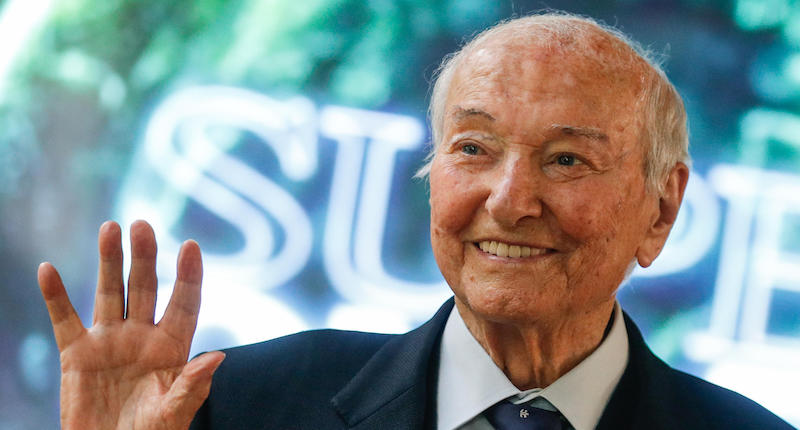
Piero Angela (Turin, 22 December 1928 – Rome, 13 August 2022) was a journalist, television host and science communicator, for seventy years one of the most recognizable voices of Rai. Creator of Quark and Superquark, author of almost forty books and one of the founders of CICAP, he brought science into Italian prime-time television[1][2]. Born and raised in Turin, he spent his youth there among the city's lyceums, the Politecnico and the postwar jazz clubs.
A Turin childhood and his father's clinic
He was the son of Carlo Angela, a psychiatrist with antifascist leanings, who passed on to him a passion for science[2][3]. During the Second World War his father ran a psychiatric clinic in San Maurizio Canavese, in the Canavese, where he hid numerous persecuted Jews, registering them under false names and false diagnoses and teaching them to pass as mentally ill[4]. In February 1944 Carlo Angela came under suspicion and was interrogated, risking execution by firing squad; he was saved by the intervention of a Piedmontese nobleman staying at the clinic, who spoke to the fascist commander. In 2001 Yad Vashem in Jerusalem recognized him as "Righteous Among the Nations"[4]. To escape the bombings, during the war years the family lived in that same clinic outside the city[3].
His son spoke of this story late in life and only rarely. After his death, the chief rabbi of Rome, Riccardo Di Segni, recalled that "Piero Angela told this story late and with great restraint, without ever boasting about it"[4].
School, the Politecnico and jazz
In Turin he attended the Vittorio Alfieri classical lyceum and then enrolled at the Politecnico, which he left when he was hired by Rai[5]. By his own admission he was bored at school and studied the bare minimum; his true passion was the piano, which he also studied at the conservatory[2][3]. In his twenties he performed in jam sessions at Turin clubs under an Americanized stage name, "Peter Angel" according to Il Post, "Peter Angela" according to Sapere.it[3][5]. Toni Lama, a leading figure of the Turin Swing Club scene, also remembered him by this latter name, recalling him coming to play the vibraphone there[6]. In 1948 Sergio Bernardini booked him for the opening night of the Capannina in Viareggio[5]. Jazz never left him: among the last projects he completed, in 2022, was a jazz piano record[2].
From radio to the evening news
He joined Rai in 1952 as a contributor to the Giornale Radio, initially working on programs about the history of jazz[5][2]. He then moved to the Telegiornale as a correspondent in Paris and Brussels and worked as a special correspondent in Yemen, Israel, Iraq and Vietnam[5][2]. In 1968 he took over as anchor of the national 1:30pm Telegiornale, and in 1976 he was the first anchor of the newly created TG2[5][2].
But the turning point had already come. His debut as a science communicator arrived in 1969 with Il futuro nello spazio; in 1971 he hosted Destinazione uomo, one of the first Italian science programs designed for a general audience[5][7]. He explained the choice this way:
"I had realized that what I really wanted to do wasn't to cover ten news stories a day, but one story for a whole year"
The quote appears in the profile Il Post published for his ninetieth birthday[3].
Quark, Superquark and popular science
Quark aired for the first time in 1981, and its first episode was watched by nine million viewers[2]. The name was chosen from about fifty proposals, meant to convey "getting inside things"[3]. The series ran until 1989, and in 1995 gave way to Superquark, which he hosted until 2022; alongside it came numerous spin-off programs, from La macchina meravigliosa, dedicated to the human body and the one he considered his favorite, to Superquark+ on RaiPlay[1][2][5]. In all, he hosted more than thirty programs and wrote almost forty books, many with his son Alberto, also a science communicator[2]. His titles include Nel cosmo alla ricerca della vita (1980), La macchina per pensare (1983), Dietro le quinte della Storia with Alessandro Barbero (2012), and the autobiographical Il mio lungo viaggio (2017)[1].
He summed up his method in a few words: "Popularizing simply means translating," he used to say, insisting that "seriousness should lie in the content, not in the form"[8][3]. As a musician, he wanted his writing to have rhythm too[3].
CICAP and critical thinking
In 1989 he was among the founders and the originator of CICAP, the Italian Committee for Investigating Claims on the Paranormal, a non-profit association based in Padua[5][9]. For decades he declined any formal role, describing himself simply as "someone from CICAP"; on 16 May 2016 the board and the members' assembly unanimously named him honorary president, shortly after Padua had granted him honorary citizenship[9].
Honors and death
He received eight honorary degrees[5][8]. In 2001 he was named Commendatore of the Order of Merit of the Italian Republic at the initiative of the President of the Republic[10]; in 2004 he became Grand Officer and in 2021 Knight Grand Cross[1]. Away from the studio he was fond of chess and a supporter of Juventus[7].
He died in Rome on 13 August 2022, at the age of 93; the news was announced by his son Alberto with the words "Safe travels, Dad"[8][1]. President Sergio Mattarella remembered him as a refined intellectual who had made culture and science accessible to an ever-wider audience[2]. He left a farewell message for the public, which closes with these words:
"Dearest all, I think I have done my part. Try to do yours too, for this difficult country of ours. A big hug"
The text, written in the preceding days, was made public on the day of his death[2]. Even during the Roman years of his career, Angela remained tied to his home region: the province of Turin was the place of his childhood, of the war years spent in his father's clinic, and of his first concerts.
Pages linking here
Sources
- Treccani
- Il Post — 13 August 2022
- Il Post — 22 December 2018
- AGI — 16 August 2022
- Sapere.it (De Agostini)
- Online-Jazz.net — 18 December 2015
- Quotidiano.net
- Il Fatto Quotidiano — 13 August 2022
- CICAP — 16 May 2016
- Presidenza della Repubblica — 30 May 2001